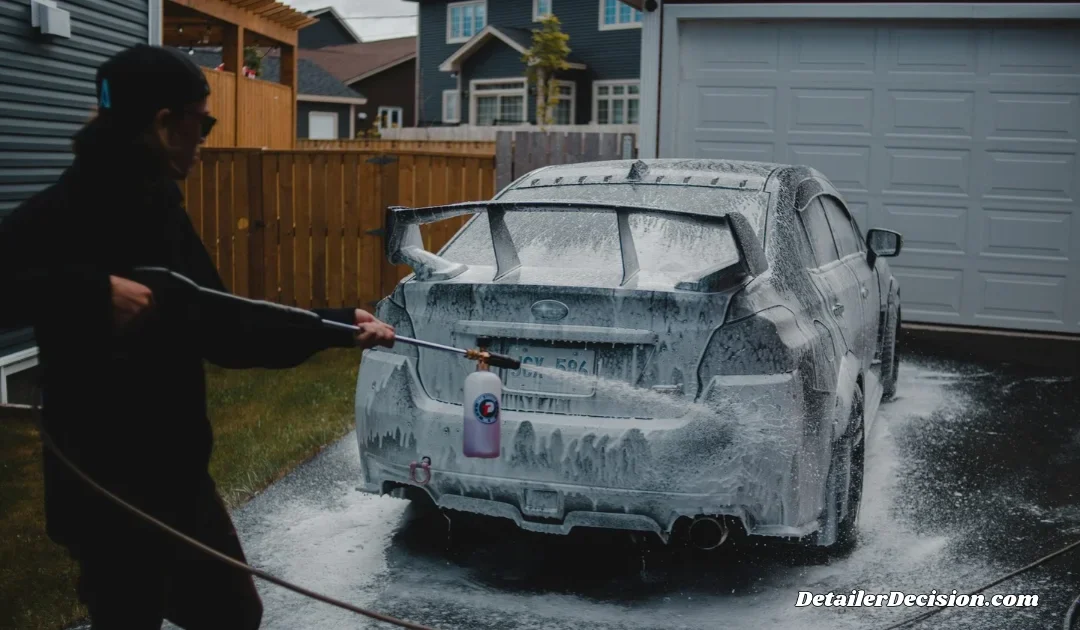
Choosing the best pressure washer for mobile detailing isn't about finding the highest-pressure machine.
A powerful machine might look impressive on paper, but that doesn't mean it belongs in your mobile detailing setup. If it requires more water than your tank can supply, draws more electricity than your power source can handle, or takes up too much space in your vehicle, it can create more problems than it solves.
For beginners, a compact electric pressure washer can be a sensible starting point. The key is balancing cleaning performance, portability, water consumption, and total setup cost.
This guide explains what matters, compares several pressure washers worth considering, and helps you decide when to buy, upgrade, or skip one entirely.
Quick Answer: What Is the Best Pressure Washer for Mobile Detailing?
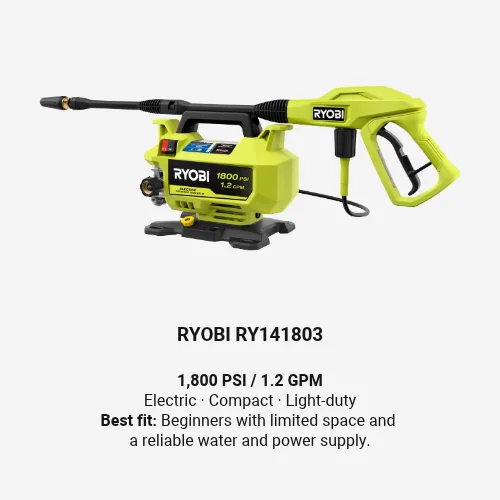
For beginners with a suitable electrical outlet and pressurized water supply, the RYOBI RY141803 1,800 PSI, 1.2 GPM Electric Pressure Washer is a practical budget starting point.
Its compact design and light-duty specifications make it worth considering for routine exterior washing. However, check its suitability for frequent commercial use, foam cannon compatibility, and tank-fed operation before purchase.
If you plan to wash several vehicles each day, you may eventually benefit from a machine with greater usable flow, better hose management, and a duty cycle suited to your workload.
The most important question isn't simply which pressure washer is best.
It's which pressure washer will actually work with your mobile detailing setup.
How Much PSI and GPM Do You Need for Mobile Detailing?
Nearly every pressure washer lists two specifications: PSI and GPM.
They measure different things, and both matter.
PSI: Cleaning Pressure
PSI stands for pounds per square inch. It describes water pressure.
Higher pressure can help remove stubborn contamination, but excessive pressure or an unsuitable spray pattern can damage paint, seals, trim, and other vehicle components.
For routine vehicle washing, a moderate-pressure electric machine is often a more practical starting point than an aggressive high-pressure model.
A machine's maximum advertised PSI is not necessarily the pressure delivered through every nozzle.
Actual pressure depends on the machine, nozzle, flow, and operating conditions.
GPM: Water Flow
GPM stands for gallons per minute.
It describes the volume of water delivered while the trigger is operating.
Flow matters because rinsing a vehicle requires enough water to carry away loosened dirt, soap, and other contaminants.
A machine with impressive PSI but limited water flow may not rinse as efficiently as expected.
For mobile detailing, GPM also affects how quickly a water tank depletes.
PSI vs. GPM: Which Matters More?
| Specification | What it affects | Buying consideration |
|---|---|---|
| PSI | Pressure at the spray | Avoid unnecessarily aggressive pressure |
| GPM | Water volume | Balance rinsing performance with supply |
| Nozzle | Spray concentration | Use vehicle-appropriate spray patterns |
| Duty cycle | Operating duration | Check suitability for repeated work |
| Power draw | Electrical demand | Confirm outlet or generator compatibility |
Practical takeaway: Don't compare pressure washers using maximum PSI alone. Look at usable flow, operating pressure, power requirements, and the type of work you actually perform.
Best Pressure Washers for Mobile Detailing: Models Worth Comparing
Several machines are worth considering, but they suit different users.
The following comparison uses manufacturer information and published independent testing. It is not a ranking based on DetailerDecision.com's own hands-on testing.
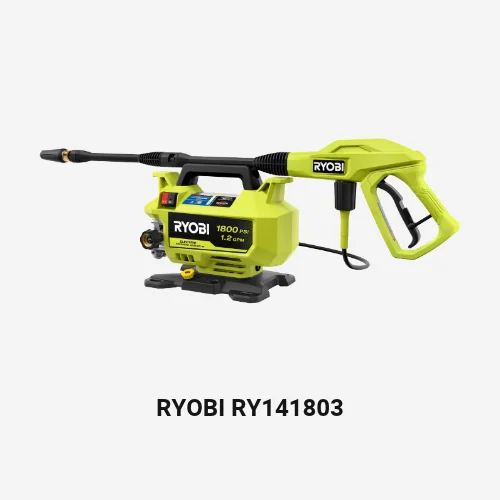
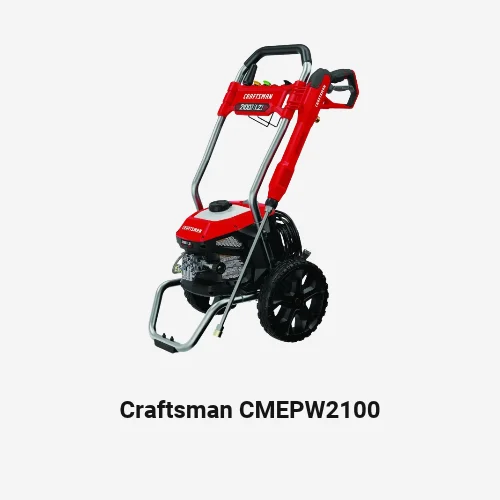
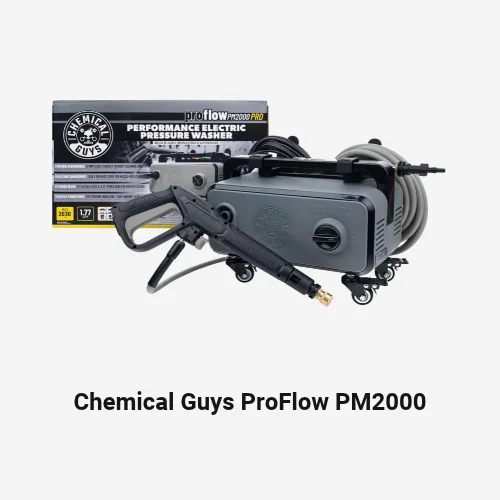
1. RYOBI RY141803 — Budget Starting Point
1,800 PSI / 1.2 GPM (manufacturer-rated)
A compact, light-duty option for beginners with limited storage space.
Skip it if: Your business requires extended, continuous operation or a water-feed arrangement the manufacturer does not support.
2. Craftsman CMEPW2100 — Tested Car-Washing Alternative
Advertised 2,100 PSI / 1.2 GPM
Car and Driver selected this machine as its overall car-washing pick in its 2026 comparison.
Skip it if its size, price, or electrical requirements don't suit your rig.
3. Chemical Guys ProFlow PM2000 — Automotive-Oriented Option
Advertised 2,030 PSI / 1.77 GPM
In-car and driver testing showed flow and pressure varied by nozzle. Its compact design and accessory organization may appeal to car-care enthusiasts.
Skip it if: You need a verified commercial-duty machine or a confirmed self-contained tank-feed solution.
The Craftsman and Chemical Guys specifications and testing observations come from the supplied March 2026 Car and Driver comparison. They should not be interpreted as independently verified 2027 product availability.
Comparison at a Glance
| Model | PSI | GPM | Best fit |
|---|---|---|---|
| RYOBI RY141803 | 1,800 | 1.2 | Budget starter |
| Craftsman CMEPW2100 | 2,100 | 1.2 | General vehicle washing |
| Chemical Guys PM2000 | 2,030 | 1.77 | Automotive-focused setup |
Figures are advertised ratings, not standardized measurements of operating performance. Actual results depend on the setup and nozzle used. Verify current prices, stock, warranties, and commercial-use eligibility.
Electric vs. Gas Pressure Washers for Mobile Detailing
Electric pressure washers are usually easier to incorporate into a small beginner setup, as long as reliable electricity is available.
Gas-powered machines can work well for certain high-volume or independent operations, but they add weight, noise, fuel handling, exhaust, and maintenance needs.
| Factor | Electric | Gas |
|---|---|---|
| Portability | Often compact | Frequently heavier |
| Noise | Generally lower | Generally higher |
| Power source | Outlet or compatible generator | Gasoline |
| Maintenance | Usually simpler | Engine and pump maintenance |
| Indoor operation | Depends on electrical safety and ventilation conditions | Never run combustion engines in enclosed spaces |
| Beginner suitability | Often a practical choice | Depends on workload and setup |
When Electric Makes Sense
Consider an electric pressure washer if you mainly do routine vehicle washes, have access to suitable electricity, and want to minimize equipment weight and complexity.
When Gas May Make Sense
A gas-powered machine may be appropriate if you need higher sustained workload capability and have suitable outdoor operating space.
But don't assume gas is automatically better for professional detailing. Many beginners won't benefit from its additional complexity.
Plan Your Equipment Budget
Once you've confirmed your licensing requirements, use our free Starter Rig Builder to explore equipment recommendations for different startup budgets.
Build My Starter RigCan You Run a Pressure Washer From a Mobile Detailing Water Tank?
This is one of the most important questions for anyone building a self-contained rig.
Not every pressure washer can draw water directly from an unpressurized tank.
Some machines require a pressurized inlet supply. Others may support specific tank-fed arrangements, sometimes with a separate transfer or booster pump.
Before purchasing, verify the manufacturer's requirements for minimum inlet pressure, flow rate, hose configuration, and approved water sources.
A machine that works perfectly with a household faucet may not operate correctly when connected directly to a water tank.
How Much Water Will Your Pressure Washer Use?
You can estimate theoretical trigger-on water consumption using a simple formula:
Water used (gal) = GPM x Trigger-on minutes
For example, using a 1.2 GPM rating:
| Trigger-on time | Calculated water use |
|---|---|
| 5 minutes | 6 gallons |
| 10 minutes | 12 gallons |
| 15 minutes | 18 gallons |
| 20 minutes | 24 gallons |
These are illustrative calculations assuming the rated flow is sustained while spraying. They don't measure actual water consumption per vehicle.
Real consumption depends on the wash process, nozzle, operating flow, vehicle size, and how long you hold the trigger.
This matters because a 50-gallon tank doesn't necessarily provide enough usable water for a predictable number of customers.
Consider tank capacity, reserve water, priming requirements, and other water-consuming tasks.
The Hidden Costs of a Mobile Detailing Pressure Washer
The pressure washer itself is only one part of the system.
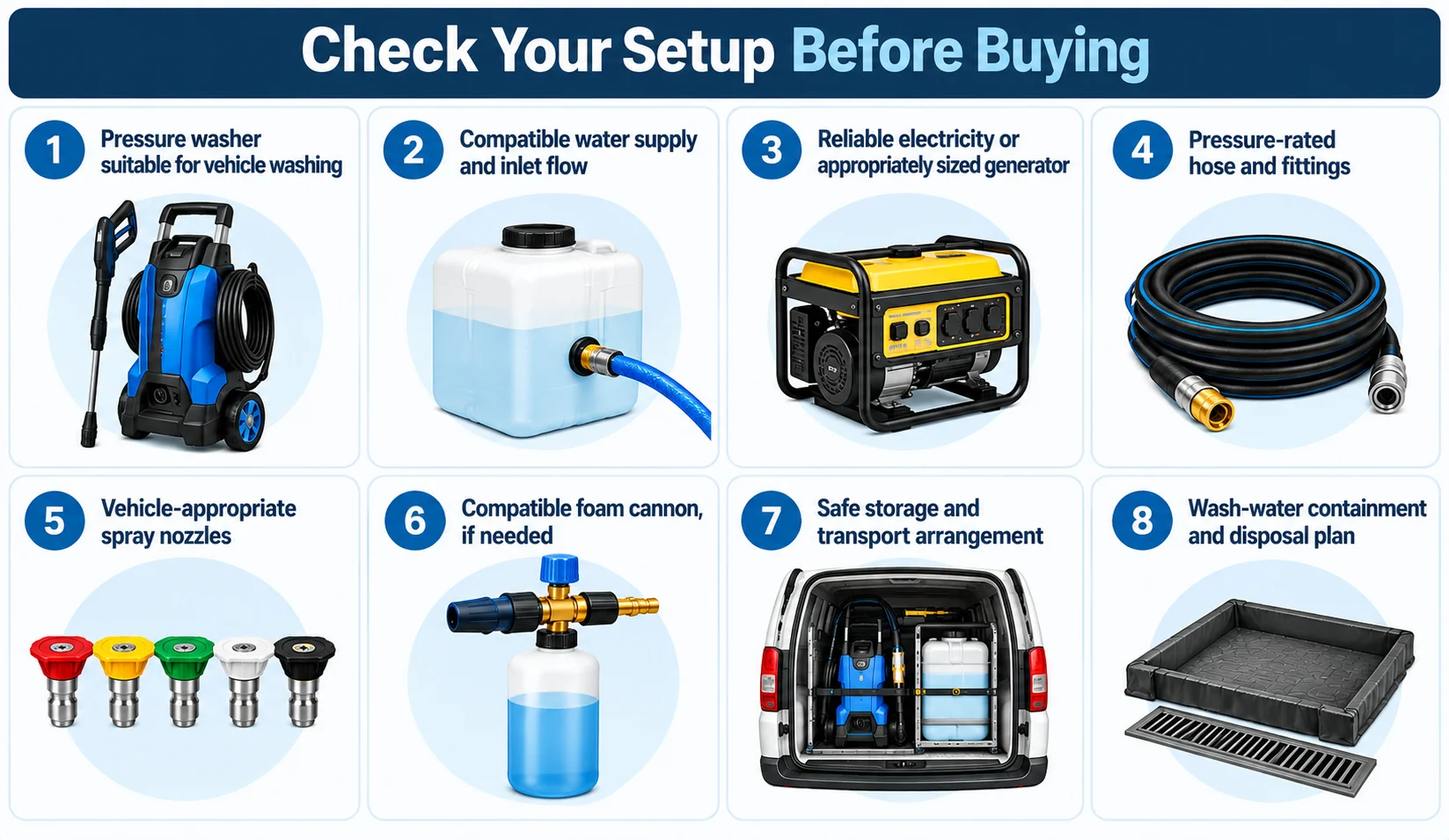
You may also need a suitable water hose, pressure hose, fittings, spray gun, foam cannon, water filtration, an extension cord, a generator, or a water transfer pump.
Not every setup needs every accessory, so check compatibility before purchasing.
The Pressure Washer System Checklist
One frequently overlooked issue is wastewater.
The U.S. Environmental Protection Agency explains that vehicle-washing runoff can contain detergents and pollutants. Its guidance emphasizes preventing contaminated wash water from entering storm drains. Local rules and permit requirements vary.
A mobile detailer should investigate local wastewater requirements before accepting exterior washing jobs.
Which Pressure Washer Fits a $750, $1,000, or $1,500 Startup Budget?
Evaluate a pressure washer purchase against the full startup budget, not as an isolated expense.
These scenarios describe purchasing priorities, not verified equipment package prices.
| Equipment budget | Suggested approach |
|---|---|
| $750 | Prioritize essential cleaning tools; consider a compact electric unit only if water and power are already available |
| $1,000 | Evaluate a compact pressure washer while preserving funds for hoses, chemicals, and compatible accessories |
| $1,500 | Consider better hose management, a suitable power solution, and upgrades justified by workload |
$750: Avoid Overbuilding
At this budget, buying a pressure washer and then discovering that you need a generator, tank pump, or additional fittings can create an expensive problem.
If your services are primarily interior-focused, a pressure washer may not be your first essential purchase.
$1,000: Build a Functional System
You may have more room for a compact electric pressure washer, but the entire setup must work together.
A lower-cost machine with the right water and electrical connections can be more useful than an expensive machine you cannot operate reliably.
$1,500: Upgrade for a Reason
A larger budget gives you more flexibility, but it doesn't automatically justify a commercial-grade pressure washer.
Spend more when you can identify a genuine operating need, such as increased workload, improved rinsing performance, better durability, or reduced setup time.
For a complete purchasing framework, see our Mobile Detailing Equipment List and Mobile Detailing Startup Kit.
Five Common Pressure Washer Buying Mistakes
1. Choosing the Highest PSI
More pressure doesn't automatically produce better vehicle-washing results. Excessive pressure can increase the risk of damage.
2. Ignoring GPM
Low water flow slows rinsing, while high flow can quickly deplete a mobile water supply.
3. Assuming Any Machine Works With a Water Tank
Check inlet requirements and manufacturer-approved feeding methods before purchasing.
4. Forgetting Power Requirements
An electric pressure washer must match the available electrical circuit or generator. Check running demand, startup behavior, and manufacturer guidance.
5. Buying Accessories Before Checking Compatibility
Hoses, foam cannons, quick-connect fittings, and spray guns aren't universally interchangeable.
Check pressure ratings, connection sizes, and compatibility before ordering.
When Should You Upgrade Your Pressure Washer?
An upgrade makes sense when your current equipment creates a measurable limitation.
For example, you may find rinsing takes longer than necessary, your hose setup slows each job, or your machine's operating limits aren't suitable for repeated daily use.
Those are better reasons to upgrade than simply wanting a higher PSI number.
Before spending more, identify the specific problem an upgrade would solve.
If the real issue is inadequate water supply, poor hose management, or limited electrical capacity, replacing the pressure washer alone may not fix it.
Build a Pressure Washer Setup That Fits Your Budget
A pressure washer should work as part of a complete mobile detailing system.
That includes your cleaning tools, water access, power supply, vehicle storage, and startup budget.
If you're planning your first equipment purchase, the DetailerDecision Starter Rig Builder can help you evaluate a starter equipment setup against your selected budget.
Stop Guessing. Start Building.
Review the recommended equipment, check any reference-price warnings, and confirm compatibility and current merchant information before buying.
Frequently Asked Questions
What PSI is best for mobile car detailing?
No universal PSI setting works for every vehicle and surface. Many compact electric machines provide enough pressure for routine washing, but safe operating pressure depends on the nozzle, distance, surface condition, and the manufacturer's instructions.
Is 1.2 GPM enough for mobile detailing?
A 1.2 GPM machine can work for basic vehicle washing, especially for beginners. Higher usable flow may improve rinsing efficiency, but it also increases water demand.
Can I use a pressure washer without a generator?
Yes, if a suitable electrical outlet is available and you're allowed to use it. Otherwise, you need a compatible power source or a different cleaning method.
Is a gas pressure washer better than an electric one?
Not necessarily. Gas machines may suit certain independent or higher-workload operations, while electric machines are often simpler and more compact. The better choice depends on your actual operating conditions.
Do I need a pressure washer to start a mobile detailing business?
Not always. Your equipment needs depend on your service menu. An interior-focused business may begin without one, while conventional exterior washing typically requires an appropriate water-delivery and cleaning method.
Final Verdict: Buy for Your Setup, Not the Highest PSI
For a beginner with access to suitable electricity and pressurized water, a compact electric pressure washer like the RYOBI RY141803 is a reasonable place to start.
The Craftsman CMEPW2100 and Chemical Guys ProFlow PM2000 offer alternative configurations worth comparing.
None should be considered a guaranteed commercial-duty or tank-compatible solution without checking the relevant manufacturer documentation.
The best pressure washer for mobile detailing is the one that performs the work you need, fits your available resources, and leaves enough budget to make the rest of your setup functional.
Disclosure: This page may contain affiliate links. If you purchase through them, we may earn a small commission at no extra cost to you.