You can spend $3,000 on mobile detailing equipment and still show up to your first job missing something important.
Maybe you bought a pressure washer but forgot the right hose connections. Maybe you invested in a generator without checking your vacuum's electrical requirements. Or maybe you bought an extractor before any customers asked for deep upholstery cleaning.
The problem isn't necessarily your budget. It's the order in which you buy equipment.
For beginners, choosing the right mobile detailing equipment starts with understanding the services you want to offer and the conditions you'll work in.
You don't need every machine on a professional detailer's shopping list. You need a complete setup that allows you to deliver your first services safely and consistently.
This guide explains what to buy first, what you can postpone, and how to avoid spending money on equipment that doesn't fit your business.
Quick Answer: What Mobile Detailing Business Equipment Should You Buy First?
For most beginners offering basic interior and exterior detailing, start with a suitable wet/dry vacuum, microfiber towels, detailing brushes, cleaning chemicals, and equipment for your chosen exterior washing method.
A pressure washer can help, but it isn't required for every washing process. Buy a generator, water tank, carpet extractor, or polisher when your services and working conditions justify them.
Here's a practical buying order.
| Priority | Equipment | Buying recommendation |
|---|---|---|
| 1 | Microfiber towels, brushes, chemicals, wash supplies | Buy for your initial services |
| 2 | Wet/dry vacuum | Buy if offering interior cleaning |
| 3 | Pressure washer and accessories | Buy if required by your wash method |
| 4 | Hoses, fittings, storage, safety supplies | Complete your working setup |
| 5 | Water tank and generator | Buy when independent utilities are necessary |
| 6 | Extractor, steam cleaner, polisher | Add when services and skills justify them |
The exact order depends on your service menu. An interior-only detailer will have different priorities from someone offering exterior maintenance washes.
The goal isn't to own the most equipment. It's to have everything required to complete the work you've promised.
Choose Your Services Before Choosing Your Equipment
One of the easiest ways to overspend is to shop for equipment before deciding what services you'll sell.
Imagine two beginners.
The first plans to offer interior vacuuming, dashboard cleaning, windows, and basic exterior maintenance washing.
The second wants to offer carpet extraction, paint correction, and preparation for ceramic coating.
Both are starting mobile detailing businesses, but their equipment needs differ significantly.
The first can use basic cleaning tools, a vacuum, and a suitable washing system. The second needs specialized machines, additional products, and the training to use them correctly.
Match equipment to your starting service menu
| Service | Essential equipment categories | Specialized equipment |
|---|---|---|
| Basic interior cleaning | Vacuum, brushes, towels, interior and glass cleaners | Extractor only for services requiring it |
| Exterior maintenance wash | Appropriate wash media, chemicals, drying towels, water or rinseless system | Pressure washer if the process requires one |
| Interior and exterior package | Combination of both basic setups | Depends on service scope |
| Deep fabric extraction | Vacuum, suitable extractor, textile products | Moisture management and drying equipment as needed |
| Paint enhancement or correction | Paint-safe washing supplies, inspection tools | Polisher, pads, abrasives, training |
This is also why a long mobile auto detailing equipment checklist can be misleading.
An item might belong in a professional toolkit without belonging in your first shopping cart.
What to do first: Write down the exact services you intend to offer during your first month. Build your shopping list around those services and remove anything that doesn't support them.
Build Your Mobile Detailing Setup With Confidence
Find the right pressure washer, vacuum, chemicals, and tools for your budget—without buying what you don't need.
Build My Starter RigThe First Equipment Purchases That Make Sense for Beginners
Your first purchases should be tools you'll use repeatedly across your intended services.
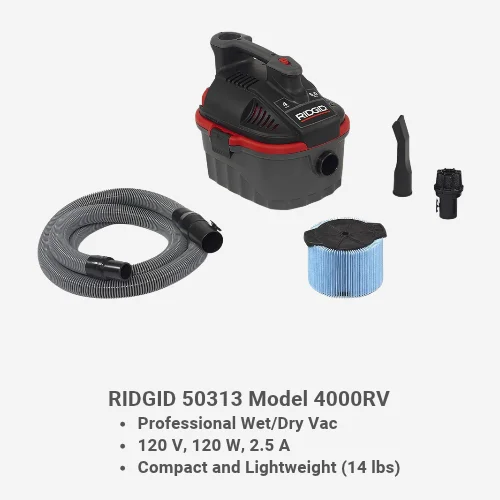
Wet/Dry Vacuum: Start Here for Interior Detailing
A wet/dry vacuum is one of the most practical early investments if your business includes interior cleaning.
It removes loose dirt, sand, crumbs, and debris from carpets, floor mats, seats, and hard-to-reach areas.
But don't choose a vacuum based only on advertised horsepower.
Look at the complete setup.
| Feature | What to check |
|---|---|
| Suction | Suitable performance for vehicle interiors |
| Hose and attachments | Access to seat rails, crevices, and tight spaces |
| Capacity | Enough for your expected workload |
| Filtration | Appropriate filters and replacement availability |
| Power | Compatibility with your electrical supply |
| Portability | Size and weight suitable for your vehicle |
A large vacuum with a short hose and inconvenient attachments can be frustrating to use inside a vehicle.
A compact machine with suitable accessories may be a better fit for a beginner who needs to transport equipment frequently.
Who should skip it? Someone offering exterior-only services.
What changes the recommendation? More interior jobs, difficult carpet contamination, limited power access, or a need for specialized extraction services.
Remember, a wet/dry vacuum and a carpet extractor do different jobs. Buying one doesn't automatically replace the other.
Microfiber Towels: Separate Them by Purpose
Microfiber towels are basic supplies, but choosing and organizing them correctly matters.
You'll need towels for drying, interior wiping, glass cleaning, and other surface-specific tasks.
Avoid using the same towel on wheels and painted surfaces.
| Towel category | Primary use |
|---|---|
| Drying towels | Exterior drying |
| Soft paint-safe towels | Paint-contact tasks and product removal |
| General-purpose towels | Interior cleaning |
| Glass towels | Windows and mirrors |
| Dedicated dirty-work towels | Wheels, tires, and door jambs |
Color coding can make it easier to keep these categories separate.
Also plan how you'll transport used towels, wash them, and store clean replacements.
Don't return a towel that picked up abrasive debris to a delicate surface.
Detailing Brushes: Start With a Small, Useful Collection
You don't need a dozen specialty brushes on day one.
Start with tools appropriate for your intended surfaces, such as interior crevices, textured floor mats, wheels, and tires.
The important factor is compatibility.
A stiff brush may work on durable rubber but is inappropriate for delicate trim, screens, or sensitive finishes.
Choose brushes based on the material you'll clean, and test unfamiliar combinations carefully, following manufacturer guidance.
Essential Detailing Chemicals
A beginner's chemical collection should be simple and safe to manage.
Start with products that support the services you actually offer.
| Product category | Typical purpose |
|---|---|
| Automotive shampoo or rinseless wash | Exterior cleaning |
| Interior cleaner | Compatible interior surfaces |
| Glass cleaner | Automotive windows |
| Wheel and tire cleaner | Suitable wheel and tire surfaces |
| Protectant or sealant | Protection where included in your service |
| Spot-specific cleaner | Particular contamination when necessary |
Don't assume one all-purpose cleaner works for every surface.
Different materials can require different products and application methods.
Follow manufacturer dilution instructions, review Safety Data Sheets, and use the protective equipment required for each chemical.
The OSHA Hazard Communication resources explain the importance of chemical hazard information, labels, and Safety Data Sheets.
Buying recommendation: Start with a small collection of compatible products. Expand when you introduce services that genuinely require additional chemicals.
Do You Need a Pressure Washer for Mobile Detailing?
A pressure washer works well for many conventional exterior washing workflows, but it isn't automatically a beginner's first purchase.
Your washing method determines whether you need one.
For example, a suitable rinseless washing process may reduce the need for a pressure washer and large quantities of rinse water. However, rinseless and waterless methods have limitations, especially with heavy contamination.
Electric vs. Gas Pressure Washers
| Consideration | Electric pressure washer | Gas pressure washer |
|---|---|---|
| Power source | Electricity | Gasoline engine |
| Portability | Many compact options | Often heavier |
| Exhaust | No combustion exhaust at point of use | Produces engine exhaust |
| Maintenance | Generally simpler engine-related upkeep | Engine and fuel-system maintenance |
| Beginner suitability | Often practical with compatible utilities | More relevant to certain independent or demanding setups |
For a beginner with reliable access to electricity and water, a compact electric pressure washer may be sufficient for routine exterior work.
But pay attention to two specifications:
PSI (pounds per square inch) measures pressure, while GPM (gallons per minute) measures water flow.
Both influence how a pressure washer operates. Higher PSI isn't automatically better, especially around damaged paint, loose trim, seals, and sensitive surfaces.
Check the manufacturer's instructions and make sure the nozzles, hoses, fittings, and water supply are compatible.
Who should postpone buying a pressure washer?
Beginners who plan to use a rinseless process, offer interior-only services, or cannot yet support the machine's water and electrical requirements may be better off waiting.
For a broader breakdown of pressure washers and other mobile detailing equipment, read our Mobile Detailing Equipment List for Beginners.
Buy the Complete System, Not Just the Machine
Here's a purchasing mistake people overlook: the machine is often only one part of the total cost.
A pressure washer needs compatible connections.
A vacuum needs appropriate attachments and filters.
A water tank needs safe installation and a way to deliver water.
A generator must support the actual electrical load.
Before buying major equipment, identify what else you need to make it work.
| Main purchase | Additional requirements to check |
|---|---|
| Pressure washer | Water hose, fittings, nozzles, power source |
| Vacuum | Attachments, filters, outlet, hose length |
| Water tank | Pump, plumbing, mounting, vehicle payload |
| Generator | Running watts, startup loads, fuel, safe placement |
| Carpet extractor | Suitable chemicals, recovery handling, drying |
| Polisher | Pads, abrasives, lighting, power, training |
Consider a hypothetical example.
Two pressure washers cost the same. One includes the accessories your setup needs. The other requires separate fittings, a replacement hose, and additional connectors.
Even if the second machine has more impressive specifications, it may be less practical.
The same principle generally applies to mobile car wash equipment.
The right comparison is the cost and suitability of the complete working system—not just the main machine's price.
Should You Buy a Water Tank and Generator?
A fully self-contained mobile detailing setup can be convenient, but it adds cost, weight, and complexity.
Before purchasing a water tank or generator, ask whether your business actually needs them.
Water Tank: Consider Access, Weight, and Wastewater
If your customers provide suitable water access with permission, you may be able to operate without carrying a large tank.
A rinseless washing method may also change your water requirements.
However, if you regularly work at locations without suitable water connections, you may need an onboard tank.
Water is heavy.
A 50-gallon tank filled with water weighs about 417 pounds, not including the tank, mounting equipment, pump, and other cargo.
That weight matters when you're operating from an SUV, pickup, van, or trailer.
Check the vehicle's available payload and use appropriate mounting and restraint systems.
Also consider wastewater.
Having a clean-water supply doesn't automatically mean you can discharge wash water into nearby drains.
The EPA's municipal stormwater guidance provides background on stormwater systems. Actual mobile washing requirements depend on applicable state, municipal, and site-specific rules.
Generator: Calculate Your Electrical Requirements
A generator can support independent operation when customer electricity isn't available.
But choosing one based only on its advertised maximum wattage is risky.
Electrical equipment may have different running and startup power requirements.
For example, if you plan to run a vacuum and pressure washer at the same time, your power system must support their combined demands and any relevant startup surge.
A generator's peak wattage may exceed its continuous running capacity.
Fuel-powered generators also present serious carbon monoxide hazards. Never operate them inside a vehicle, garage, enclosed trailer, or partially enclosed space.
Who should postpone these purchases? Beginners with reliable permitted access to suitable customer utilities and services that don't require onboard systems.
What changes the recommendation? Working at locations without utilities, higher service volumes, or an operating model that requires independence.
Equipment Beginners Can Usually Buy Later
Some machines are valuable because they allow you to offer specialized services.
That doesn't mean every beginner needs them.
| Equipment | Consider buying when | Reason to postpone |
|---|---|---|
| Carpet extractor | You offer compatible deep fabric extraction | Routine vacuuming doesn't require one |
| Steam cleaner | Your process requires steam and surfaces tolerate it | Adds training and operating complexity |
| Dual-action polisher | You offer paint enhancement or correction | Requires additional products and skills |
| Water tank | You need independent water | Adds weight and plumbing requirements |
| Generator | You need independent electricity | Adds fuel, maintenance, and safety considerations |
| Dedicated trailer | Equipment volume and transportation needs justify it | Existing transportation may be sufficient |
Don't confuse postponing equipment with avoiding professional standards.
If you advertise a service requiring an extractor, you must have the appropriate tools and skills to deliver it.
If you're only offering basic interior cleaning, you may not need that machine yet.
The decision should follow the service—not the appearance of a professional setup.
Mobile Detailing Business Equipment on a $750, $1,000, or $1,500 Budget
Your budget should help you prioritize equipment, not pressure you to spend every dollar.
DetailerDecision.com uses three illustrative starter equipment budgets to help beginners compare possible setups.
These are planning scenarios, not verified current retailer quotes or guaranteed complete business startup costs.
$750 Starter Setup: Focus on Basic Services
At $750, prioritize essential equipment and supplies.
If you offer interiors, make a suitable vacuum a top priority. Add appropriate towels, brushes, chemicals, washing supplies, and necessary accessories.
Avoid spending most of your budget on one machine while leaving essential supplies unfunded.
$1,000 Starter Setup: Complete Your Workflow
A $1,000 equipment budget may provide more flexibility.
Depending on your existing tools and intended services, you may be able to include a compact electric pressure washer.
But reserve money for hoses, fittings, storage, consumables, and replacement supplies.
A functional setup matters more than owning one expensive piece of equipment.
$1,500 Starter Setup: Improve Reliability
With $1,500, you have more room to choose dependable equipment, improve organization, and maintain a useful supply of consumables.
You can also evaluate specialized upgrades if your services justify them.
However, a larger budget doesn't automatically mean you need a generator, water tank, or extractor.
| Budget | Main purchasing goal | What to avoid |
|---|---|---|
| $750 | Essential tools for basic services | Unnecessary advanced machines |
| $1,000 | Complete and compatible setup | Overspending on one product |
| $1,500 | Reliability, supplies, useful upgrades | Complexity without a clear need |
These scenarios assume you address transportation and other required business resources separately.
For the complete startup process, see How to Start a Mobile Detailing Business.
How to Decide What Equipment to Buy Next
Once you have the essentials, deciding what to purchase next becomes a different problem.
You might be considering a larger vacuum, an extractor, a pressure washer upgrade, or an independent power system.
Before you buy, ask four questions.
Does it support a service I actually sell?
An extractor may make sense if you offer suitable upholstery extraction. It may be unnecessary if you primarily perform exterior washes.
Will it work with my current setup?
Check power requirements, water connections, vehicle storage, weight, and compatibility with existing accessories.
What is the complete purchase cost?
Include necessary accessories, consumables, maintenance, and replacement parts.
Can the purchase wait?
If your current equipment can safely and reliably deliver your promised services, you may not need an upgrade.
This framework separates equipment that solves a real problem from equipment that's simply attractive to own.
Five Equipment Buying Mistakes That Can Waste Your Startup Budget
Buying equipment before deciding on services
Without a clear service menu, it's difficult to know which purchases are essential.
Define your services before shopping.
Ignoring water and electrical requirements
A machine that cannot operate at your typical job locations won't be useful.
Confirm your utilities before purchasing dependent equipment.
Forgetting accessories
Missing hoses, connectors, attachments, or filters can prevent a machine from working as intended.
Calculate the complete system cost.
Buying specialized machines too early
An extractor or polisher may be valuable, but only when you have the services, skills, and workflow to use it properly.
Don't buy equipment simply because experienced detailers own it.
Ignoring transportation and storage
Equipment must fit in your vehicle and stay secured during transport.
Consider payload, loading, access, and keeping clean and contaminated supplies separate.
Your Mobile Detailing Equipment Buying Checklist
Before ordering equipment, work through this checklist.
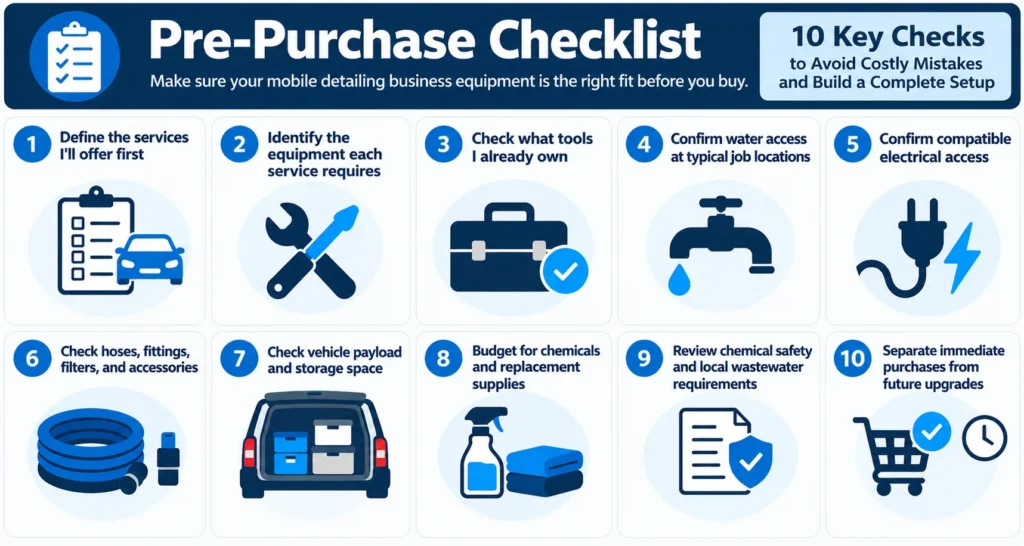
You don't have to complete every future upgrade before taking your first job. You do need to complete the checks relevant to the services you intend to deliver.
For example, someone offering interior-only cleaning may not need a pressure washer or water tank. But they still need to confirm that their vacuum and other equipment can operate safely at the customer's location.
Build Your First Setup With the Starter Rig Builder
A generic equipment list shows what products are available. It can't fully account for your services, existing tools, transportation, or utility access.
That's why you should plan your purchases before ordering.
DetailerDecision.com's Starter Rig Builder helps beginners explore recommended equipment and estimated setup costs using supported budget options.
Stop Guessing. Start Building.
Not sure how to allocate your equipment budget? Explore starter equipment recommendations for $750, $1,000, or $1,500 before committing to purchases.
Explore Build My Starter RigOnce you've chosen your equipment, you'll also need to plan how to operate your business legally. Our Car Detailing License guide explains the business-registration and licensing questions beginners should investigate.
Before setting service prices, review our Interior Car Detailing Prices List to understand how to structure interior service packages.
Frequently Asked Questions about Mobile Detailing Business Equipment
What equipment do beginners need for a mobile detailing business?
For basic interior and exterior services, common essentials include a suitable vacuum, microfiber towels, brushes, cleaning chemicals, and supplies for your chosen washing method. Your exact needs depend on your services and access to water and electricity.
Can I start mobile detailing without a pressure washer?
Yes. Some service models use suitable rinseless washing methods or focus on interior detailing. However, the washing method must suit the vehicle's condition and the service you offer.
Do I need a generator and water tank?
Not necessarily. These become more important when you need independent water or electricity. Beginners using suitable customer utilities with permission may be able to postpone them.
How much should I budget for mobile detailing equipment?
DetailerDecision.com uses illustrative equipment budgets of $750, $1,000, and $1,500 for planning. Actual costs depend on your equipment choices, existing tools, accessories, and operating model. These amounts do not represent total business startup costs.
What equipment should I upgrade first?
Upgrade equipment that is limiting your ability to deliver an existing service safely, consistently, or efficiently. The right next purchase depends on your workload, available utilities, and service menu.
Final Thoughts: Buy Equipment in the Right Order
Starting a mobile detailing business doesn't require buying every tool established professionals use.
It requires choosing equipment that supports the services you plan to offer.
Start with basic cleaning tools and the machines your initial services require. Confirm your power and water access. Check the cost of supporting accessories. Then add specialized equipment when your workload and services justify it.
Whether you're planning a $750 setup or a $1,500 equipment budget, the same principle applies:
Buy what you need to complete your first services—not everything you might want to own later.
Disclosure: This page may contain affiliate links. If you purchase through them, we may earn a small commission at no extra cost to you.