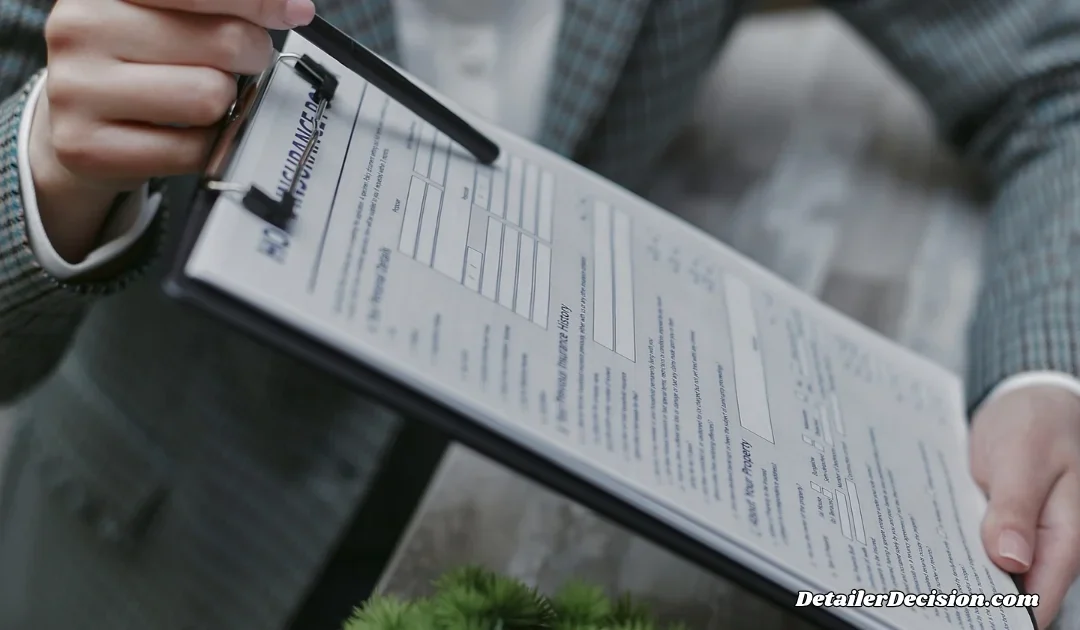
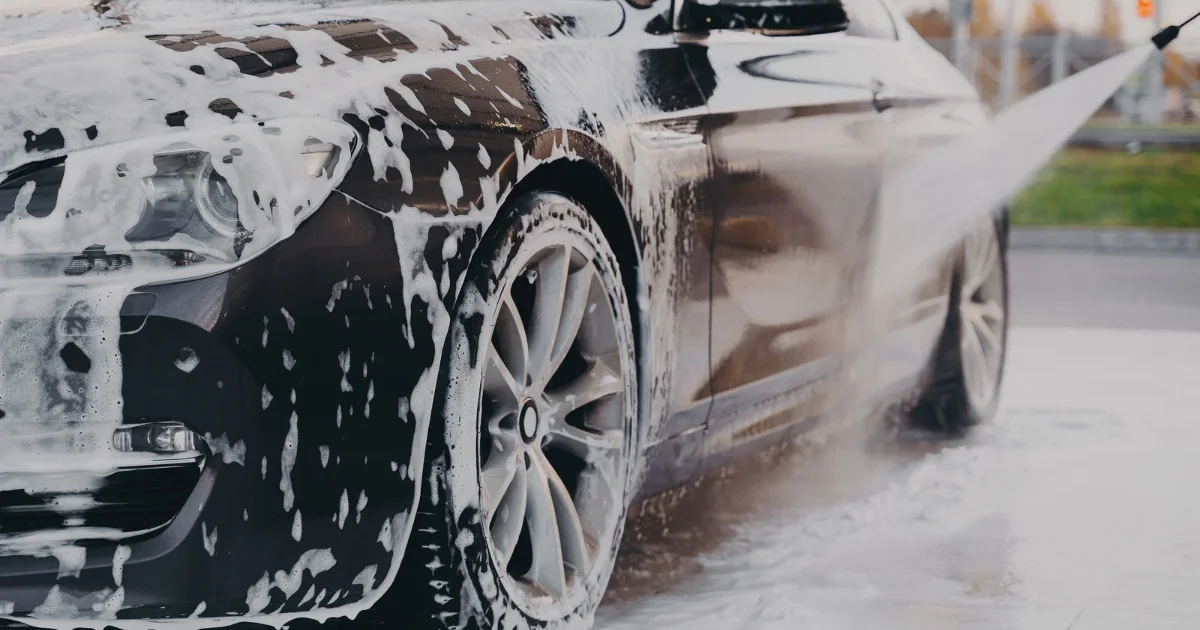
You arrive at a customer's driveway, unload your pressure washer, and begin setting up. A few minutes later, someone trips over your hose and falls.
Or imagine that a chemical spill damages the customer's garage floor.
These are the kinds of accidents that make general liability insurance for mobile detailing worth understanding before you start taking paid jobs.
But there's a catch. General liability insurance may protect you against certain third-party injuries and property damage, but it leaves one of your biggest risks uncovered: damage to the vehicle you're detailing.
Here's what general liability insurance typically covers, what it doesn't, how much it costs, and how to decide whether it's enough for your business.
Quick Answer: What It Covers, Excludes & Costs
General liability insurance for mobile detailing generally helps protect your business against covered third-party bodily injury, property damage, and certain personal or advertising injury claims.
For example, it may help if a customer trips over your equipment or you accidentally damage nearby property.
However, it typically doesn't cover damage to a customer's vehicle in your care, your detailing equipment, or accidents involving your business vehicle.
According to Insureon's published auto detailing and car wash customer data, the median general liability premium is $54 per month, although your actual cost depends on your operations, location, coverage limits, and other factors.
The most important step is confirming which customer-vehicle damage scenarios your policy covers before purchasing it.
What Is General Liability Insurance for Mobile Detailing?
General liability insurance is a type of business insurance that helps pay for certain claims brought against your business by customers, visitors, and other third parties.
For mobile detailers, these claims can arise at customers' homes, apartment complexes, office parking lots, and other work locations.
Unlike a fixed-location detailing shop, your workspace changes throughout the day.
One appointment might involve working beside a customer's garage. The next could involve cleaning a vehicle in a busy commercial parking lot.
Each location introduces different risks.
For example:
- A visitor trips over an extension cord.
- A pressure washer hose damages a nearby fence.
- A cleaning product spills onto a customer's driveway.
- A bystander slips on a wet surface near your work area.
A general liability policy may help cover qualifying medical expenses, legal defense costs, settlements, or property damage claims arising from covered incidents.
The U.S. Small Business Administration's business insurance guidance identifies general liability as a common way to protect against third-party injuries, property damage, and related legal costs.
However, general liability isn't a warranty for your detailing work, and it doesn't automatically protect every item or vehicle you touch.
What Does General Liability Insurance Cover for Mobile Detailers?
The following examples illustrate situations in which general liability coverage may apply.
| Incident | Potential general liability coverage |
|---|---|
| Customer trips over a detailing hose | Bodily injury |
| Pressure washer damages a nearby fence | Third-party property damage |
| Visitor slips on a wet walkway | Bodily injury |
| Chemical damages a garage floor | Property damage, subject to exclusions |
| Business advertisement triggers a covered defamation claim | Personal and advertising injury |
These are hypothetical scenarios, not guarantees of coverage. The policy's wording, exclusions, endorsements, and circumstances determine whether a claim is covered.
1. Third-Party Bodily Injury
Suppose you're washing a customer's SUV in their driveway.
Your extension cord runs between the vehicle and the garage. A visitor doesn't notice it, trips, and gets hurt.
If the visitor sues your business, general liability insurance may help cover medical expenses and legal defense costs.
This protection matters even if you work alone.
You don't need a large shop or several employees for a customer or visitor to get hurt around your equipment.
2. Damage to Someone Else's Property
Mobile detailers work around homes, landscaping, garages, and parked vehicles.
Imagine accidentally striking a customer's garage door with a pressure washer wand.
If the incident qualifies as covered third-party property damage, general liability insurance may help with repair costs.
However, damage to property you're actively working on, or property otherwise in your care, custody, or control, can be treated differently.
That distinction matters most when the damaged property is the customer's vehicle.
3. Personal and Advertising Injury
General liability policies can also include personal and advertising injury coverage.
Depending on the policy, this may address certain claims involving defamation, advertising-related copyright infringement, or other specified offenses.
For most beginner detailers, bodily injury and property damage are likely to be more immediate concerns.
Still, understanding the full policy helps you avoid paying for coverage you don't need.
Build Your Mobile Detailing Setup With Confidence
Find the right pressure washer, vacuum, chemicals, and tools for your budget—without buying what you don't need.
Build My Starter RigWhat General Liability Insurance Usually Does Not Cover
This is where many beginners misunderstand mobile detailing insurance.
A policy that protects you if someone trips over a hose might not cover damage you cause while polishing that person's car.
Damage to Customer Vehicles in Your Care
Suppose you're performing paint correction on a customer's vehicle and accidentally damage the clear coat.
You submit a claim under your general liability policy.
The insurer may deny coverage because standard general liability insurance commonly excludes certain damage to property in your care, custody, or control.
Other exclusions may apply to faulty workmanship or damage to the specific property being worked on.
That means incidents such as these require particular attention:
- Scratching paint during washing or polishing.
- Damaging leather with an unsuitable cleaning chemical.
- Burning through clear coat during machine polishing.
- Damaging trim while applying a specialty product.
- Causing interior damage while using an extractor.
Ask about GarageKeepers coverage and any other endorsements that specifically cover detailing-related damage.
Don't assume buying GarageKeepers insurance automatically solves every problem, either. Some garagekeepers policies exclude faulty workmanship or damage caused by the work itself.
Ask for written confirmation covering the actual services you provide.
Theft of Your Own Equipment
If someone steals your vacuum, generator, or pressure washer from your detailing van, general liability insurance generally won't replace those tools.
Portable tools and equipment coverage, sometimes arranged through inland marine insurance, may address qualifying losses.
Business Vehicle Accidents
If you're driving to a customer's appointment and collide with another vehicle, your general liability policy generally doesn't cover the driving accident.
You may need commercial auto insurance or other appropriate coverage for business-use vehicles.
Employee Injuries
General liability insurance isn't a substitute for workers' compensation.
If you hire employees, workers' compensation requirements depend on your state and business circumstances.
Replacing Poor-Quality Work
If a customer is unhappy with a detailing job and demands a refund or correction, general liability insurance generally doesn't pay simply because the work failed to meet expectations.
Insurance doesn't replace good service, the right chemicals, safe operating procedures, or clear customer communication.
General Liability vs. Garagekeepers Insurance: Which Do You Need?
For mobile detailers, this is arguably the most important insurance comparison.
General liability generally covers claims involving third parties and their property.
Garagekeepers insurance covers certain losses involving customers' vehicles while they are in your care, custody, or control.
However, the two coverages are not interchangeable.
| Hypothetical situation | General liability | Garagekeepers |
|---|---|---|
| Customer trips over a hose | Potentially covered | Generally not its purpose |
| Equipment damages a garage door | Potentially covered | Generally not its purpose |
| Customer vehicle is damaged while in your care | Often excluded | Potentially covered |
| Polisher damages clear coat | Often excluded | Depends on work-related exclusions |
| Customer vehicle is stolen while in your custody | Generally excluded | Potentially covered |
| Your pressure washer is stolen | Generally excluded | Generally not covered |
Coverage descriptions are illustrative. Actual results depend on the applicable policy and circumstances.
Does Garagekeepers Insurance Cover Paint Correction Damage?
Not necessarily.
Garagekeepers coverage can be structured in different ways, and policy language may distinguish between damage to a vehicle while in your custody and damage caused by your actual work.
For example, accidentally damaging a customer's vehicle while moving it may be treated differently from damaging paint during polishing.
If you offer paint correction, ceramic coatings, engine bay detailing, or other specialized services, ask the insurer to confirm how those operations are covered.
For a broader explanation of insurance types, see our Mobile Detailing Insurance Guide.
How Much Does General Liability Insurance for Mobile Detailing Cost?
The cost of a general liability insurance policy for mobile detailers depends on several factors.
These include your location, annual revenue, services, claims history, coverage limits, and deductibles.
Published insurer and broker data provide useful benchmarks, but they aren't guaranteed quotes.
Published General Liability Cost Benchmarks
Insureon — Auto detailing and car wash customers, $54/mo, $648 annualized from rounded monthly median
Progressive Commercial — All-business median, 2025, $55/mo, $660 annualized from monthly median
Insureon's figure is more directly relevant because it comes from auto detailing and car wash customers.
Progressive's figure covers a broader range of businesses and serves as a comparison rather than a mobile-detailing-specific estimate.
These are historical published benchmarks, not confirmed 2027 premiums.
What Affects Your Premium?
Two detailers offering similar services can receive different insurance quotes.
Insurers may consider:
- Location: State, local risk factors, and applicable insurance requirements.
- Services: Insurers may evaluate basic washing differently from paint correction or specialty treatments.
- Revenue: Higher business activity can increase exposure.
- Employees: Additional workers can change the business's risk profile.
- Claims history: Previous losses may influence pricing.
- Coverage limits: Higher limits may cost more.
- Deductibles: Higher deductibles can reduce premiums but increase out-of-pocket costs.
- Endorsements: Additional coverage may increase the overall price.
When comparing quotes, provide the same business information to each insurer.
Otherwise, a cheaper premium may simply reflect narrower coverage.
How Much General Liability Coverage Should a Mobile Detailer Carry?
Many general liability policies offer limits such as $1 million per occurrence and $2 million aggregate.
Insureon reports these limits as a common arrangement for its auto detailing and car wash customers.
But that doesn't mean every mobile detailer automatically needs exactly those limits.
Understanding Policy Limits
Per-occurrence limit: The maximum the insurer pays for one covered occurrence, subject to policy terms.
Aggregate limit: The maximum payable for applicable covered claims during the policy period, subject to the policy's aggregate provisions.
For example, a policy with a $1 million per-occurrence limit and a $2 million aggregate limit doesn't mean you have $2 million available for every individual accident.
Coverage limits also don't override exclusions.
A $2 million policy doesn't necessarily protect a customer's vehicle if the damage falls outside the policy's coverage.
Choosing Your Limits
Consider the locations where you work, the services you provide, your customer contracts, and the financial consequences of a serious claim.
Commercial clients and property managers may require particular limits or additional insured endorsements.
Before buying, ask your agent whether the quoted limits meet your contractual obligations and whether additional coverage fits your operations.
Do You Need General Liability Insurance for Mobile Detailing?
General liability insurance isn't universally required by law for every mobile detailing business in the United States.
However, that doesn't mean operating without it is a good decision.
You may need coverage to satisfy customer contracts, property management requirements, or other business arrangements.
More importantly, an uncovered injury or property damage claim could become a significant financial burden.
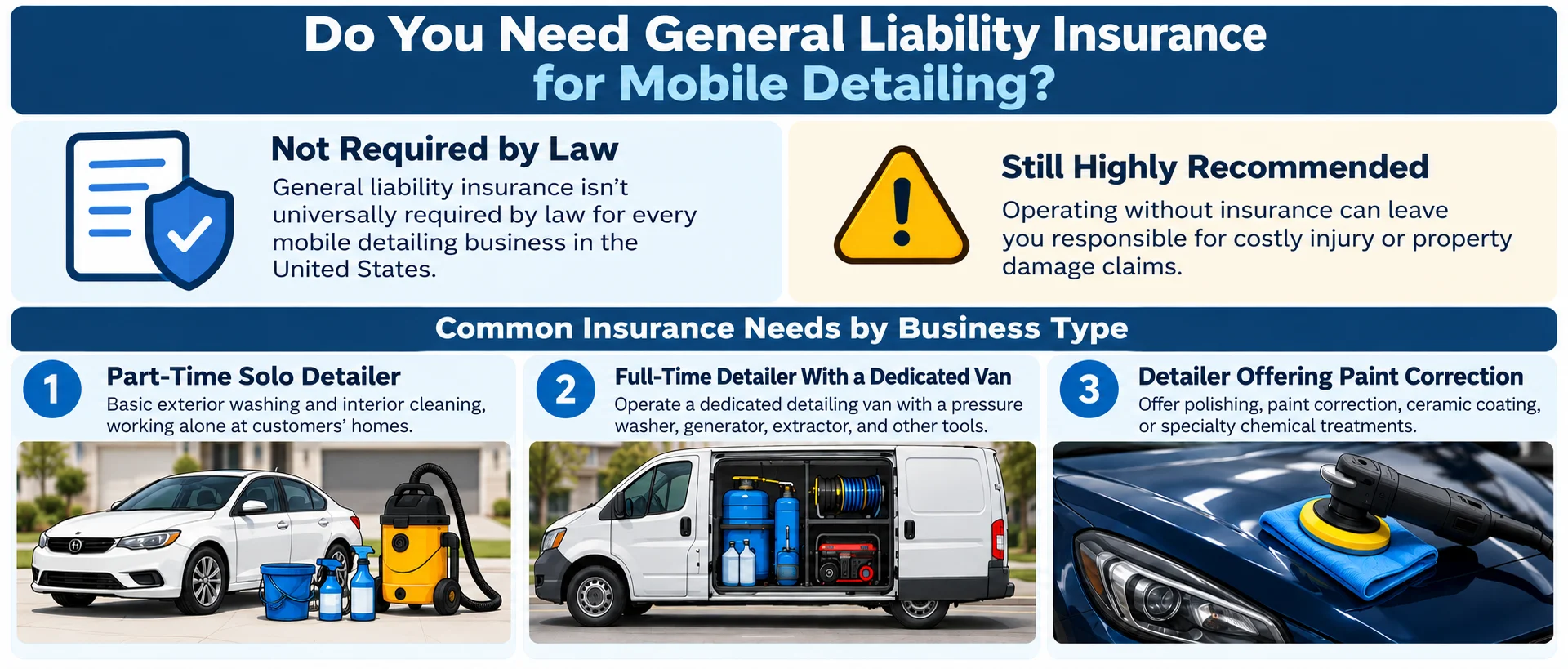
Scenario 1: Part-Time Solo Detailer
Suppose you're starting with basic exterior washing and interior cleaning, working alone at customers' homes.
General liability is a sensible early coverage to investigate.
But you should also confirm whether your vehicle insurance allows business use and adequately covers damage to customers' vehicles.
Even a small operation can face claims involving expensive vehicles.
Scenario 2: Full-Time Detailer With a Dedicated Van
If you operate a dedicated detailing van carrying a pressure washer, generator, extractor, and other tools, general liability is only one part of your insurance needs.
Commercial auto and portable equipment coverage also matter.
Customer-vehicle protection also deserves close attention.
Scenario 3: Detailer Offering Paint Correction
If you offer polishing, paint correction, ceramic coating, or specialty chemical treatments, ask specifically about damage caused during those services.
The biggest coverage gap may involve the exact vehicle you're paid to work on.
For a broader business setup checklist, read How to Start a Mobile Detailing Business.
7 Questions to Ask Before Buying General Liability Insurance
Before purchasing a policy, ask the insurance agent these seven questions.
- Does this policy cover mobile detailing at customers' homes, offices, and parking lots? Confirm that your actual operating locations are included.
- What happens if I accidentally damage a customer's vehicle while detailing it? Ask about care, custody, or control exclusions and customer-vehicle coverage.
- Does the policy cover paint correction, ceramic coatings, and chemical treatments? Have the insurer identify any restrictions on the services you provide.
- What are the per-occurrence and aggregate limits? Make sure you understand the available protection.
- What deductibles and exclusions apply? A low premium can come with significant out-of-pocket obligations.
- Can I obtain a certificate of insurance or add a commercial client as an additional insured? Ask about the process and any fees.
- What happens if I expand my services, hire employees, or add another vehicle? Understand when your policy needs updating.
A useful final question is:
Can you show me the policy language or endorsement that addresses damage to a customer's vehicle while I'm actively detailing it?
A verbal reassurance is less useful than a clear written explanation supported by the actual policy.
Stop Guessing. Start Building.
Not sure how to allocate your equipment budget? Explore starter equipment recommendations for $750, $1,000, or $1,500 before committing to purchases.
Explore Build My Starter RigHow to Compare General Liability Insurance Quotes
You don't need to choose an insurer based solely on a familiar brand name or the lowest advertised premium.
Instead, compare the coverage itself.
| What to compare | Why it matters |
|---|---|
| Annual premium | Shows the total recurring cost |
| Per-occurrence limit | Maximum protection for one covered occurrence |
| Aggregate limit | Overall applicable policy-period protection |
| Deductible | Potential out-of-pocket expense |
| Covered operations | Confirms your detailing services are included |
| Exclusions | Identifies important gaps |
| Customer-vehicle protection | Clarifies damage to vehicles being serviced |
| Additional insured options | May be needed for commercial contracts |
| Equipment coverage | Determines whether separate protection is needed |
Start by researching providers and marketplaces such as Progressive Commercial, Insureon, and Simply Business.
These are comparison starting points, not an independently tested ranking of insurers.
Get multiple quotes using the same description of your business, services, and coverage needs.
Common General Liability Insurance Mistakes
Buying the Cheapest Policy Without Checking Exclusions
A low monthly price means little if the policy excludes a loss that could seriously affect your business.
Compare exclusions and deductibles before choosing a policy.
Assuming Customer-Vehicle Damage Is Covered
This is one of the biggest potential mistakes for a mobile detailer.
Confirm customer-vehicle protection and any work-related damage exclusions in writing.
Describing Your Business Too Vaguely
Don't simply say you run a cleaning business if you regularly work on customers' vehicles.
Tell the insurer that you operate a mobile auto detailing business and describe your actual services.
Ignoring Commercial Auto Coverage
If you use a van, SUV, or truck for business appointments, check your vehicle insurance.
Personal auto coverage may restrict certain business activities.
Forgetting to Update Your Policy
Adding paint correction, hiring employees, purchasing another vehicle, or taking on commercial contracts can change your insurance needs.
Review your coverage whenever your business changes.
How General Liability Insurance Fits Into Your Startup Budget
Insurance is a recurring business expense, not simply another item on your equipment shopping list.
Beginners should separate equipment purchases from ongoing operating costs.
| Budget category | Typical examples | Planning approach |
|---|---|---|
| Equipment | Pressure washer, vacuum, chemicals | Initial purchases and replacements |
| General liability | Third-party liability coverage | Recurring premium |
| Other insurance | Customer-vehicle, auto, equipment | Quote separately |
| Licensing | Registrations and permits | Check state and local requirements |
| Vehicle expenses | Fuel and maintenance | Ongoing operating costs |
| Cash reserve | Deductibles and unexpected expenses | Keep funds available |
If you're building a $750, $1,000, or $1,500 equipment setup, don't assume that equipment budget also includes insurance, licensing, and other business expenses.
For equipment planning, the Mobile Detailing Equipment List can help you identify what your setup requires.
You can also use the Starter Rig Builder to explore equipment recommendations for different budgets.
The Starter Rig Builder is an equipment planning tool, not an insurance quote calculator.
Is General Liability Insurance Required for a Mobile Detailing Business?
General liability insurance requirements depend on your location and business circumstances.
While a general liability policy isn't universally mandatory for mobile detailing businesses, commercial contracts or property access agreements may require it.
Other insurance obligations may apply independently.
For example, state motor vehicle insurance requirements still apply, and businesses with employees may have workers' compensation obligations.
Business licenses and insurance policies also serve different purposes.
A license authorizes certain business activities where required. Insurance helps address covered financial risks.
For related guidance, see our Car Detailing License and Mobile Detailing Business License guides.
Frequently Asked Questions about General Liability Insurance for Mobile Detailing
Does general liability insurance cover scratches on customer cars?
Not automatically. Standard general liability policies commonly exclude certain damage to property in your care, custody, or control. Ask about customer-vehicle coverage and any exclusions for damage caused during detailing work.
Can I start a mobile detailing business without general liability insurance?
Depending on your state and business arrangements, general liability may not be legally required. However, contracts may require it, and operating without adequate coverage can lead to high out-of-pocket costs.
How much does a general liability insurance policy cost?
Insureon reports a $54 monthly median for its auto detailing and car wash customers. Actual premiums vary by location, services, business size, limits, deductibles, and other underwriting factors.
Do I need garagekeepers insurance if I detail cars at customers' homes?
Working at customers' homes doesn't automatically eliminate the risk of damage to customer vehicles. Ask an insurance professional whether garagekeepers coverage or another policy or endorsement appropriately covers your mobile operations and the services you perform.
Does general liability insurance cover stolen detailing equipment?
Generally, no. Portable tools and equipment insurance, often available through inland marine coverage, may protect against certain equipment losses. Check the covered locations, theft conditions, limits, and exclusions.
Final Thoughts: Buy Coverage That Matches Your Actual Risks
General liability insurance for mobile detailing is an important starting point because accidents can happen even during routine washing and interior cleaning.
But it doesn't protect every part of your business.
The most important distinction is between claims involving third-party injuries or property damage and damage to a customer's vehicle while you're working on it.
Before purchasing coverage, describe your actual services, compare multiple quotes, and confirm important exclusions in writing.
A policy should protect you against the risks you genuinely face—not simply provide a low monthly premium and a certificate of insurance.
Disclaimer: This article provides general educational information for U.S. mobile detailing businesses. It is not legal or insurance advice. Requirements and coverage vary by state, insurer, and policy. Consult your state regulator and a licensed insurance professional for guidance specific to your business.