Starting a mobile detailing business means working on vehicles worth far more than your entire equipment setup. A pressure-washer accident, a damaged leather seat, or a stolen generator could quickly turn a profitable week into an expensive problem.
That's why you should look into mobile detailing insurance before you take your first paying customer.
But beginners often get confused: buying general liability insurance doesn't automatically cover damage to a customer's car. Your detailing van, portable equipment, and employees can also require different types of protection.
This guide explains what car detailing insurance covers, which policies beginners should consider, how much they may cost, and what to check before paying for coverage.
Quick Answer: What Insurance Do You Need for Mobile Detailing?
Most mobile detailing businesses should consider general liability insurance, customer-vehicle coverage, and appropriate commercial auto insurance. Tools and equipment coverage may also be worthwhile, while businesses with employees often need workers' compensation.
No single insurance policy automatically covers every mobile detailing risk. Your coverage needs depend on your services, location, vehicles, employees, and the wording of the policies you purchase.
What Is Mobile Detailing Insurance?
Mobile detailing insurance combines business insurance policies that protect detailers from financial losses related to their work.
Unlike a traditional detailing shop, a mobile operator travels to customers' homes, offices, apartment complexes, or commercial parking lots.
That creates several different exposures.
You might accidentally damage someone's driveway, injure a bystander with a hose, scratch a customer's vehicle, or lose expensive equipment during transportation.
Each situation may fall under a different insurance policy.
For example, imagine three hypothetical incidents:
- A customer trips over your extension cord and gets injured.
- Your polishing machine damages the paint on a customer's vehicle.
- Someone steals your extractor from your detailing van.
Although all three incidents happen while operating the same business, they may involve three separate insurance coverages.
That is why choosing business insurance for auto detailing should start with identifying risks, not just finding the lowest advertised monthly premium.
Build Your Mobile Detailing Setup With Confidence
Find the right pressure washer, vacuum, chemicals, and tools for your budget—without buying what you don't need.
7 Types of Mobile Detailing Insurance Explained
The following table summarizes the most relevant insurance options for beginners.
| Insurance type | Main purpose | When to consider it |
|---|---|---|
| General liability | Third-party injuries and certain property damage | Most detailing businesses |
| Garagekeepers | Covered damage to customer vehicles in your care | When handling customer vehicles |
| Commercial auto | Business-related vehicle accidents | When using a vehicle for detailing work |
| Tools and equipment | Covered loss or damage to portable gear | When transporting valuable equipment |
| Workers' compensation | Employee work-related injuries or illnesses | When hiring employees |
| Hired and non-owned auto | Certain liability involving non-owned vehicles used for business | When staff use personal or rented vehicles |
| Business owner's policy (BOP) | Bundled liability and commercial property protection | When a business has eligible property exposures |
These are coverage categories, not a universal list of legal requirements. Availability, definitions, and exclusions vary by insurer and state.
1. General Liability Insurance for Mobile Detailing
General liability insurance is one of the first policies a new detailer should investigate.
It generally addresses covered claims involving bodily injury or property damage to third parties.
For example, imagine you're detailing a car in a customer's driveway. Your pressure washer hose stretches across a walkway, and a visitor trips over it.
If the visitor is injured and files a claim, general liability insurance may cover medical expenses, legal defense costs, or damages.
Other potential examples include accidentally damaging a customer's garage door or breaking a nearby window with equipment.
However, general liability has an important limitation.
Standard general liability policies commonly exclude damage to property in your care, custody, or control.
A customer's car being cleaned, polished, or otherwise worked on may fall into that category.
That means you shouldn't assume general liability insurance covers a scratched hood, damaged leather seat, or paint correction accident.
Ask your insurer how they handle customer-vehicle damage before purchasing the policy.
2. Garagekeepers Insurance: Protecting Customer Vehicles
Garagekeepers insurance matters because customers trust you with valuable vehicles.
It covers certain losses involving customer vehicles while they are in your care, custody, or control.
Depending on the policy, covered incidents may include vehicle damage, theft, fire, or other specified events.
However, garagekeepers' policies vary.
Some provide legal liability coverage, which generally depends on the business being legally responsible for the loss. Other forms may offer direct primary or direct excess protection under different conditions.
A key issue for detailers is whether the policy covers damage caused by the work itself.
For example, burning through clear coat during polishing may be treated differently from accidentally striking a vehicle while moving it.
Some policies exclude faulty workmanship or damage to the specific part being worked on.
Before buying garagekeepers insurance, ask the agent to confirm in writing whether your actual services are covered, including interior cleaning, chemical application, paint correction, ceramic coating, and vehicle movement where applicable.
For further coverage explanations, see Insureon's garagekeepers insurance guide.
3. Commercial Auto Insurance for Your Detailing Vehicle
If you use a van, pickup truck, SUV, or trailer to transport detailing equipment, review your vehicle insurance carefully.
Personal auto insurance may restrict or exclude certain business activities. The exact treatment depends on your insurer, vehicle ownership, and how you use the vehicle.
Commercial auto insurance can cover business-related driving exposures.
Depending on the coverages selected, it may address:
- Liability for injuries or property damage caused by a covered accident.
- Collision damage to your business vehicle.
- Theft, vandalism, or weather-related damage to your vehicle under comprehensive coverage.
- Other protections required or offered in your state.
Suppose you're driving your detailing van to a customer's appointment and collide with another vehicle.
The resulting liability and vehicle damage may fall under your commercial auto policy rather than your general liability policy.
But commercial auto insurance doesn't necessarily protect the loose detailing equipment inside your van.
Your generator, vacuum, extractor, and portable pressure washer may need separate coverage.
Progressive Commercial specifically identifies commercial auto insurance as a major consideration for mobile auto detailing businesses.
4. Tools and Equipment Insurance
Mobile detailers frequently transport valuable equipment between jobs.
That equipment might include pressure washers, wet/dry vacuums, steam cleaners, polishers, extractors, generators, and portable lighting.
Tools and equipment insurance, often arranged through an inland marine policy or endorsement, can cover certain losses involving portable business property.
For example, suppose someone breaks into your parked detailing van and steals your vacuum and extractor.
A well-written equipment policy may cover the loss.
Before purchasing, check whether the policy covers equipment:
- Inside a locked vehicle overnight.
- At a customer's property.
- While traveling between jobs.
- At home or in a storage unit.
- When stolen without visible forced entry.
Also confirm whether claims are paid using replacement cost or actual cash value, and whether individual item limits apply.
An equipment policy is not a maintenance contract. It may exclude ordinary wear, deterioration, and mechanical breakdown.
For help identifying the equipment you need to insure, see our Mobile Detailing Business Equipment Guide.
5. Workers' Compensation Insurance
If you hire employees, workers' compensation may be required by law.
This insurance generally covers qualifying work-related injuries or illnesses, such as medical expenses and partial wage replacement.
A detailer could be injured while lifting a heavy water tank, slipping on wet pavement, or handling cleaning chemicals.
Workers' compensation rules vary by state. The requirements can depend on the number of employees, business structure, industry classification, and other factors.
Don't assume hiring only one part-time employee automatically exempts your business.
Also, a sole proprietor isn't necessarily covered by a workers' compensation policy unless the applicable rules and policy specifically provide that coverage.
Check your state's workers' compensation agency before hiring.
6. Hired and Non-Owned Auto Insurance
Hired and non-owned auto insurance, commonly called HNOA, can provide liability protection when certain vehicles not owned by the business are used for business purposes.
For example, an employee might use their own car to pick up detailing supplies.
If an accident occurs, the employee's personal auto policy may be involved, but your business could also face a liability claim.
HNOA may help address covered business liability in these situations.
It generally doesn't replace commercial auto coverage for business-owned vehicles, and it may not cover physical damage to the employee's car.
7. Business Owner's Policy (BOP)
A business owner's policy combines certain types of insurance into one package, typically general liability and commercial property insurance.
It can help if you run a detailing shop, rent commercial space, or keep substantial equipment and inventory at a covered location.
Some BOPs also include or offer business income protection for qualifying interruptions caused by covered property losses.
However, a BOP does not automatically include garagekeepers insurance, commercial auto, or protection for all portable equipment.
For a fully mobile business without a commercial premises, a separate liability policy and targeted endorsements may be more appropriate.
Ask an agent to compare the two approaches rather than assuming a bundled policy is always cheaper.
General Liability vs. Garagekeepers: What’s the Difference?
This is one of the most important distinctions in car detailing insurance.
| Situation | General liability | Garagekeepers |
|---|---|---|
| Customer trips over a hose | Potentially covered | Generally not its purpose |
| Pressure washer damages a nearby fence | Potentially covered | Generally not its purpose |
| Customer vehicle damaged while in your care | Often excluded | Potentially covered |
| Paint damaged during polishing | Often excluded | Depends on workmanship exclusions |
| Customer vehicle stolen while in your custody | Generally not covered | Potentially covered |
| Your own equipment is stolen | Generally not covered | Generally not covered |
Examples are illustrative. Actual coverage depends on policy language, exclusions, endorsements, and the circumstances of the claim.
The key question isn't simply whether you have liability insurance.
It's whether your insurance specifically addresses the damage your detailing operations could cause.
If you're considering paint correction or other higher-risk services, discuss them with your insurer before offering them to customers.
How Much Does Mobile Detailing Insurance Cost in 2027?
No reliable universal monthly price exists for mobile detailing insurance.
Premiums depend on location, services, business revenue, employee count, vehicle use, insurance limits, deductibles, and claims history.
However, published insurer and broker data can provide a useful starting point.
Published Insurance Cost Benchmarks
Insureon reports the following median monthly premiums for its auto detailing and car wash insurance customers.
| Insurance type | Published monthly median | Annualized equivalent |
|---|---|---|
| General liability | $54 | $648 |
| Business owner's policy | $89 | $1,068 |
| Workers' compensation | $131 | $1,572 |
| Commercial auto | $46 | $552 |
Source: Insureon — Auto Detailing and Car Wash Insurance Costs. Annualized amounts are monthly medians multiplied by 12, not separately reported annual premiums. These are published customer benchmarks, not confirmed 2027 quotes.
Insureon also reports a $38 monthly median for garagekeepers coverage across its broader auto-service customer population. That figure doesn't apply to mobile detailers.
Do not add these numbers together or treat them as a guaranteed insurance package price.
Different customer populations, eligibility conditions, deductibles, and coverage limits can make the combined premium substantially different.
For comparison, Progressive Commercial reports a 2025 general liability median of $55 per month across its broader business customer population, demonstrating why the industry and sample behind an insurance statistic matter.
What Affects Your Insurance Premium?
Two mobile detailing businesses in the same city can receive very different quotes.
Insurers may consider the following factors:
- Services offered: Basic washing, interior detailing, paint correction, and specialty treatments can create different risks.
- Vehicle values: Working on expensive vehicles can increase potential customer-property losses.
- Business location: State laws, local claims patterns, and other regional factors can affect premiums.
- Revenue and workload: More jobs can mean greater exposure.
- Equipment value: Expensive tools can require higher property coverage limits.
- Claims history: Previous losses may affect underwriting and premiums.
- Deductibles and coverage limits: Higher deductibles may reduce premiums but increase out-of-pocket costs.
When comparing quotes, use the same business information and request comparable coverage limits.
Otherwise, a cheaper quote may simply provide less protection.
What Insurance Should a Beginner Mobile Detailer Get?
Not every detailer needs the same insurance package.
The most useful approach is to match your coverage to how your business actually operates.
Scenario 1: Solo Beginner Working From a Personal Vehicle
Suppose you're starting part-time, traveling to customers' driveways, and offering basic exterior washing and interior cleaning.
Your first priorities should include checking general liability, customer-vehicle damage coverage, and whether your existing vehicle insurance permits your business activities.
You should also evaluate portable equipment protection based on your tools' value.
Workers' compensation may not be required for a solo owner, but you should check state rules and optional coverage.
Scenario 2: Full-Time Detailer With a Dedicated Van
Now suppose you've invested in a dedicated van carrying a pressure washer, extractor, generator, chemicals, and water equipment.
Your insurance considerations expand.
Commercial auto coverage and portable equipment protection become especially important, alongside liability and customer-vehicle coverage.
If you perform paint correction or ceramic coating, disclose those services when requesting quotes.
A policy that worked for basic maintenance washing may not cover all the exposures of your expanded services.
Scenario 3: Growing Business With Employees
Once you hire workers, your risk profile changes.
In addition to existing liability, auto, and customer-vehicle coverage, you'll need to consider workers' compensation and any liability related to employees using personal vehicles for business tasks.
You may also need higher coverage limits or additional insured endorsements to meet commercial client contract requirements.
These scenarios illustrate priorities, not predetermined insurance packages or legal requirements.
Insurance Budget Planning for a New Detailing Business
Beginners sometimes overlook insurance as an operating expense while purchasing equipment.
A startup budget should separate one-time equipment purchases from recurring business costs.
| Budget category | Examples | Planning approach |
|---|---|---|
| Equipment | Vacuum, washer, towels, chemicals | One-time purchases plus replacements |
| Insurance | Liability, customer-vehicle, commercial auto | Recurring premiums and deductibles |
| Licensing | Local permits and registrations | Jurisdiction-specific fees |
| Vehicle operations | Fuel, maintenance, registration | Recurring costs |
| Customer acquisition | Website, advertising, business cards | Initial and ongoing costs |
| Cash reserve | Unexpected expenses and claims deductibles | Set aside funds separately |
If you're comparing $750, $1,000, and $1,500 equipment budgets, don't assume those amounts also cover insurance, licensing, and vehicle expenses.
Our Start a Mobile Detailing Business guide explains the broader startup process.
You can also use the Starter Rig Builder to plan equipment purchases around your budget. It is an equipment planning tool, not an insurance quote calculator.
Stop Guessing. Start Building.
Not sure how to allocate your equipment budget? Explore starter equipment recommendations for $750, $1,000, or $1,500 before committing to purchases.
Is Mobile Detailing Insurance Required by Law?
Insurance requirements depend on your state, business structure, employees, vehicles, and contractual obligations.
General liability insurance isn't required for every mobile detailing business, but customers, landlords, property managers, or commercial clients may require it.
Commercial vehicles must satisfy applicable state motor vehicle insurance requirements, and business use may require different coverage from personal use.
Workers' compensation is mandatory for many employers, subject to state-specific rules and exemptions.
A business license and an insurance policy are different.
A license does not automatically insure your business, and insurance does not replace a required license or permit.
For related guidance, see:
The U.S. Small Business Administration recommends assessing business risks and comparing coverage terms and prices rather than selecting insurance solely on cost.
6 Common Mobile Detailing Insurance Mistakes
1. Assuming General Liability Covers Every Accident
A general liability policy is not an all-purpose detailing policy.
Confirm how the insurer handles customer vehicles and damage caused during detailing.
2. Failing to Disclose Your Actual Services
Tell the insurer whether you perform basic washing, paint correction, ceramic coatings, engine bay cleaning, or other specialized work.
A vague description of your business may create uncertainty about whether particular activities are covered.
3. Using Personal Auto Insurance Without Checking Business Use
Don't assume your personal policy covers regular transportation of commercial equipment or business-related driving.
Explain how you use the vehicle and request written confirmation of appropriate coverage.
4. Ignoring Portable Equipment
Your detailing tools may not be fully protected by your commercial auto or general liability policy.
Check equipment coverage limits, storage requirements, and theft exclusions.
5. Choosing Insurance Based Only on Monthly Price
A lower premium can come with higher deductibles, lower limits, or important exclusions.
Compare what each policy covers before deciding.
6. Forgetting to Update Coverage as the Business Grows
Adding employees, buying a second vehicle, purchasing expensive equipment, or expanding into specialty services can change your insurance needs.
Review coverage whenever your business operations change.
How to Choose the Best Mobile Detailing Insurance
The best mobile detailing insurance is not necessarily the cheapest policy or the one with the most recognizable company name.
It's the policy combination that addresses your real business risks at a price you can sustain.
Step 1: List Your Business Activities
Describe your services, equipment, business vehicle, working locations, employee count, and whether you ever move or store customer vehicles.
Be specific.
Step 2: Identify Your Biggest Potential Losses
Consider incidents that could be financially difficult for you to handle on your own.
For example, damaging an expensive customer vehicle may create a very different financial exposure from replacing a small detailing accessory.
Step 3: Request Comparable Quotes
Obtain quotes from multiple licensed insurance providers or agents familiar with automotive service businesses.
Potential starting points include:
| Provider or marketplace | Why consider it |
|---|---|
| Progressive Commercial | Commercial auto and access to detailing-related business coverage |
| Insureon | Comparing business insurance options through a marketplace |
| The Hartford | Educational information and referral to Tivly for detailing insurance |
These are research starting points, not a ranking based on independently tested quote prices, claims service, or policy quality.
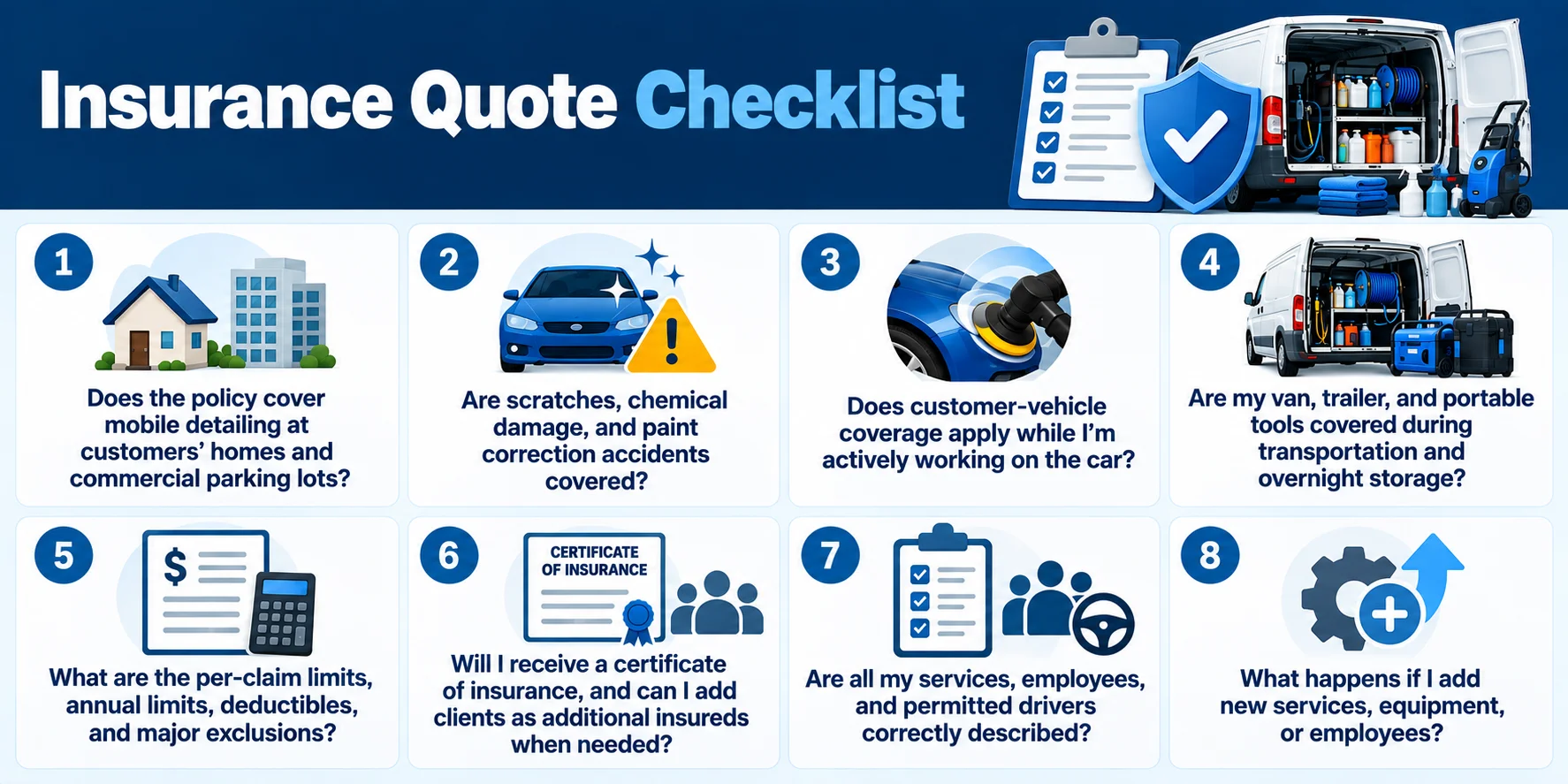
Step 4: Ask These Questions Before Buying
Use this checklist when speaking with an insurance agent.
Step 5: Read the Policy Documents
A quote summary or certificate of insurance is not a substitute for the actual policy terms.
Review exclusions, endorsements, covered operations, and deductibles.
If anything is unclear, ask for written clarification before accepting the policy.
How Can Mobile Detailers Reduce Insurance Costs?
Several ways can help you manage insurance expenses without ignoring important risks.
First, compare multiple quotes using the same coverage requirements. This makes price differences more meaningful.
Second, ask whether bundling eligible policies could reduce your premium.
Third, consider whether a higher deductible fits your financial situation. A higher deductible may lower your premium, but it also means you pay more out of pocket if a covered loss occurs.
Finally, reduce avoidable risks through practical work procedures.
Inspect hoses and electrical cords, secure equipment during transport, use appropriate chemicals, document the vehicle's condition before work, and keep walkways clear.
These practices are worthwhile even if they don't produce an immediate insurance discount.
Frequently Asked Questions about Mobile Detailing Insurance
Can I start a mobile detailing business without insurance?
Depending on your state and operations, some forms of business liability insurance may not be legally mandatory. However, applicable vehicle insurance and workers' compensation requirements still apply. Operating without suitable coverage can expose you to substantial out-of-pocket losses.
Does general liability insurance cover scratches on customer cars?
Not necessarily. General liability commonly excludes property in your care, custody, or control. Ask about garagekeepers coverage and any exclusions for damage caused by detailing work.
Do I need garagekeepers insurance if I never keep cars overnight?
You may still need customer-vehicle protection because you may have a vehicle in your care while you detail it. However, the applicability and scope of garagekeepers coverage depend on the insurer and policy wording.
Can I insure my mobile detailing equipment separately?
Yes. Portable tools and equipment coverage may be available through inland marine insurance or an appropriate endorsement. Confirm which items, locations, and causes of loss are covered.
How much insurance coverage should a mobile detailer carry?
No single limit fits every business. Consider your services, customer vehicle values, contracts, potential liability, and financial resources. An insurance professional can help you compare limits and deductibles.
Final Thoughts: Protect Your Business Before Your First Job
Mobile detailing insurance is more than another monthly expense. It is part of building a business that can handle accidents without putting every dollar you've invested at risk.
For beginners, the most important starting point is understanding the difference between general liability, customer-vehicle coverage, and commercial auto insurance.
From there, evaluate your equipment, employees, and specific services.
Don't buy a policy simply because the monthly price looks attractive. Make sure it covers the incidents most likely to affect your business, and confirm key details in writing.
Once you understand your insurance needs, you can move forward with the rest of your startup planning, from business licensing to choosing the right equipment.
Disclaimer: This article provides general educational information for U.S. mobile detailing businesses. It is not legal or insurance advice. Requirements and coverage vary by state, insurer, and policy. Consult your state regulator and a licensed insurance professional for guidance specific to your business.