Starting a mobile detailing business doesn't mean you need to buy every piece of equipment you see in a professional detailing video.
A pressure washer, vacuum, generator, water tank, extractor, polisher, and dozens of chemicals might look like a complete setup. But buying everything at once can leave you with expensive equipment you rarely use—and not enough money for the supplies you actually need.
A practical mobile detailing startup kit begins with the services you plan to offer, the utilities available at your customers' locations, and the equipment you already own.
This guide covers the essential tools, the difference between basic and professional kits, and how to plan a workable setup around a $750, $1,000, or $1,500 equipment budget.
What Do You Need in a Mobile Detailing Startup Kit?
For a beginner offering basic interior and exterior detailing, a starter kit typically includes:
- A suitable wet/dry vacuum for interior cleaning
- An exterior washing system appropriate for the services offered
- Car shampoo or rinseless wash products
- Interior cleaner, glass cleaner, and wheel/tire cleaner
- Microfiber towels, wash mitts, and detailing brushes
- Buckets, spray bottles, and applicators
- Compatible hoses, fittings, and electrical accessories
- Storage containers and basic personal protective equipment
You may also need independent water and electrical power, depending on where you work.
The key is to build a complete working system, not simply collect individual tools.
A $750 setup with reliable access to customer water and electricity may be more practical than a $1,500 setup that requires equipment the operator cannot safely power or transport.
Mobile Detailing Startup Kit Checklist: Essential vs. Optional Equipment
Before buying anything, separate the equipment you need for your initial services from tools you can add later.
| Equipment | Priority | Why you need it |
|---|---|---|
| Wet/dry vacuum | Essential for vacuum-based interior services | Removes dirt, debris, and loose material |
| Washing equipment | Essential for exterior washing | Supports the chosen wash method |
| Microfiber towels | Essential | Cleaning, wiping, and drying |
| Detailing brushes | Essential when needed | Reaches vents, trim, wheels, and tight areas |
| Cleaning chemicals | Essential | Removes dirt and contamination from intended surfaces |
| Spray bottles and applicators | Essential as applicable | Allows controlled chemical application |
| Hoses and fittings | Conditional | Connects compatible water equipment |
| Pressure washer | Conditional | Supports certain exterior washing workflows |
| Water tank | Conditional | Supplies water when an independent supply is required |
| Generator | Conditional | Provides independent electrical power |
| Carpet extractor | Service-dependent | Deep-cleaning upholstery and carpets |
| DA polisher | Service-dependent | Machine polishing and paint correction |
The equipment you need changes with the services you advertise.
For a more extensive breakdown, see our Mobile Detailing Equipment List.
Wet/Dry Vacuum: Your Interior Cleaning Foundation
A suitable vacuum is one of the most useful tools for a beginner offering interior detailing.
Use it to remove loose debris from carpets, floor mats, seats, and accessible crevices. Some models also support wet pickup, although their capabilities vary.
When choosing a vacuum, look beyond the advertised horsepower.
Consider suction performance, hose reach, filter requirements, tank capacity, portability, and available electrical power.
A large vacuum may offer more capacity but take up valuable space in your vehicle. A smaller unit may be easier to transport but require more frequent emptying.
Who should skip an expensive vacuum upgrade?
Beginners who already own a suitable, functioning vacuum should first check whether it meets their workload. A new machine isn't automatically a better investment than missing brushes, towels, or cleaning supplies.
Exterior Washing Equipment: Pressure Washer or Rinseless Wash?
Not every beginner needs a pressure washer immediately.
A conventional exterior wash may require a suitable water supply, hose, wash solution, buckets, mitts, and drying towels.
A pressure washer can help with certain cleaning tasks, but it also requires electricity, water flow, hoses, and fittings.
When a Pressure Washer Makes Sense
Consider one when your service menu requires it, you have access to appropriate water and power, and the full equipment system fits your budget.
Pay attention to both PSI (pressure) and GPM (water flow), and use appropriate nozzles and operating techniques to avoid surface damage.
When Rinseless Washing May Make Sense
A compatible rinseless wash method may reduce water consumption and equipment requirements for suitable maintenance cleaning.
However, it isn't a universal replacement for conventional washing. Heavy mud, abrasive contamination, or other conditions may require a different process.
Choose your washing method according to vehicle condition, manufacturer instructions, service scope, and local wastewater requirements.
Ready to Build Your Starter Rig?
Choose your budget, explore essential equipment, and see an estimated setup cost before you buy.
Build My Starter RigCleaning Chemicals: Buy for Your Services, Not the Number of Bottles
A professional car detailing kit doesn't need 20 different chemicals to work.
For basic services, begin with products that cover your actual cleaning tasks.
| Chemical category | Typical purpose | Buying consideration |
|---|---|---|
| Car shampoo or rinseless wash | Exterior cleaning | Match the wash method |
| Interior cleaner | Interior surfaces | Check material compatibility |
| Glass cleaner | Windows and mirrors | Choose an automotive-compatible formula |
| Wheel/tire cleaner | Wheel and tire cleaning | Verify surface compatibility |
| Interior protectant | Appropriate trim and surfaces | Check finish and material suitability |
| Spray sealant | Optional exterior protection | Match the service offered |
An all-purpose cleaner can be useful, but don't assume it is safe for every interior surface or dilution.
Always follow the product label and safety data sheet, including dilution instructions, required protective equipment, and handling precautions.
Avoid buying large chemical containers until you understand how much product your actual services consume.
Microfiber Towels, Brushes, and Accessories
Small accessories can make or break whether your detailing kit is practical.
You may have a good vacuum and washing system but still struggle if you don't have enough clean towels, suitable brushes, or working spray bottles.
Build separate supplies for different cleaning tasks.
For example, don't reuse a wheel-cleaning towel on delicate painted surfaces.
Keep heavily contaminated towels separate, and follow appropriate microfiber washing and care instructions.
A practical beginner kit should include enough supplies to complete the expected workload without repeatedly using dirty materials.
Mobile Detailing Setup: Water, Power, and Transportation
One of the biggest differences between home detailing and operating a mobile detailing business is the need to transport and operate your equipment at different locations.
Before purchasing a water tank or generator, answer three questions.
Can You Use Customer Water and Electricity?
If customers can provide access and permission, you may avoid buying independent utility equipment initially.
Confirm availability before accepting a job.
Check that the water connection, electrical supply, equipment ratings, and working conditions are suitable.
Do You Need a Water Tank?
A water tank becomes relevant when your services require water and customers don't have suitable access.
However, water adds significant weight.
For example, 50 U.S. gallons of water weigh about 417 pounds, not including the tank, mounting hardware, and other equipment.
Verify your vehicle's payload capacity, load distribution, and cargo securement before planning an onboard system.
Do You Need a Generator?
You may need a generator when you require independent electrical power.
Calculate the running and starting loads of the equipment you intend to use. Check compatibility, operating requirements, and safe transport.
Never operate a fuel-powered generator inside a vehicle, enclosed trailer, garage, or other enclosed or partially enclosed area where carbon monoxide can accumulate.
How Much Does a Mobile Detailing Startup Kit Cost in 2027?
A useful way to plan your first equipment purchases is to compare three budgets: $750, $1,000, and $1,500.
These figures are equipment-planning scenarios, not verified retail bundle prices or guaranteed total startup costs.
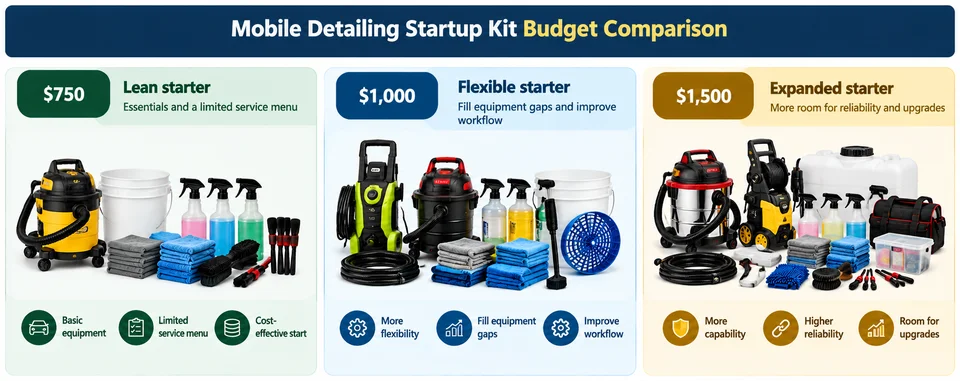
Planning levels only. Actual purchase totals depend on equipment, retailer prices, availability, and operating requirements.
$750 Mobile Detailing Startup Kit: Start With the Essentials
A $750 equipment budget may work for a beginner offering a limited range of services, particularly when suitable equipment and customer utilities are already available.
Focus on basic interior cleaning, an appropriate exterior washing method, chemicals, towels, and brushes.
Avoid purchasing an extractor, polisher, or generator simply to make your setup look more professional.
If essential equipment exceeds the budget, reduce the service menu or reconsider the budget rather than removing necessary safety or compatibility items.
$1,000 Mobile Detailing Startup Kit: Improve Your Workflow
An additional $250 creates more flexibility, but it should solve a specific problem.
You might need a suitable vacuum, missing hoses and fittings, additional towels, or more reliable storage.
A compact electric pressure washer may fit some $1,000 plans, but only if the remaining budget covers the accessories and other essential equipment.
The objective is a more complete setup, not necessarily a larger collection of tools.
$1,500 Mobile Detailing Startup Kit: Expand Carefully
At $1,500, you can afford better core equipment, extra supplies, or upgrades that support a higher workload.
However, even this budget doesn't guarantee a fully self-contained mobile operation.
An onboard water system, generator, suitable vehicle, and wastewater management equipment may cost substantially more.
Upgrade only when the purchase supports a service you're prepared to provide.
Should You Buy a Professional Car Detailing Kit or Individual Products?
Prepackaged detailing kits can be convenient, especially for beginners who don't yet know which chemicals and accessories they need.
But a kit isn't automatically a good value.
| Buying factor | Prepackaged kit | Individual products |
|---|---|---|
| Convenience | Often easier to purchase | Requires more research |
| Product selection | Limited to bundle contents | Tailored to your services |
| Compatibility | Must check every included item | Can select compatible equipment |
| Unnecessary items | May include products you won't use | Easier to avoid |
| Missing accessories | Still possible | Must check your own list |
| Cost | Depends on actual bundle value | Depends on individual prices |
Before purchasing a bundle, check every included item against your service checklist.
A kit containing premium chemicals but no suitable vacuum won't cover a vacuum-based interior service.
Similarly, a pressure washer package may exclude the hoses, connectors, or accessories your setup requires.
Buy a complete workflow, not just a convenient box.
Five Common Mobile Detailing Startup Kit Mistakes
Buying Advanced Equipment Too Early
Extractors, steam cleaners, and polishers can be useful, but they aren't automatically necessary for basic maintenance detailing.
Purchase specialized equipment when your services, skills, and operating conditions justify it.
Ignoring Accessories
Hoses, fittings, electrical accessories, spray bottles, and replacement supplies can affect whether equipment works together.
Include them in your budget before deciding that a machine is affordable.
Assuming Customer Utilities Are Always Available
Some locations may lack suitable electrical outlets or accessible water connections.
Confirm utility requirements and customer permission before booking.
Overlooking Wastewater Rules
Mobile detailing can produce contaminated wash water.
The U.S. Environmental Protection Agency explains that vehicle washing can carry detergents, oils, metals, and other pollutants into stormwater systems.
Before selecting your washing workflow, check local requirements for commercial vehicle washing, runoff prevention, collection, and disposal.
Spending the Entire Budget on Equipment
Your equipment budget is only one part of starting a business.
The U.S. Small Business Administration identifies expenses such as licenses, permits, insurance, marketing, and working capital as important startup considerations.
Set aside money for these expenses separately rather than assuming a $1,000 equipment purchase means your business is ready to operate.
How to Choose the Right Mobile Detailing Startup Kit
Use your planned services and operating conditions to guide your purchases.
| Your situation | Recommended approach |
|---|---|
| Limited budget with customer utilities available | Start with essential equipment for a narrow service menu |
| Existing vacuum and washing equipment | Reuse suitable tools and purchase missing items |
| No reliable water or electricity | Calculate independent utility requirements before buying |
| Multiple jobs per day | Prioritize capacity, consumables, and reliability |
| Planning advanced detailing services | Budget for specialized tools, training, and safe operation |
| Limited vehicle space | Prioritize portable equipment and secure storage |
Two beginners with the same budget may need completely different equipment.
Someone who already owns a suitable vacuum and can use customer water may have enough money for additional supplies.
Someone who must provide independent water and power may find the same budget inadequate.
This is why a fixed shopping list rarely fits everyone.
Build Your Mobile Detailing Setup With the Starter Rig Builder
Once you understand the equipment categories, the next step is to evaluate what your particular setup requires.
The DetailerDecision Starter Rig Builder helps you plan around your budget, services, expected workload, available utilities, and existing equipment.
It also flags equipment decisions that need further verification, rather than treating every result as purchase-ready.
Stop Guessing. Start Building.
Not sure which equipment fits your budget and working conditions?
Build Your Mobile Detailing Setup With Confidence
Find the right pressure washer, vacuum, chemicals, and tools for your budget—without buying what you don't need.
Build My Starter RigVerify retailer prices, product availability, compatibility, and purchase requirements before ordering.
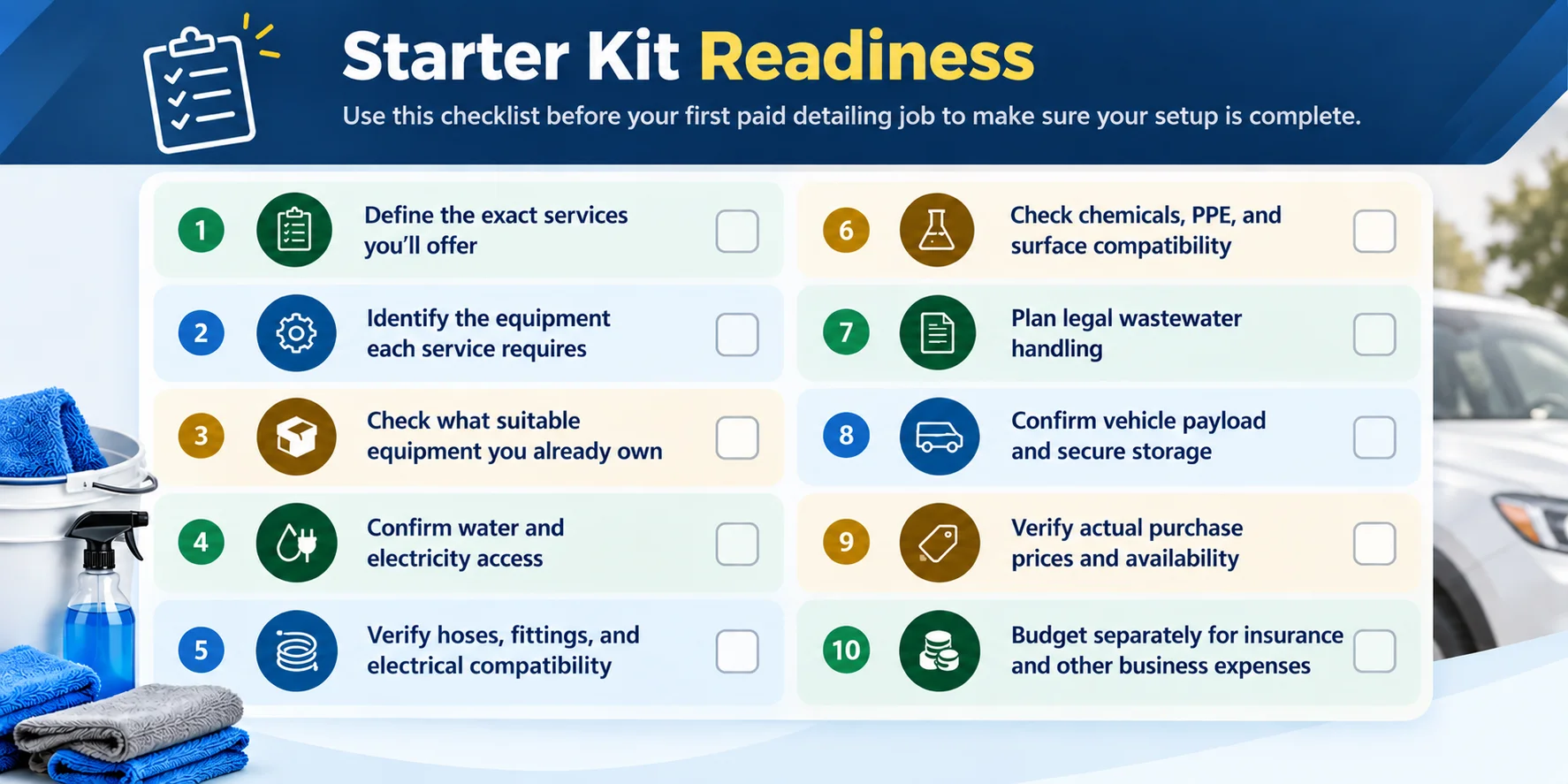
Before Your First Paid Detailing Job: Final Checklist
Frequently Asked Questions about Mobile Detailing Startup Kit
Is $750 enough for a mobile detailing startup kit?
It may be enough for a limited equipment setup when you already own suitable tools and have access to customer utilities. It doesn't guarantee you can launch a complete business.
What equipment is most important for a beginner detailer?
There is no single universal tool. For basic interior and exterior services, a suitable vacuum, appropriate washing equipment, chemicals, towels, and brushes are common priorities.
Do I need a pressure washer to start mobile detailing?
Not necessarily. The answer depends on your washing method, service menu, vehicle conditions, and available utilities.
Is a professional car detailing kit worth buying?
It can be, provided the included products match your services, and the total price offers reasonable value. Check for missing accessories and unnecessary products.
What should I buy after completing my starter kit?
Upgrade the equipment that solves a demonstrated limitation. That might be capacity, reliability, a missing accessory, or a specialized tool needed for a new service.
Final Verdict: Build the Kit Your Business Actually Needs
The best mobile detailing startup kit isn't the one with the most tools.
It's the one that lets you deliver your advertised services safely, consistently, and within a realistic budget.
Start with essential equipment, verify your working conditions, and avoid upgrades that don't solve a practical problem.
Whether your equipment budget is $750, $1,000, or $1,500, build around the work you intend to do—not an arbitrary list of products.
When you're ready to compare equipment options, use the Starter Rig Builder to plan your setup.
Disclosure: This page may contain affiliate links. If you purchase through them, we may earn a small commission at no extra cost to you.