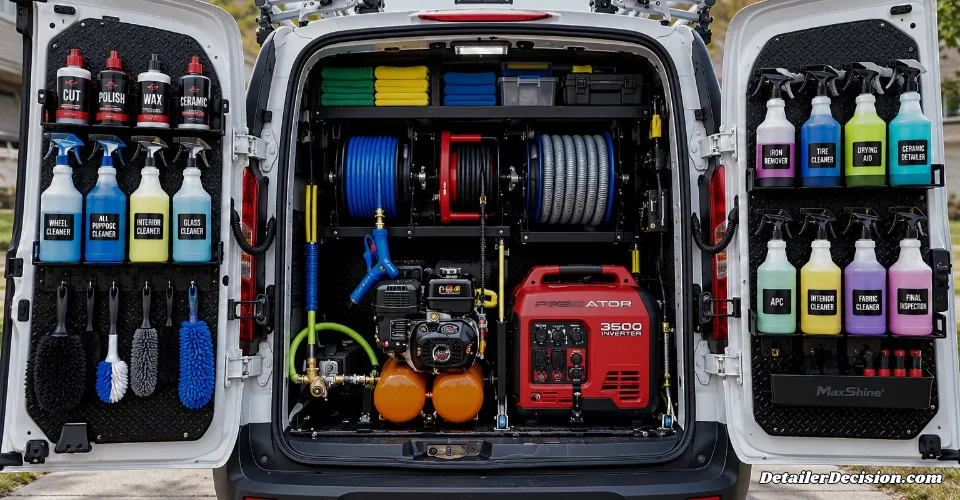
For your first mobile detailing equipment setup, pair a wet/dry vacuum and basic wash tools with the water, power, and secure storage needed to deliver your booked services. If you’re starting with maintenance washes and interior cleaning, you have a clear reason to postpone specialized machines: those services rely on cleaning fundamentals, while extraction and paint correction require additional equipment and skills.
Your mobile detailing setup works as a system. A pressure washer needs a compatible water supply; an electric machine needs enough power; every added component increases vehicle payload. A compact rig becomes expensive when you discover a mismatch after installation.
As you start a mobile detailing business, define your service menu and confirm customer hookups before choosing major equipment. You’ll give your mobile car detailing operation a workable starting point while preserving space and cash for upgrades.
Key Takeaways
- Match your equipment to the services you’re prepared to deliver.
- Verify water supply, electrical demand, and loaded vehicle weight before installation.
- Add specialized machines when your bookings justify their cost and space.
What Equipment Do You Need to Start?
Your essential mobile detailing equipment includes the tools and supplies you need for your initial service menu.
Use your mobile detailing equipment list as a purchasing checklist, then check each item against the work you intend to sell.
| Your service | Your starting equipment | Your purchase condition |
|---|---|---|
| Exterior maintenance | Suitable wash method, buckets, wash mitts, microfiber towels, wheel brush, car shampoo | Confirm water access and wastewater handling |
| Interior maintenance | Wet/dry shop vac, detailing brushes, glass cleaner, compatible all-purpose cleaner | Match attachments to carpets, crevices, and upholstery |
| Dressing and protection | Applicator pads, surface-specific protectants, sealant | Verify material compatibility and application conditions |
| Heavy-soil cleaning | Appropriate degreaser and dedicated brushes | Follow dilution and surface restrictions |
For pressure-washer-based car detailing, a foam cannon is an optional application accessory. You still need a safe contact-wash process and separate tools for wheels.
Add a carpet extractor when you offer wet fabric cleaning. A heated extractor adds heating demand to your power plan; a steam cleaner requires heat-safe surfaces and controlled application.
Reserve a dual-action polisher for services that include paint correction and the necessary inspection lighting, pads, and compounds. Before offering ceramic coating application, account for paint preparation, weather protection, and the curing requirements of your chosen ceramic coatings.
Keep chemical labels and safety data sheets accessible. Use labeled, compatible containers, and follow product directions for dilution and protective equipment.
Build Your Mobile Detailing Setup With Confidence
Find the right pressure washer, vacuum, chemicals, and tools for your budget—without buying what you don't need.
Build My Starter RigHow Do You Match Water and Power to Your Equipment?
You match water and power by checking each machine’s inlet requirements and electrical demand before selecting your tank or generator.
For your mobile car wash setup, confirm whether you’ll use customer utilities or bring your own supplies. Record those arrangements before accepting the job.
- Separate PSI from GPM. PSI describes pressure; GPM describes flow. Compare both when selecting your pressure washer for mobile detailing, then use vehicle-safe nozzles and working distances.
- Verify tank-feed compatibility. Some pressure washers require pressurized inlet water. Check the manual for gravity-feed approval, minimum inlet flow, filtration, and any required supply pump.
- Size water from your process. Measure consumption during practice jobs. Include hose losses and reserve water without assuming a fixed number of cars per tank.
- Calculate simultaneous loads. Add the running watts of equipment you’ll operate together, then accommodate manufacturer-specified starting demand. Check generator continuous output separately from peak output.
- Check the circuit. With an electric pressure washer, confirm receptacle capacity, shared loads, cord rating, and GFCI protection. Unplugged equipment contributes no operating load.
An inverter generator still needs sufficient continuous and starting capacity. A gas pressure washer supplies its own engine power, while your vacuum and other electrical equipment still need a power source.
Operate portable generators outdoors, away from doors, windows, and vents, following manufacturer clearance instructions. Keep exhaust directed away from occupied areas, and protect electrical connections from water.
How Should You Fit and Secure Your Rig?
Lay out your rig to keep it within safe loaded weight limits, with rated restraints and access to frequently used equipment.
Check your vehicle’s payload label and applicable axle ratings before installing a water tank. Water adds approximately 8.34 pounds per U.S. gallon, plus the tank’s weight. Include your passengers, fuel, shelving, chemicals, and every machine in the loaded calculation; confirm the finished configuration on a vehicle scale.
For a detailing trailer, also check tow ratings, trailer capacity, tongue weight, and hitch limits. Have a qualified installer check mounting and weight distribution.
- Keep heavy equipment low. Position it to maintain suitable axle loading and vehicle balance.
- Use rated restraints. Secure tanks and machines to appropriate structural mounting points. Account for liquid movement with transport-suitable tank design.
- Plan hose routing. Place hose reels where you can deploy them without sharp bends or abrasion. Keep walkways clear.
- Separate clean and dirty supplies. Store clean microfiber towels in closed containers and used towels in a separate, ventilated collection container.
- Contain chemicals. Secure bottles upright, provide secondary containment, and follow storage compatibility instructions.
For small, low-profile mobile detailing setups, use removable bins and preserve access to service points. In a pickup truck, protect equipment from weather and theft. In an SUV, isolate chemicals from occupants and keep fuel-powered equipment out of the passenger area.
How Much Should You Budget for Equipment and Upgrades?
Budget for a complete working setup, including installation and operating supplies, before committing money to major machines.
For an existing-vehicle mobile detailing business, rough planning envelopes are $750–$1,500 for a lean launch and $3,500–$6,000 for a more equipped launch. Treat these as preliminary allowances, with current itemized quotes determining your actual total. Your vehicle purchase and a custom build require separate budgeting.
| Your budget scenario | Your planning scope |
|---|---|
| Lean, customer hookups | Core cleaning equipment, hoses, electrical protection, chemicals, towels, secure bins |
| More equipped launch | Higher-cost machines or added water-and-power independence, subject to installation costs |
| Specialized service upgrade | Extraction, polishing, steam, or coating preparation equipment tied to a defined service |
Account for fittings, inlet filters, hose adapters, mounting hardware, extension cords, tax, freight, and replacement consumables. Add towel laundering, equipment maintenance, insurance, and locally required wastewater handling to your car detailing business operating budget.
Your starter rig plan should distinguish equipment purchases from installation costs and cash reserved for ongoing work.
Upgrade against an identified constraint: add extraction for fabric-cleaning bookings, independent utilities for locations without hookups, or polishing equipment for trained correction work. Before purchasing more mobile detailing equipment, verify the remaining payload, storage space, and power capacity.
Build a Rig That Fits Your First Bookings
Your first mobile detailing setup should support a defined service menu with verified utilities and secure transport.
Complete a practice job using the full configuration before your first paid appointment. Record water consumption and check electrical performance under the intended load. Then confirm that every machine remains accessible and every container has a secure travel position.
Use those observations to revise your packing layout and finalize which services your rig can deliver.
Frequently Asked Questions about Mobile Detailing Equipment Setup
How do you choose a water tank shape?
Choose a transport-suitable water tank that fits your available footprint and approved mounting arrangement. Check access to the fill port, outlet, and restraints before committing to a shape.
How do you manage generator noise?
Compare published sound ratings under equivalent test conditions, then check job-site restrictions before scheduling work. Keep the generator in its manufacturer-approved outdoor operating position; never enclose it to reduce noise unless you use an expressly approved system.
How do you handle wastewater at customer locations?
Confirm local wastewater requirements before performing exterior washing. Your mobile detailing setups need containment, recovery, or another permitted disposal method wherever required; keep wash water out of storm drains.
How do you manage drying after using a carpet extractor?
Use controlled solution application and thorough recovery passes, then provide ventilation appropriate to the conditions. Explain drying expectations to your customer and avoid leaving fabric saturated.
How do you prepare to use a dual-action polisher professionally?
Practice your process on suitable test panels and learn to inspect paint condition before selling correction work. Use a test spot to establish the pad-and-product combination, and protect vulnerable trim and edges.
Final Thoughts
A successful mobile detailing equipment setup starts with choosing the right tools for your services, verifying water and power requirements, and keeping your rig safe and organized.
Start with the essentials, avoid unnecessary expenses, and upgrade your equipment as your business grows and customer demand increases.
Disclosure: This page may contain affiliate links. If you purchase through them, we may earn a small commission at no extra cost to you.