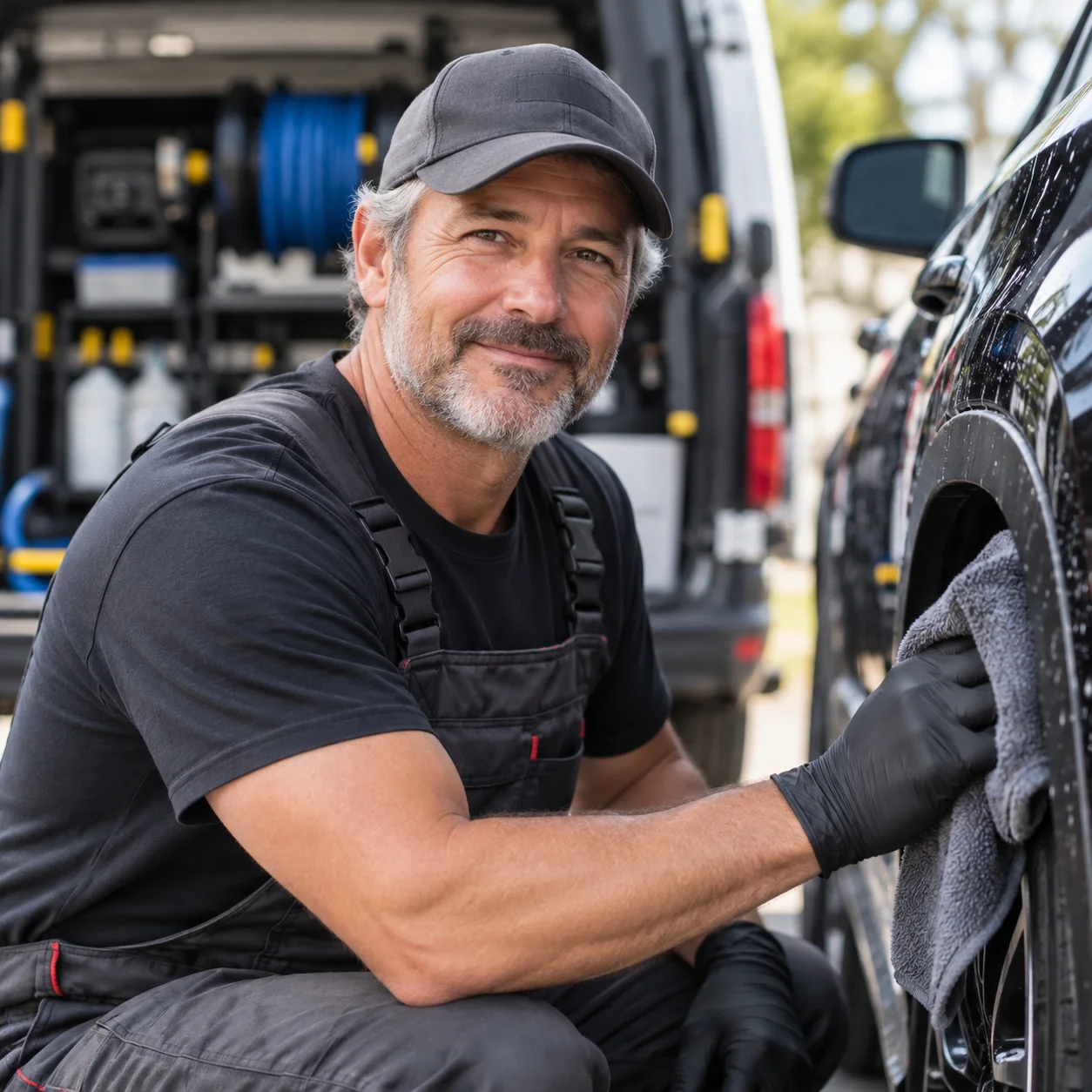

Starting a mobile detailing business doesn't require a fully equipped van, expensive equipment, or a commercial space before your first customer.
But you do need a plan that works beyond your driveway.
The equipment you buy, the services you offer, and the distance you travel between appointments all affect whether your business can make money.
A beginner with an existing vehicle and access to customer water and electricity has very different startup requirements from someone planning a fully self-contained mobile detailing operation.
This guide walks you through starting a mobile detailing business in the United States, from choosing your first services and estimating costs to selecting equipment, meeting business requirements, setting prices, and finding customers.
The goal is simple: Build a business that can complete its first paying jobs without buying equipment it doesn't need.
Quick Answer: What Do You Need to Start a Mobile Detailing Business?
To start a mobile detailing business, you generally need:
- A clearly defined detailing service menu.
- The skills and equipment to perform those services safely.
- Suitable transportation and equipment storage.
- A reliable plan for water and electricity.
- Required business registrations, permits, and insurance.
- A pricing structure that accounts for operating expenses.
- A way for local customers to find and book you.
You don't necessarily need a dedicated detailing van, water tank, generator, or expensive steam cleaner immediately.
Those purchases depend on your business model.
For equipment planning, budgets of $750, $1,000, and $1,500 can be useful starting points for a limited setup. However, these amounts are equipment planning scenarios, not guaranteed prices for launching an entire business.
Your actual startup funding must also cover business expenses, insurance, transportation, supplies, and operating cash.
Step 1: Decide What Mobile Detailing Services You’ll Offer
Before shopping for equipment, decide what customers will actually pay you to do.
This is one of the most important decisions in your mobile detailing business plan.
A beginner offering basic interior cleaning needs different equipment than someone providing paint correction, ceramic coatings, or extensive upholstery restoration.
Start With Services You Can Deliver Consistently
A simple beginner service menu might include:
| Service | Typical Work | Equipment Focus |
|---|---|---|
| Basic interior detail | Vacuuming, surface cleaning, glass | Vacuum, brushes, towels, cleaners |
| Exterior wash | Safe washing, wheels, drying | Wash equipment, towels, chemicals |
| Interior and exterior package | Combined basic services | Both equipment groups |
| Maintenance detail | Routine cleaning of maintained vehicles | Efficient, repeatable tools |
These are service categories, not promises that a basic kit can do every job.
Start with services you've practiced and can perform without damaging customer vehicles.
Advanced paint correction, stain restoration, and ceramic coating applications require additional knowledge, preparation, and equipment.
Practical takeaway: Choose two or three services first. Build your equipment list around those services instead of buying tools and trying to invent services afterward.
Step 2: Research Your Local Market Before Spending Money
A mobile car wash business competes on more than cleaning quality.
Customers also consider convenience, trust, availability, and price.
Start by examining established detailers in your intended service area.
Look at their service menus, published prices, customer reviews, and booking options.
Pay particular attention to complaints.
If customers repeatedly mention late arrivals, unclear pricing, or incomplete work, those complaints may reveal opportunities to differentiate your business.
Define a Practical Service Area
Travel time can quietly consume your profits.
A job that takes two hours to complete may take three hours or more once you include driving, setup, packing, and customer communication.
Start with a manageable service area instead of promising to travel anywhere.
As bookings increase, consider grouping appointments geographically to reduce unnecessary driving.
Your objective isn't simply to reach more customers. It's to serve customers efficiently so each appointment is worthwhile.
Step 3: Calculate Your Mobile Detailing Startup Costs
One of the biggest sources of confusion for beginners is the difference between equipment costs and total startup costs.
They aren't interchangeable.
Your equipment budget covers the tools and supplies needed to perform detailing services.
Your complete business startup budget must also account for legal requirements, insurance, transportation, marketing, and cash reserves.
What Should Your Startup Budget Include?
| Expense Category | Examples |
|---|---|
| Cleaning equipment | Vacuum, washing tools, hoses, brushes |
| Chemicals and supplies | Shampoo, cleaners, towels, applicators |
| Water and power | Customer utilities or independent systems |
| Transportation | Existing vehicle, fuel, storage |
| Business requirements | Registration, permits, insurance |
| Marketing | Website, business listings, promotional materials |
| Operating expenses | Maintenance, software, payment fees |
| Cash reserve | Unexpected costs and slower weeks |
The U.S. Small Business Administration recommends estimating startup expenses before opening and considering the funds needed to support early operations.
That distinction matters for mobile detailers because a low-cost equipment setup doesn't eliminate recurring business expenses.
Can You Start With $750, $1,000, or $1,500?
These three equipment budgets represent different planning constraints.
| Equipment Budget | Main Priority | Important Limitation |
|---|---|---|
| $750 | Support a narrow service menu | Existing equipment may be necessary |
| $1,000 | Establish a practical core workflow | Compatibility and completeness must be checked |
| $1,500 | Improve readiness and reliability | Does not guarantee independent water and power |
A $750 equipment budget may work for a limited service offering if you already own suitable tools and can use permitted customer utilities.
At $1,000, you may have more flexibility for essential accessories, supplies, or better-suited equipment.
A $1,500 budget may improve your options, but it still doesn't guarantee a complete self-contained setup.
These are not fixed product bundles. Actual purchases depend on current prices, service requirements, and equipment compatibility.
For a detailed breakdown, read our Mobile Detailing Startup Cost Guide.
The key question isn't how much equipment you can afford. It's whether your chosen equipment can deliver the services you intend to sell.
Ready to Build Your Starter Rig?
Choose your budget, explore essential equipment, and see an estimated setup cost before you buy.
Build My Starter RigStep 4: Choose the Right Mobile Detailing Business Equipment
Your first equipment purchases should support a complete, repeatable workflow.
A collection of expensive tools isn't useful if you're missing a hose fitting, suitable vacuum attachment, or essential cleaning product.
Essential Exterior Detailing Equipment
Depending on your services and washing method, you may need:
- Suitable washing equipment, such as a hose, pressure washer, or appropriate rinseless-wash setup.
- Wash mitts and microfiber drying towels.
- Buckets and compatible accessories.
- Wheel brushes and cleaning products.
- Automotive shampoo or suitable rinseless products.
- Applicators and surface protection products.
A pressure washer can make some exterior-cleaning workflows more efficient, but it isn't automatically necessary for every mobile detailing operation.
Consider the washing method, water availability, surface condition, and local wastewater requirements before deciding.
Essential Interior Detailing Equipment
A beginner's interior setup may include:
- A suitable wet/dry vacuum.
- Interior detailing brushes.
- Microfiber towels.
- Interior surface cleaners.
- Automotive glass cleaner.
- Crevice attachments.
- Applicators and protective supplies.
For deep fabric cleaning, you may eventually need an extractor.
A steam cleaner may also help in specific applications, provided it's appropriate for the surfaces you're cleaning.
Neither tool should be treated as a mandatory purchase for every beginner.
Don't Forget the Small Accessories
Hoses, extension cords, fittings, spray bottles, storage containers, and extra towels can make or break a setup in practice.
Before purchasing, check that accessories are compatible with your equipment and rated for their intended use.
For electrical tools, follow manufacturer requirements and appropriate electrical safety practices.
A complete first workflow matters more than a complete equipment collection.
Step 5: Decide Whether You Need a Water Tank and Generator
This decision can substantially change your startup costs.
Some mobile detailers use existing water and electrical connections at customer locations.
Others need independent systems.
Neither approach is automatically better.
Option A: Use Customer Water and Electricity
A utility-dependent setup may reduce the need for a generator, water tank, pump, and associated transport equipment.
However, don't assume every customer can provide suitable utilities.
Before accepting an appointment, confirm:
- Whether water is available and permitted for your use.
- Whether an appropriate electrical connection is accessible.
- Whether your equipment can operate safely at the location.
- Whether the work area is suitable.
- How you will contain or manage wash water.
A smaller equipment setup is useful only when it can reliably support the jobs you're booking.
Option B: Build a Self-Contained Mobile Setup
If you cannot depend on customer utilities, you may need:
- A water storage tank.
- A compatible pump and hose system.
- A suitable generator or other power source.
- Secure equipment mounting.
- Appropriate wastewater management equipment.
- A vehicle with sufficient payload capacity.
Water weight is an important constraint.
A 50-gallon supply of water weighs about 417 pounds, not including the tank itself, equipment, passengers, or other cargo.
That weight can be significant in a smaller vehicle.
Similarly, choosing a generator requires more than checking a tool's advertised wattage.
You must consider running loads, starting surge, simultaneous equipment use, and manufacturer requirements.
Who should skip a self-contained setup initially?
Beginners whose customers can reliably provide permitted utilities, whose services don't require independent systems, and whose budgets are limited may be better served by a simpler setup.
What changes that recommendation?
Regular work at locations without utilities, fleet contracts, higher workloads, and changing customer requirements may justify independent water and power equipment.
Don't purchase those systems until you've verified the need and the technical requirements.
Step 6: Handle Registration, Licenses, Insurance, and Wastewater Rules
A mobile detailing business is still a business.
Before taking paid jobs, check the requirements for the state, county, and city where you plan to operate.
Business Registration
Depending on your circumstances, you may operate as a sole proprietor or form another business entity, such as an LLC.
Business structure affects legal, tax, and administrative considerations.
Check whether you need to register a business name, obtain permits, collect sales tax, or secure a federal Employer Identification Number.
Insurance
Working on customer vehicles creates financial risks.
Discuss your activities with an insurance professional and ask about appropriate coverage for:
- General liability.
- Business vehicle use.
- Equipment and business property.
- Customer vehicles in your care, custody, or control.
- Workers' compensation if you hire employees.
Don't assume a personal auto policy or general liability policy automatically covers every detailing-related risk.
Wastewater and Environmental Requirements
Vehicle wash water may contain detergents, oils, dirt, and other contaminants.
Rules governing wastewater collection, discharge, and storm drains vary by location.
Check applicable local and state requirements before operating.
A business that washes vehicles on private driveways may still be subject to wastewater restrictions.
Choosing a different washing method doesn't automatically remove your responsibility to comply with local rules.
Build Your Mobile Detailing Setup With Confidence
Find the right pressure washer, vacuum, chemicals, and tools for your budget—without buying what you don't need.
Build My Starter RigStep 7: Set Prices Based on Actual Job Costs
Pricing is where many promising detailing businesses struggle.
Charging $150 for a job doesn't mean you've earned $150.
You still need to account for chemicals, fuel, travel, payment fees, equipment wear, insurance, and the value of your working time.
A Simple Pricing Example
Consider this hypothetical job:
| Item | Amount |
|---|---|
| Customer price | $180 |
| Supplies and consumables | $15 |
| Travel-related expense | $12 |
| Payment processing | $6 |
| Remaining before fixed costs and labor | $147 |
Now suppose the appointment requires three hours of detailing and one hour of driving, setup, and cleanup.
The $147 remaining represents $36.75 per hour across four hours, before accounting for your labor compensation, fixed overhead, taxes, and other business expenses.
That's not your net profit.
This example shows why you should factor travel time and operating expenses into your pricing decisions.
Calculate Your Break-Even Point
The SBA provides a useful break-even formula:
Break-even jobs = Monthly fixed costs ÷ (Average job price − Variable cost per job)
For example, assume:
- Monthly fixed costs: $600
- Average job price: $180
- Variable costs per job: $30
Your contribution per job is $150.
Under these assumptions, you would need four jobs to cover $600 in fixed costs.
However, this simplified calculation doesn't determine your take-home earnings. If you haven't accounted for owner labor, taxes, or other costs, you'll need more revenue.
Use your own operating numbers as soon as you begin completing paid jobs.
Step 8: Find Your First Mobile Detailing Customers
You don't need a large advertising budget to begin testing demand.
You do need a way for local customers to discover your business, evaluate your work, and contact you.
Set Up Your Google Business Profile
Google offers Business Profiles for eligible businesses that serve customers at their locations.
A mobile detailer may qualify as a service-area business.
Create an accurate profile with your real business information, service areas, operating hours, and contact details.
If you don't serve customers at your business address, follow Google's guidance for hiding that address.
Add genuine photos of your equipment and completed work, with customer permission where appropriate.
A profile can improve your visibility, but it doesn't guarantee immediate rankings or bookings.
Build Trust With Real Work
Before-and-after photos can help potential customers understand your services.
Use genuine photos rather than stock images presented as completed customer jobs.
Ask satisfied customers for honest reviews without offering incentives.
Keep your service descriptions clear so customers know what they're purchasing.
Start With a Manageable Outreach Plan
Potential early customers include:
- Friends and acquaintances who need detailing services.
- Local community members.
- Car enthusiasts.
- Busy professionals.
- Small businesses with company vehicles.
Focus on relevant local relationships instead of contacting large numbers of people indiscriminately.
Track which inquiries become actual bookings.
Ten serious inquiries from nearby customers may be more useful than hundreds of social media views that never produce a job.
Step 9: Create a Repeatable Workflow for Every Appointment
A professional-looking setup isn't enough if your service process is inconsistent.
Create a simple workflow before your schedule becomes busy.
Inquiry → Estimate → Booking → Vehicle inspection → Service → Final inspection → Payment → Follow-up
Before beginning work, document the vehicle's condition and confirm the agreed services.
Photograph existing damage where appropriate, and obtain the customer's permission to keep records.
During the job, follow a consistent cleaning process and use products according to manufacturer instructions.
At completion, inspect your work, confirm customer satisfaction, and record the actual time and supplies used.
These records help you improve future estimates and identify services that take longer than expected.
Step 10: Know When to Upgrade Your Equipment
Equipment upgrades should solve specific business problems.
Buying a larger generator or more expensive vacuum doesn't automatically make your business more profitable.
Consider upgrading when you can identify a recurring limitation.
| Situation | Potential Upgrade |
|---|---|
| Repeated bookings require deep fabric cleaning | Suitable extractor |
| Customers regularly lack utility access | Independent water or power system |
| Existing vacuum slows down interior work | More appropriate vacuum |
| Higher workload causes supply shortages | Additional towels and consumables |
| Storage becomes disorganized | Better vehicle storage system |
Before purchasing, ask three questions:
What problem will this equipment solve?
How often does that problem occur?
Can the expected benefit justify the full purchase and operating cost?
If you cannot answer those questions, the upgrade may be premature.
Build Your Mobile Detailing Equipment Plan Before You Buy
You now have a clearer picture of the services, equipment, and operating conditions involved in starting a mobile detailing business.
The next step is turning those decisions into a practical equipment plan.
DetailerDecision's Starter Rig Builder helps you evaluate equipment needs based on your budget, service preferences, workload, utility access, and existing equipment.
Instead of starting with a shopping cart, start with your actual working conditions.
The tool is designed for equipment planning, not for calculating your entire business startup cost. Product prices, availability, and compatibility may require further verification, and you must budget business costs such as insurance, registration, and taxes separately.
If a result requires further checking, use it as a reason to verify the missing information before purchasing—not as a guarantee the setup is complete.
Your Mobile Detailing Business Startup Checklist
Checklist before accepting your first paid appointment:
- [ ] Choose the services you'll offer initially.
- [ ] Practice your cleaning process and understand product safety.
- [ ] Research local competitors and customer demand.
- [ ] Define your service area.
- [ ] Create a realistic equipment budget.
- [ ] Confirm water and electrical requirements.
- [ ] Verify equipment compatibility and prices.
- [ ] Check vehicle storage and payload limits.
- [ ] Complete required registrations and permits.
- [ ] Arrange appropriate insurance.
- [ ] Verify wastewater and local operating rules.
- [ ] Establish service prices and payment procedures.
- [ ] Create a Google Business Profile if eligible.
- [ ] Prepare a booking and customer communication process.
- [ ] Keep operating cash available for unexpected expenses.
You don't need the most elaborate setup in your market.
You need a setup that supports the services you've promised, meets applicable requirements, and can operate consistently.
Frequently Asked Questions about Start a Mobile Detailing Business
How much money do I need to start a mobile detailing business?
There is no universal startup cost. Equipment budgets of $750, $1,000, or $1,500 can support limited setups under suitable conditions, but they don't cover full startup costs. You must budget separately for insurance, registration, transportation, supplies, and working capital.
Can I start a mobile detailing business with no experience?
You can start learning without professional experience, but you should practice and build the skills you need before charging customers. Learn safe washing techniques, chemical handling, interior surface care, and vehicle inspection procedures.
Do I need a van to start a mobile detailing business?
Not necessarily. An existing suitable vehicle may be enough for a compact equipment setup. Before relying on it, verify cargo space, payload capacity, safe storage, and transportation requirements.
Do I need a pressure washer and generator?
Not every beginner needs both. Your requirements depend on the services you offer, your washing methods, and access to suitable customer utilities. A self-contained setup requires additional power, water, transport, and safety planning.
Is a mobile detailing business profitable?
It can be, but profitability depends on pricing, customer demand, labor time, travel, operating expenses, and business efficiency. Estimate your break-even point and track actual results instead of relying on generalized income claims.
Final Thoughts: Start With a Service You Can Deliver
Starting a mobile detailing business is not primarily about assembling the biggest collection of equipment.
It's about building a service that customers want and that you can deliver reliably.
Choose your first services, understand local requirements, calculate realistic costs, and purchase equipment that supports your actual workflow.
As customer demand grows, use real operating experience to decide which upgrades make sense.
Start with the work. Build the equipment plan around it. Expand when the numbers justify it.
Plan Your Equipment With the Starter Rig Builder →
Disclosure: This page may contain affiliate links. If you purchase through them, we may earn a small commission at no extra cost to you.