Starting a mobile detailing business is more than buying a pressure washer, loading supplies into your vehicle, and finding your first customer.
Before accepting paid jobs, you need to understand which business licenses, registrations, and permits apply to your services.
The confusing part? No single mobile detailing business license covers every location in the United States.
Your requirements may change depending on where your business is based, where you detail vehicles, whether you hire employees, and how you handle wastewater.
This guide explains what to check, where to find reliable answers, and how to avoid common licensing mistakes before launching.
Do You Need a Mobile Detailing Business License?
Quick Answer: You may need a general business license, an industry-specific car wash registration, environmental approvals, or other local permits to operate a mobile detailing business legally.
Requirements depend on your state, city, county, business structure, and services.
The U.S. Small Business Administration (SBA) explains that licensing requirements vary by location and business activity.
Some jurisdictions regulate vehicle cleaning through specific car wash licensing programs. Others use general business registrations or local operating permits.
For example:
- California: Car washing and polishing businesses may be subject to state registration requirements, with important distinctions involving employers and certain excluded activities.
- New York City: Covered mobile, on-demand, and pop-up detailing businesses must obtain a Car Wash License.
- Other locations: Requirements may involve local business authorization, tax registration, wastewater compliance, or other approvals.
The safest approach is to check the requirements for your specific business before advertising or accepting paid work.
For a broader explanation of industry licensing, see our Car Detailing License Guide.
What Licenses and Permits Does a Mobile Detailing Business Need?
Several types of registration or authorization may apply to a mobile detailing operation.
They are not interchangeable.
| Requirement | Purpose | When to Check |
|---|---|---|
| General business license | Authorizes business activity locally | Every startup |
| Car wash/detailing registration | Covers regulated vehicle-cleaning operations | Where specific rules apply |
| DBA registration | Registers a trade name | If using a business name |
| EIN | Federal business tax identification | Based on tax and business requirements |
| Sales tax registration | Supports applicable tax collection and reporting | Based on state rules |
| Wastewater approval | Addresses wash-water collection or disposal | Especially for exterior washing |
| Mobile vendor or zoning permit | Regulates certain operating locations | Based on local ordinances |
| Employer registrations | Addresses hiring and employment obligations | When employing workers |
Not every item is required in every jurisdiction. This table identifies what to investigate, not a universal licensing checklist.
General Business License
Many cities and counties require businesses to obtain a general business license, business tax certificate, or similar authorization.
A mobile business may need to provide its operating address, ownership details, and a description of the services offered.
However, not every jurisdiction issues a universal general business license.
Contact your city or county business licensing office to determine what applies.
Business Registration and EIN
Business registration establishes or records your business under the applicable legal structure.
You might operate as a sole proprietor, form a limited liability company (LLC), or choose another permitted structure.
An LLC is not a substitute for a business license.
Similarly, an Employer Identification Number (EIN) is a federal tax identification number, not permission to perform detailing services.
The IRS issues EINs for free. Some sole proprietors without employees don't need one for federal tax purposes, though an EIN may be useful or required for other legitimate business purposes.
Official resource: IRS — Employer Identification Number.
Sales Tax Registration
Your state may require sales tax registration depending on what you sell and whether your services are taxable.
For example, selling bottles of detailing chemicals or other automotive accessories may create different tax obligations from providing detailing services alone.
Some states also tax certain cleaning services.
Check your state department of revenue or taxation rather than assuming that service businesses never collect sales tax.
Ready to Build Your Starter Rig?
Choose your budget, explore essential equipment, and see an estimated setup cost before you buy.
Build My Starter RigWhy Mobile Detailing Has Different Licensing Challenges
A fixed-location detailing shop usually operates at one established address.
A mobile detailer travels to customers.
That difference creates questions about operating locations, property restrictions, and wastewater handling.
Working in Multiple Cities or Counties
Suppose your business is based in one city, but you accept appointments in two neighboring municipalities.
Your home city's business registration may not automatically cover every location where you provide services.
Depending on local rules, another city may require a separate business license, business tax registration, or other authorization.
Before expanding your service area, check whether the destination municipality regulates businesses operating within its boundaries.
Practical tip: Keep a list of every city or county you serve and record the licensing office's response.
Detailing at Customers' Homes
Working on a customer's driveway does not automatically exempt your business from local regulations.
You may need to consider:
- Whether commercial vehicle washing is permitted at that location
- Where wastewater will flow
- Whether equipment or vehicles obstruct public access
- Applicable noise or operating-hour restrictions
- Property owner or homeowner association rules
Customer permission is useful, but it does not override government regulations.
Working in Apartment Complexes and Commercial Parking Lots
A customer may book a detail at an apartment complex, office building, or shopping center.
Before arriving, confirm whether the property owner or manager permits commercial detailing.
Some locations may restrict water use, vehicle washing, chemical storage, or equipment operation.
A mobile detailing business should establish these conditions before confirming an appointment, not after unloading its equipment.
Mobile Detailing License Requirements: California and New York City
California and New York City provide useful examples of why location-specific research matters.
California: Car Washing and Polishing Registration
California's Department of Industrial Relations administers registration requirements for businesses that wash and polish cars.
The regulated activities include washing, cleaning, drying, polishing, detailing, and other cosmetic vehicle care.
However, the rules also define covered employers and identify exclusions.
A solo detailer who doesn't employ anyone should confirm how the requirements apply to their operation.
For covered businesses, California's published annual registration and assessment fees total $300 per branch location.
Other conditions, including documentation and bonding requirements, may apply.
Official resource: California Department of Industrial Relations — Car Washing and Polishing.
New York City: Car Wash License
New York City's Department of Consumer and Worker Protection requires a Car Wash License for covered businesses that clean vehicles.
Importantly, this includes mobile, on-demand, and pop-up services.
The published fee for a full two-year license term is $550, although the actual application fee depends on the licensing cycle.
Applicants may also need supporting documentation, tax information, insurance records, and a surety bond.
New York City's requirements should not be confused with a statewide licensing rule applying identically to every municipality in New York.
Official resource: NYC Car Wash License Application Checklist.
What About Other States?
Don't assume your business is exempt simply because your state doesn't issue a license specifically called a mobile car detailing license.
You may still need local operating authorization, tax registration, environmental compliance, or other permits.
Start with your state government, then check the cities and counties where you plan to perform work.
Do Mobile Detailers Need a Wastewater Permit?
This is one of the most important compliance questions for anyone offering exterior washing.
Vehicle wash water can contain dirt, detergents, oils, metals, and other pollutants.
When contaminated water enters a storm drain, it may reach waterways without passing through a wastewater treatment system.
The Environmental Protection Agency (EPA) provides guidance on reducing vehicle-washing pollution, including containing wash water and avoiding direct discharges into storm drains.
Whether you need a specific permit depends on the applicable federal, state, and local rules and your discharge arrangements.
How Your Services Affect Wastewater Requirements
| Detailing Service | Main Compliance Question |
|---|---|
| Interior vacuuming | Are there restrictions on the work location or waste disposal? |
| Interior shampooing | How will you collect and dispose of wastewater from the extraction? |
| Exterior hand washing | Where will the wash water drain? |
| Pressure washing | Is runoff containment or recovery required? |
| Rinseless or waterless washing | What waste, residue, or runoff still needs management? |
| Engine-bay cleaning | Could oils or other contaminants enter drainage systems? |
The table is a planning framework, not a legal classification of these services.
A rinseless or waterless method may reduce water use, but it does not automatically exempt the operator from environmental requirements.
Likewise, using biodegradable chemicals does not automatically make wastewater discharge legal.
Before purchasing a water tank or pressure washer, ask your local stormwater authority or wastewater department:
- Can you wash commercial vehicles at customers' properties?
- Must you contain or recover wash water?
- Where can you legally discharge collected wastewater?
- Do you need specific permits, inspections, or approved disposal arrangements?
Practical takeaway: Your wastewater plan should influence your equipment purchases, not become an afterthought.
How to Get a Mobile Detailing Business License: 7 Steps
Make licensing research more manageable by following a consistent process.
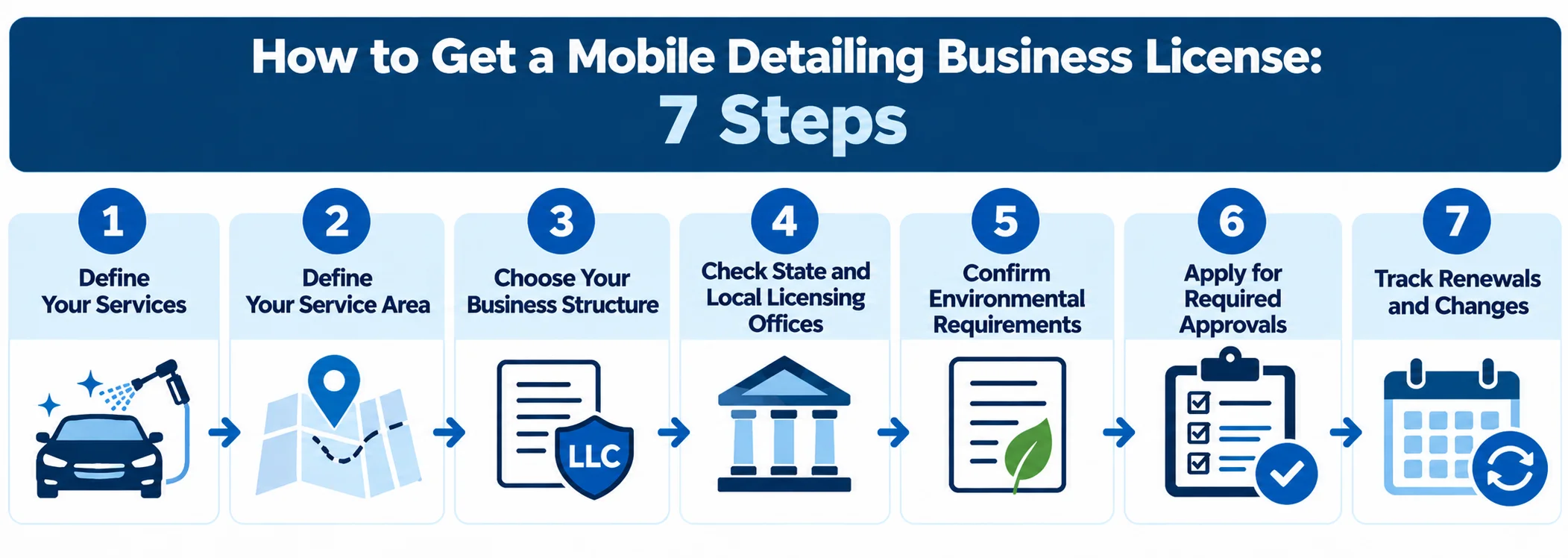
Step 1: Define Your Services
Write down the services you plan to offer.
For example, interior-only detailing may create different wastewater concerns from pressure washing or engine-bay cleaning.
Your service list helps licensing officials identify applicable regulations.
Step 2: Define Your Service Area
Identify your home business address and every city or county where you intend to accept appointments.
Check whether each jurisdiction requires separate business authorization.
Do not assume one license automatically covers your entire service area.
Step 3: Choose Your Business Structure
Decide whether you will operate as a sole proprietor, LLC, or another business entity.
Your choice affects registration, taxes, liability, and administrative obligations.
Consider professional legal or tax advice if you are uncertain which structure fits your situation.
Step 4: Check State and Local Licensing Offices
Start with the appropriate state business agency or Secretary of State.
Then contact your city or county licensing office.
Explain that you will travel to customers' locations to provide vehicle cleaning and detailing services.
Ask which licenses, registrations, and permits apply.
Step 5: Confirm Environmental Requirements
Contact the relevant stormwater or wastewater authority.
Describe your planned washing methods, chemicals, water supply, and wastewater collection system.
Ask for written guidance or a link to the applicable rules when possible.
Step 6: Apply for Required Approvals
Complete the required applications and provide supporting documentation.
Depending on the jurisdiction, this may include business information, tax records, insurance documentation, or other materials.
Do not assume submitting an application means you are authorized to begin operating.
Confirm when approval becomes effective.
Step 7: Track Renewals and Changes
Store copies of licenses, permits, registrations, and relevant government correspondence.
Record expiration dates and renewal requirements.
Recheck your obligations when you hire employees, add new services, or expand into another jurisdiction.
How Much Does a Mobile Detailing Business License Cost?
No reliable nationwide price exists for a mobile detailing business license.
Costs depend on the issuing government, business structure, location, and activities.
For example, the published California car washing and polishing registration and assessment fees total $300 annually per branch location for covered businesses.
New York City's standard full two-year Car Wash License fee is $550, with prorated application fees depending on timing.
Neither figure represents a national average.
Other expenses may include business entity filing fees, trade-name registration, bonding, insurance, or environmental compliance equipment.
Budget for More Than the License Fee
A beginner's mobile detailing business plan should separate licensing costs from equipment purchases and operating expenses.
| Budget Category | What to Include |
|---|---|
| Business setup | Applicable registration and filing fees |
| Licenses and permits | Required local or industry-specific approvals |
| Insurance | Appropriate coverage and premiums |
| Environmental compliance | Wastewater collection or disposal equipment if needed |
| Detailing equipment | Vacuum, washer, tools, and accessories |
| Supplies | Chemicals, towels, brushes, and consumables |
| Operations | Fuel, payment processing, and marketing |
The goal is to understand the full startup commitment before investing heavily in equipment.
For a practical equipment breakdown, see our Mobile Detailing Equipment List.
Do You Need an LLC to Start a Mobile Detailing Business?
Not necessarily.
A sole proprietorship may be a legally available starting structure.
An LLC creates a separate legal entity and can provide liability protection, subject to applicable law and circumstances.
However, an LLC does not eliminate every potential personal liability, and it does not replace business insurance.
It also does not automatically satisfy local licensing requirements.
Choose your business structure based on your financial, legal, and operational needs rather than assuming every mobile detailer must form an LLC immediately.
Do You Need Insurance for Mobile Detailing?
Insurance and licensing are different, but both deserve attention before your first paid job.
A business license doesn't automatically protect you if you damage a customer's vehicle.
Depending on your operation, relevant coverage may include:
- General liability: Addresses certain third-party injury and property-damage claims, subject to policy terms.
- Garagekeepers or other customer-vehicle coverage: May address damage to vehicles in your care, depending on the policy and the work performed.
- Commercial auto: Covers specified risks associated with business vehicle use.
- Tools and equipment coverage: May protect portable equipment against covered losses.
- Workers' compensation: May be required when you employ workers.
Do not assume general liability insurance covers every scratch, stain, or electronic failure that could occur while detailing a customer's vehicle.
Ask an insurance professional specifically about mobile detailing activities, care-custody-control exclusions, and coverage for damage during active work.
Read the policy terms and exclusions before relying on the coverage.
Can You Detail Cars Without a License as a Side Hustle?
Possibly, but doing only a few jobs per month does not automatically exempt you from business regulations.
Whether you work full-time, part-time, or occasionally, your obligations depend on local law and the nature of your activities.
For example, detailing vehicles for friends and family may still be considered a business activity if you regularly accept payment.
No universal federal income threshold eliminates all mobile detailing licensing requirements.
Business licensing and income-tax reporting are also separate issues.
Before accepting paid appointments, check local rules rather than relying on advice that you can wait until your business reaches a particular revenue level.
Common Mobile Detailing Licensing Mistakes
Several avoidable mistakes can cause delays or create unnecessary risk.
Assuming one license covers every city. Your service area may cross multiple jurisdictions. Check each applicable local authority.
Confusing an LLC with a business license. Forming a company does not automatically authorize all business activities.
Ignoring wastewater disposal. A legal business registration does not give you unrestricted permission to discharge wash water.
Assuming customer permission is enough. Property owners may approve a detailing appointment, but local operating and environmental restrictions still apply.
Treating insurance as automatic coverage. Different policies cover different risks, and exclusions matter.
Forgetting renewals. Some registrations and permits expire. Keep a compliance calendar and review requirements when your operation changes.
Plan Your Equipment Budget
After confirming your licensing requirements, use our free Starter Rig Builder to explore equipment recommendations for different startup budgets.
Build My Starter RigMobile Detailing Business License Checklist
Use this checklist before accepting your first paying customer.
- Define the detailing services you will offer.
- Identify your home business address and intended service area.
- Choose and register your business structure where required.
- Check state, county, and city licensing requirements.
- Confirm whether car wash-specific registration applies.
- Check DBA and tax registration obligations.
- Determine whether you need an EIN.
- Verify wastewater collection and disposal rules.
- Check parking, property, and mobile operation restrictions.
- Review appropriate business insurance coverage.
- Obtain required approvals before beginning regulated activities.
- Save documentation and record renewal dates.
This checklist helps organize your research. It does not replace instructions from the government agencies responsible for your business location.
What Should You Do After Confirming Your License Requirements?
Once you understand your legal obligations, focus on building a setup that can deliver your planned services safely and consistently.
You don't need to buy every professional detailing machine right away.
Start with a manageable service menu, choose compatible equipment, and allow money for supplies, insurance, and operating expenses.
Our Start a Mobile Detailing Business Guide explains the broader startup process.
If you want to develop your skills before working on customers' vehicles, explore our Auto Detailing Training Guide.
Plan Your Mobile Detailing Equipment Budget
After confirming your licensing and environmental requirements, use the free Starter Rig Builder to explore equipment recommendations for different startup budgets.
Compare your options before committing money to a setup that may not fit your services or working conditions.
The tool helps with equipment planning. It does not determine legal compliance or replace government licensing guidance.
Frequently Asked Questions
Do I need a mobile detailing business license in every state?
Not necessarily a license with that exact name. State and local governments use different licensing and registration systems. Check the requirements for every jurisdiction where you intend to operate.
Can I start a mobile detailing business from home?
Possibly. You may be able to use your home as a business base, but zoning, home-occupation rules, storage restrictions, and other local requirements may apply.
Do I need a license to detail cars in customers' driveways?
You may need business authorization and other permits, depending on the location and services. Working on private property does not automatically exempt you from local business or environmental regulations.
Is a mobile car detailing license the same as an LLC?
No. An LLC is a business entity structure. A license or permit authorizes particular activities under applicable government rules.
Do I need a certification to start a mobile detailing business?
Professional detailing certification is generally a voluntary credential rather than a universal government licensing requirement. Training can improve your skills, but certification does not replace required business approvals.
Final Thoughts
Getting a mobile detailing business license isn't necessarily complicated, but requirements vary by location.
The most useful approach is to answer three questions before launching:
Where is your business based? Where will you perform detailing services? What services will you offer?
Those answers help you determine which licensing offices, tax agencies, and environmental authorities to contact.
Once you understand your legal requirements, you can build an equipment setup and service plan around what you're allowed and prepared to do.
Regulatory information reviewed in October 2026. Requirements, fees, and application procedures may change. Confirm current rules with the relevant government agencies before operating. This article provides general educational information, not legal or tax advice.