You don't need to spend thousands of dollars at a detailing school to start learning how to clean cars professionally. But watching a few videos and buying a pressure washer won't automatically prepare you to take on paying customers.
The right auto detailing training depends on what you already know, which services you want to offer, and how much money you can afford to invest before launching your business.
Some beginners can build their skills through free tutorials, structured practice, and guidance from experienced detailers. Others benefit from hands-on instruction, especially when learning paint correction, machine polishing, or ceramic coating application.
This guide explains the main training options, how certification works, what detailing schools teach, and how to decide whether a paid course is worth it.
Quick Answer: What Is the Best Auto Detailing Training for Beginners?
For most beginners, start with basic interior and exterior detailing, practice on vehicles you have permission to work on, and develop a repeatable cleaning process before investing in advanced courses.
There are four common ways to learn:
| Training Option | Best For | Main Advantage | Main Limitation |
|---|---|---|---|
| Free tutorials and self-study | Beginners exploring detailing | Low learning cost and flexible schedule | No direct instructor feedback |
| Online detailing courses | Beginners wanting structured lessons | Learn at your own pace | Limited hands-on assessment |
| In-person detailing schools | Beginners seeking supervised practice | Direct instruction and feedback | Tuition, travel, and time commitments |
| Professional certification | Detailers seeking formal recognition | Demonstrates assessed knowledge or skills | Certification alone does not guarantee proficiency or customers |
Our recommendation: Start by identifying the services you want to offer. Then choose training that addresses the specific skills you need.
A beginner planning basic mobile interior cleaning may not need the same training as someone preparing to offer multi-stage paint correction.
What Do You Learn in Auto Detailing Training?
Professional automotive detailing training covers much more than washing a vehicle and applying wax.
A useful program should teach you to recognize different surfaces, choose the right chemicals, operate equipment safely, and follow a consistent workflow.
Exterior Detailing Fundamentals
Exterior training typically includes safe washing methods, wheel and tire cleaning, drying techniques, and paint protection.
You should understand how to:
- Inspect a vehicle before beginning work.
- Select cleaning products appropriate for each surface.
- Reduce the risk of scratching paint during washing.
- Clean wheels and tires without damaging sensitive finishes.
- Remove bonded contamination using suitable methods.
- Apply waxes, sealants, or other protection products correctly.
Knowing when not to use an aggressive chemical or cleaning method is as important as knowing how to remove dirt.
Interior Detailing Fundamentals
Interior work introduces different materials and cleaning challenges.
Training should address carpets, fabric upholstery, leather, vinyl, plastics, glass, and delicate interior components.
For example, a heavily soiled fabric seat may require a different process from a lightly dusty leather seat.
Beginners should learn to inspect materials, test products in inconspicuous areas, control moisture, and recognize situations where aggressive cleaning could cause damage.
Equipment and Chemical Safety
Equipment training should explain how to use pressure washers, vacuums, extractors, brushes, sprayers, and other tools.
Chemical training is equally important.
The U.S. Occupational Safety and Health Administration (OSHA) provides guidance on cleaning chemical hazards, including proper labeling, protective equipment, ventilation, and Safety Data Sheets.
If you plan to employ workers, you also need to address applicable workplace safety and hazard communication requirements.
Official resource: OSHA — Protecting Workers Who Use Cleaning Chemicals
Paint Correction and Ceramic Coating
Advanced automotive detailing training may include machine polishing, identifying paint defects, using polishing pads and compounds, evaluating paint thickness, and preparing coatings.
These services require more controlled practice than routine maintenance washing.
Using an unsuitable pad, polish, or technique can damage a vehicle's finish. A short demonstration is not the same as being able to perform the procedure consistently.
Beginners should build foundational skills before accepting advanced correction work.
Ready to Build Your Starter Rig?
Choose your budget, explore essential equipment, and see an estimated setup cost before you buy.
Build My Starter RigOnline Auto Detailing Training vs. Hands-On Schools
Both online and in-person training can be useful. The best choice depends on the skill you want to learn.
Online Auto Detailing Training
Online courses are particularly useful for understanding equipment, cleaning sequences, product selection, and business fundamentals.
They let you review lessons repeatedly and study from home.
However, video lessons cannot fully replace an experienced instructor who can watch your technique and correct mistakes.
This matters most when learning skills such as machine polishing or working on delicate vehicle surfaces.
Before paying for an online course, check whether it includes practical demonstrations, instructor feedback, updated materials, and clear learning objectives.
Hands-On Detailing Schools
In-person detailing schools let you practice with equipment under supervision.
Some programs combine classroom instruction with actual vehicle work.
For example, Detail King describes a three-day program covering business operations, exterior detailing, and interior detailing. Auto Detail School advertises a five-day program covering technical skills and business topics.
These programs may suit beginners who want structured instruction or experienced detailers who need help with specific techniques.
However, a longer course is not automatically a better course.
Ask how much time students spend operating equipment themselves rather than watching demonstrations.
Which Format Should You Choose?
Choose online learning if you are building foundational knowledge, need flexibility, and can arrange safe practical experience separately.
Consider hands-on training if you need direct feedback, are struggling with a particular technique, or plan to offer higher-risk services.
A combination of both may be the most practical route.
Detailing Schools Worth Comparing
No single detailing school is automatically best for every beginner.
The following providers are useful starting points for researching different training formats.
These are examples of published programs, not independently tested or ranked schools.
| Training Provider | Published Training Focus | What to Check Before Enrolling |
|---|---|---|
| Detail King | Three-day business, exterior, and interior training | Current tuition, dates, hands-on time |
| Auto Detail School | Five-day technical and business training | Practical assessments, instructor access, total cost |
| Smart Detailing University | Multi-day detailing and business instruction | Current availability and updated course details |
| SNS Auto Supply | Specialized detailing and marketing classes | Whether the specific class matches your needs |
Detail King
Detail King's published program separates training into business education, exterior detailing, and interior detailing.
Its curriculum covers pricing services, marketing, washing, polishing, extraction, and interior reconditioning.
That combination may appeal to beginners who want to understand both the technical work and the business side.
Website: Detail King Training
Ding King Auto Appearance School
Auto Detail School advertises a five-day training program covering paint correction, interior and exterior detailing, chemical use, and business management.
Its published description emphasizes workshop conditions.
Before enrolling, confirm how much supervised practice each student receives and the exact qualifications awarded.
Website: Ding King Auto Appearance School
Smart Detailing University
Smart Detailing University (SDU), associated with Chemical Guys, has published a five-day training program covering detailing procedures, equipment, chemicals, and business topics.
However, the referenced course page includes an older schedule. Prospective students should confirm whether the program is still offered and whether the curriculum has changed.
Website: Smart Detailing University Course Information
SNS Auto Supply
SNS Auto Supply offers detailing education, including business marketing instruction.
Its training catalog may help people looking for shorter classes instead of a comprehensive multi-day program.
Check the current course listing carefully, because available topics can change.
Website: SNS Auto Supply Training Classes
Questions to Ask Any Detailing School
Before paying tuition, ask:
- How much time will I spend working directly on vehicles?
- What is the student-to-instructor ratio?
- Are tools, chemicals, and practice vehicles provided?
- Does the course teach general methods or mainly promote one product brand?
- Will an instructor evaluate my work and explain mistakes?
- What certificate or credential will I receive?
- What is the refund policy, and are there additional costs?
A school should clearly explain what students will learn and be able to demonstrate by the end of the course.
Do You Need Auto Detailing Certification?
You generally don't need a private professional detailing certificate to start learning or offering standard detailing services in the United States.
However, that does not mean you can operate a business without meeting local legal requirements.
Professional certification and government licensing serve different purposes.
Certification shows you completed a course or passed an industry assessment. Business licenses and permits concern whether you may legally operate in a particular jurisdiction.
International Detailing Association Certification
The International Detailing Association (IDA) offers an industry certification program.
Its first phase awards the Certified Detailer (CD) designation after candidates pass ten knowledge examinations.
The examinations cover subjects including equipment, chemicals, interior detailing, paint correction and protection, safety, and detailing terminology.
Candidates must achieve at least 80% on each examination.
The second phase, Skills Validated (SV), involves hands-on assessments. Candidates who meet the requirements can earn the CD-SV designation.
According to the IDA's published certification information, the complete Phase I examination package costs:
| Candidate Type | Published Phase I Exam Package |
|---|---|
| IDA member | $200 |
| Non-member | $400 |
These are examination-package prices, not the full cost of professional training. Membership fees, practical assessment fees, and other expenses may apply.
The IDA also requires continuing education to maintain certification.
Official resource: International Detailing Association — Certification
Is Online Certification Enough?
Online certification can validate technical knowledge.
However, not every online certificate represents the same achievement.
A course-completion certificate may simply confirm participation. A knowledge-based examination evaluates understanding. A practical assessment evaluates demonstrated ability.
The IDA specifically distinguishes its knowledge examinations from hands-on skills validation.
If you are researching auto detailing certification classes online, find out exactly what the certificate proves before paying.
Certification vs. Business Licensing
A detailing certificate does not replace required business registration, permits, insurance, or environmental compliance.
Requirements vary by location and operating model.
A mobile operator may need to consider local business licensing, wastewater rules, and restrictions on where services can be performed.
For more information, read our Car Detailing License Guide.
How Much Does Auto Detailing Training Cost?
Training costs depend on the provider, course format, subject matter, and whether travel is required.
A free tutorial may cost nothing to access, but practicing still requires equipment and materials.
A paid online course may eliminate travel expenses, while an in-person school may require lodging, transportation, and time away from other work.
Instead of comparing tuition alone, calculate your complete training investment.
The Real Cost of a Training Program
| Expense | What to Include |
|---|---|
| Tuition | Course enrollment and instruction |
| Travel | Transportation to the training location |
| Accommodation | Hotel or other lodging |
| Meals | Food not included in tuition |
| Practice supplies | Chemicals, towels, pads, and other consumables |
| Equipment | Tools needed to continue practicing |
| Certification | Separate examination or assessment fees |
| Lost working time | Income or opportunities given up while attending |
Consider a hypothetical situation.
Two schools teach similar introductory skills. One is local, while the other requires several nights away from home.
Even if the distant school charges less tuition, transportation and lodging could make it more expensive overall.
The better investment is not necessarily the cheaper advertised course. It is the one that provides useful instruction at a total cost you can justify.
Should You Spend Money on Training or Equipment First?
The answer depends on what is preventing you from making progress.
If you lack basic equipment, a practical starter setup may let you begin learning through supervised or controlled practice.
If you already own suitable equipment but repeatedly struggle with technique, targeted instruction may be more valuable.
If you want to offer advanced correction services, professional feedback may be more valuable than buying another machine or chemical.
A useful rule: Spend money on the limitation that is currently preventing you from working safely and consistently.
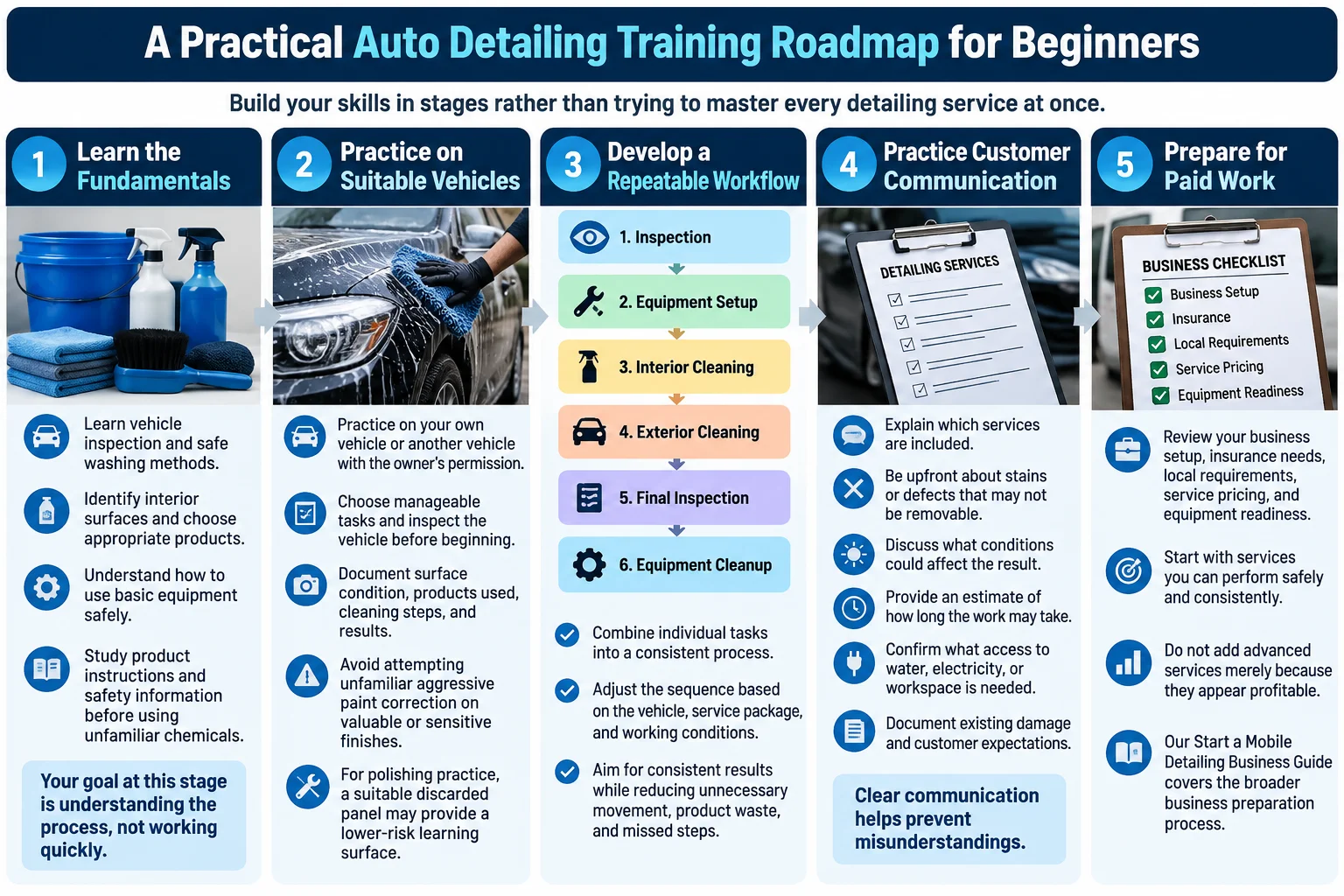
A Practical Auto Detailing Training Roadmap for Beginners
Rather than trying to master every detailing service immediately, build your skills in stages.
Stage 1: Learn the Fundamentals
Start with vehicle inspection, safe washing, identifying interior surfaces, handling chemicals, and operating basic equipment.
Study product instructions and safety information before using unfamiliar chemicals.
At this stage, your goal is understanding the process, not working quickly.
Stage 2: Practice on Suitable Vehicles
Practice on your own vehicle or another vehicle with the owner's permission.
Choose manageable tasks, and inspect the vehicle before you begin.
Document surface condition, products used, cleaning steps, and results.
Avoid attempting unfamiliar aggressive paint correction on valuable or sensitive finishes.
For polishing practice, a suitable discarded panel may provide a lower-risk learning surface.
Stage 3: Develop a Repeatable Workflow
Once you understand individual tasks, combine them into a consistent process.
For example:
Inspection → Equipment Setup → Interior Cleaning → Exterior Cleaning → Final Inspection → Equipment Cleanup
The sequence may change depending on the vehicle, service package, and working conditions.
Your goal is to produce consistent results while reducing unnecessary movement, product waste, and missed steps.
Stage 4: Practice Customer Communication
Technical skills are only one part of running a detailing business.
You should also be able to explain:
- Which services are included.
- Which stains or defects may not be removable.
- What conditions could affect the result.
- How long the work may take.
- What access to water, electricity, or workspace is needed.
- How to document existing damage and customer expectations.
Clear communication helps prevent misunderstandings.
Stage 5: Prepare for Paid Work
Before accepting customers, review your business setup, insurance needs, local requirements, service pricing, and equipment readiness.
Start with services you can perform safely and consistently.
Do not add advanced services merely because they appear profitable.
Our Start a Mobile Detailing Business Guide covers the broader business preparation process.
Plan Your Equipment Budget
After confirming your licensing requirements, use our free Starter Rig Builder to explore equipment recommendations for different startup budgets.
Build My Starter RigAre You Ready to Detail Customers’ Cars?
Completing a course is not the same as being ready to deliver a professional service independently.
Use the following checklist as a self-assessment.
Beginner Detailing Readiness Checklist
- I can inspect a vehicle and identify obvious pre-existing damage.
- I understand which products suit common interior and exterior surfaces.
- I can follow product labels, dilution instructions, and safety precautions.
- I can operate my basic equipment safely.
- I have practiced a complete cleaning workflow.
- I know when to stop to avoid damaging a surface.
- I can explain what my service includes and excludes.
- I can estimate the supplies and equipment required for a job.
- I understand the business and legal requirements relevant to my location.
- I can consistently deliver the services I plan to sell.
This is a practical planning checklist, not an official certification test or guarantee of competence.
If you cannot confidently complete several items, identify the missing skills and focus your next training sessions on those areas.
Common Auto Detailing Training Mistakes
Paying for Advanced Training Too Early
Paint correction and ceramic coating courses can be valuable, but beginners may benefit more from mastering basic washing and interior cleaning first.
Advanced instruction becomes more useful once you understand the surfaces, products, and equipment involved.
Confusing a Certificate With Professional Competence
A certificate can document a completed program or passed assessment.
It cannot guarantee you'll perform every future job correctly.
Keep practicing, review mistakes, and learn new techniques.
Choosing a School Based Only on Marketing
Promotional language, attractive facilities, and graduate testimonials don't show how much hands-on instruction you will receive.
Compare course outlines, assessment methods, instructor access, and total costs.
Buying Too Much Equipment Before Choosing Services
A beginner does not necessarily need a generator, extractor, polisher, and extensive chemical collection on day one.
Your equipment should match the services you are trained to provide.
Buying specialized tools before you develop the skills to use them can tie up money you'd rather use elsewhere.
Ignoring Business Skills
Learning how to clean vehicles is essential, but operating a service business also requires pricing, scheduling, customer communication, expense tracking, and legal preparation.
Technical training and business preparation should develop together.
Turning Your Training Into a Mobile Detailing Business
Once you can consistently perform basic services, the next question is how to build a workable mobile setup.
Your training should help determine which equipment you actually need.
For example, someone focused on maintenance washes and basic interior cleaning may need different equipment than someone offering carpet extraction or machine polishing.
Before buying equipment, answer four questions:
- Which services am I qualified and prepared to offer?
- Will I have reliable access to customer electricity and water?
- How much equipment can my vehicle safely carry?
- What equipment budget do I have after other business expenses?
These decisions affect your choice of pressure washer, vacuum, chemicals, storage, and optional accessories.
Our Mobile Detailing Startup Kit Guide explains how to prioritize essential equipment.
Plan Your Starter Equipment Around Your Skills
If you're ready to move from training to equipment planning, try the free Starter Rig Builder.
It helps you explore starter equipment recommendations based on your budget and setup requirements.
You can compare the suggested equipment with the services you plan to offer, then review compatibility, pricing, and anything that still needs verification before you buy.
Training teaches you what you need to do. Equipment planning helps you prepare.
Frequently Asked Questions about Auto Detailing Training
Can I learn auto detailing without going to school?
Yes. You can learn the fundamentals through tutorials, product documentation, practice, and guidance from experienced detailers.
However, self-study requires discipline, and advanced techniques may benefit from direct feedback from professionals.
How long does it take to learn auto detailing?
There is no universal timeline.
Learning basic washing and interior cleaning differs from becoming consistently proficient in paint correction or other advanced services.
Progress depends on practice quality, service complexity, and feedback.
Are online auto detailing certification classes legitimate?
Some online programs provide useful instruction or formal knowledge assessments.
However, certificates vary in meaning. Check the issuing organization, assessment requirements, and whether they evaluate practical skills.
Do I need certification to start a mobile detailing business?
A private detailing certification is generally not a universal legal requirement for ordinary mobile detailing services in the United States.
You may still need applicable business licenses, permits, insurance, and environmental compliance measures. Verify requirements in the areas where you plan to operate.
Is paying for a detailing school worth it?
It can be worthwhile if the course teaches skills you need, provides meaningful hands-on practice, and fits your budget.
If you only need introductory knowledge, free resources and controlled practice may be a more economical starting point.
For specialized work, targeted hands-on instruction may provide greater value.
Final Thoughts: Choose Training Based on the Work You Want to Do
The best auto detailing training is not necessarily the most expensive course or the one offering the most certificates.
It is the training that helps you develop the skills you actually need for the services you plan to provide.
Start with safe cleaning fundamentals. Practice deliberately. Seek professional instruction when you need feedback or want to expand into more complex services.
Treat certification as a way to demonstrate assessed knowledge or skills, not as a substitute for practical competence or business compliance.
When you are ready to build your mobile setup, choose equipment that supports the work you can do confidently.
That approach gives you a more useful foundation than buying advanced equipment or enrolling in expensive training before you know what you need.
Disclosure: This page may contain affiliate links. If you purchase through them, we may earn a small commission at no extra cost to you.