Do you need car detailing certification to start working as a professional detailer?
In most U.S. cases, you don't need a private detailing certification to work as a professional detailer. However, certification can help you document your knowledge, build professional skills, and show your commitment to customers.
The challenge is deciding which certification is worth paying for.
Some programs test what you already know. Others teach practical skills through detailing classes. Some manufacturers also offer specialized training for products like ceramic coatings.
These credentials serve different purposes, and none automatically replaces the business licenses or permits you may need.
This guide explains how car detailing certification works, what the International Detailing Association (IDA) requires, how much certification can cost, and how to choose a training path that fits your experience and business goals.
Do You Need Car Detailing Certification?
No general federal professional certification is required to perform ordinary car detailing in the United States. Private detailing certifications are generally voluntary credentials, not government-issued occupational licenses.
That means you don't necessarily need to become a certified detailer to offer basic interior cleaning, exterior washing, or other routine detailing services.
However, that does not mean you can operate a business without meeting local requirements.
You may still need business registration, local permits, appropriate insurance, or environmental compliance measures depending on where and how you operate.
Certification vs. Business License: What's the Difference?
| Requirement | Purpose | Generally mandatory? |
|---|---|---|
| Car detailing certification | Demonstrates industry knowledge or skills | No, generally voluntary |
| Detailing training certificate | Documents completion of a training program | No, generally voluntary |
| Business license or permit | Authorizes regulated business activities | Depends on location and operations |
| Business registration | Establishes or registers a business where required | Depends on business structure and jurisdiction |
| Specialized product certification | Documents manufacturer-specific training or authorization | Depends on the product program or service arrangement |
For example, someone who earns an IDA Certified Detailer credential may still need a city business license to operate a mobile detailing service.
Similarly, a business owner with the appropriate permits may legally offer ordinary detailing services without holding a private industry certification, subject to applicable local rules.
The U.S. Small Business Administration explains that business licensing and permitting requirements vary by business activity and location.
For a detailed explanation, see our Car Detailing License Guide or Mobile Detailing Business License Guide.
What Types of Car Detailing Certification Are Available?
Not every detailing certificate represents the same level of training, assessment, or professional recognition.
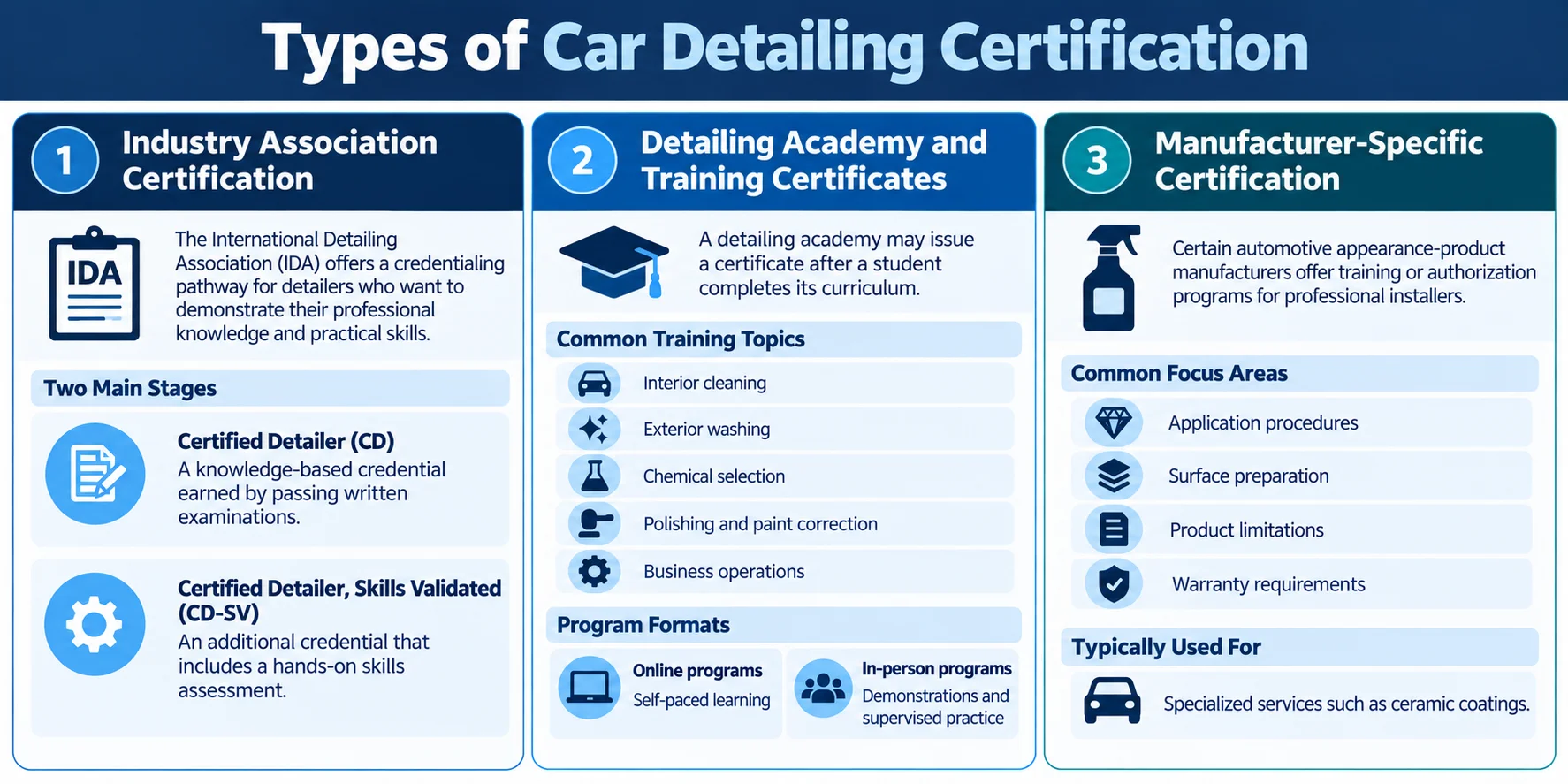
Most options fall into three categories.
1. Industry Association Certification
The International Detailing Association offers a credentialing pathway for detailers who want to demonstrate their professional knowledge and practical skills.
Its certification program has two main stages:
- Certified Detailer (CD): A knowledge-based credential earned by passing written examinations.
- Certified Detailer, Skills Validated (CD-SV): An additional credential that includes a hands-on skills assessment.
The distinction matters because passing written examinations does not automatically mean a detailer has completed practical skills validation.
2. Detailing Academy and Training Certificates
A detailing academy may issue a certificate after a student completes its curriculum.
Depending on the provider, training may cover interior cleaning, exterior washing, chemical selection, polishing, paint correction, or business operations.
Some programs are entirely online, while others involve demonstrations and supervised practice.
A certificate of completion is not necessarily equivalent to an independently assessed professional credential.
Before enrolling, find out whether the program includes an examination, a practical assessment, or simply proof of attendance.
3. Manufacturer-Specific Certification
Certain automotive appearance-product manufacturers offer training or authorization programs for professional installers.
These are particularly relevant to specialized services such as ceramic coatings.
Manufacturer programs may teach specific application procedures, surface preparation, product limitations, and warranty requirements.
However, authorization for one product line does not automatically qualify you to work with every coating or detailing process.
Check the manufacturer's current requirements before describing yourself as an authorized installer.
Plan Your Equipment Budget
After confirming your licensing requirements, use our free Starter Rig Builder to explore equipment recommendations for different startup budgets.
Build My Starter RigHow to Become an IDA Certified Detailer
The International Detailing Association offers one of the more clearly documented professional certification pathways in the detailing industry.
Its program separates knowledge assessment from practical skills validation.
Step 1: Understand the Certified Detailer (CD) Exams
The first phase includes ten written exams covering different aspects of detailing.
According to the IDA, the subjects are:
- Equipment
- Chemicals
- Glass
- Interior Detailing
- Leather
- Paint Correction & Protection
- Wheels & Tires
- Prep Wash/Engine Bay
- Detailing Terminology
- Safety & Compliance
Candidates must earn at least 80% on each examination to pass.
Candidates can take the examinations online through the IDA's learning platform or at participating in-person events.
Importantly, the CD examination program evaluates existing knowledge. Do not confuse it with a comprehensive beginner training course.
Someone with little practical experience may benefit from structured training before attempting the examinations.
Step 2: Complete the Examination Requirements
The IDA allows a second attempt at each examination at no additional charge.
If a candidate needs a third attempt, the published retake fee is $10 per examination, with additional requirements for accessing that attempt.
Candidates must successfully complete all ten examinations to earn the CD designation.
Step 3: Consider Skills Validated (CD-SV)
After completing the CD stage, detailers can pursue the Skills Validated assessment.
This phase evaluates practical abilities rather than relying only on written answers.
The IDA identifies four principal hands-on assessment areas:
- Wash Bay/Prep
- Interior
- Exterior Correction
- Finishing Steps
An IDA-recognized Independent Trainer conducts the assessment.
This additional qualification may be particularly relevant to detailers who want an independently assessed record of their practical skills.
Step 4: Maintain Your Certification
IDA certification isn't just a one-time examination.
The organization requires eight hours of qualifying detailing-related continuing education during each two-year maintenance period.
Certification maintenance also involves a fee and renewal deadlines.
Consider these ongoing requirements before enrolling, especially if you are comparing IDA certification with a training provider's one-time completion certificate.
Official source: International Detailing Association — Certified Detailer
How Much Does Car Detailing Certification Cost?
Certification costs depend on the issuing organization, whether training is included, and whether you choose online instruction or in-person assessment.
The IDA publishes the clearest pricing for its certification exams.
IDA Certification Costs
| Certification expense | IDA member | Non-member |
|---|---|---|
| Complete CD exam set (10 exams) | $200 | $400 |
| Individual CD exam | $25 | $45 |
| Third exam attempt | $10 | $10 |
| Skills Validated assessment (listed event rate) | $200 | $400 |
| Two-year certification maintenance | $100 | $150 |
Source: IDA certification information, FAQ, and published event rates reviewed October 2026. Event-related fees may vary, and membership dues, travel, training, and other expenses are separate.
One important detail: paying for IDA membership solely to get the member examination rate isn't automatically the cheaper option.
Compare membership dues with the actual savings available for the certifications you intend to pursue.
Also, a certification exam fee isn't necessarily a training fee. If you need instruction before testing, your total cost may be higher.
What About Private Detailing Classes?
Private detailing schools use different pricing models.
A self-paced online course may have a different cost structure from a multi-day, instructor-led program that includes practical training, materials, and assessments.
Instead of choosing a program based only on its advertised certificate, ask for an itemized breakdown of what you will receive.
Check whether the tuition includes equipment use, chemicals, assessments, certificates, retakes, and any required follow-up instruction.
Travel, lodging, and lost work time can also affect the total cost of attending an in-person detailing academy.
Is Car Detailing Certification Worth It?
Certification can be worthwhile, but its value depends on what you expect it to accomplish.
A credential can document knowledge or training. It does not guarantee higher prices, more customers, or business profitability.
For many beginners, the most valuable part of a certification program is the practical education behind it.
When Certification May Be Worth Considering
You are new to professional detailing.
Structured detailing classes can teach chemical safety, vehicle inspection, cleaning procedures, and techniques to reduce the risk of surface damage.
If you have limited experience, a program that teaches and assesses hands-on skills may offer more immediate value than a certificate based only on written knowledge.
You already have practical experience.
An experienced detailer may find the IDA's knowledge-based certification useful for documenting existing competency.
Skills validation may provide additional evidence of practical proficiency.
You want to offer specialized services.
Paint correction and ceramic coating application involve techniques that can damage finishes or produce unsatisfactory results when performed incorrectly.
Relevant hands-on training and product-specific instruction may be more useful than a general certificate of completion.
You want to improve your professional presentation.
A recognized credential can add to your business's credibility.
However, customers may also evaluate your work through before-and-after photographs, clear service descriptions, reviews, and professional communication.
When You May Want to Skip Certification for Now
Certification may not be your immediate priority if you are still learning basic cleaning techniques, have a limited startup budget, or aren't sure which services you plan to offer.
You may be better served by spending time on foundational instruction and supervised practice before paying for a formal assessment.
Experienced detailers with established skills may also find that specialized training addresses their needs more effectively than another general certificate.
The key question isn't whether certification looks impressive.
Ask what you will be able to do more safely, confidently, or competently after completing the program.
Which Certification Path Should You Choose?
The right path depends on your experience and the services you intend to provide.
| Your situation | Suggested next step | Main reason |
|---|---|---|
| Complete beginner | Foundational detailing classes and practice | Develop basic skills |
| Beginner with limited funds | Targeted instruction and controlled practice | Avoid paying for unnecessary credentials |
| Experienced detailer | Consider IDA CD | Document professional knowledge |
| Experienced detailer seeking practical assessment | Consider IDA CD-SV | Demonstrate hands-on proficiency |
| Future ceramic coating installer | Relevant coating training and manufacturer requirements | Learn product-specific procedures |
| Mobile detailing business owner | Confirm licensing and operating requirements | Address legal and operational obligations |
These recommendations are a decision framework, not an assessment of any particular school's teaching quality.
A Practical Example: A Beginner Starting a Mobile Detailing Business
Imagine you have a limited equipment budget and want to begin with routine interior and exterior cleaning.
You don't plan to offer machine polishing or ceramic coatings yet.
In that situation, your first priorities should be learning safe cleaning procedures, practicing consistently, and understanding how to deliver the services you advertise.
You might begin with foundational training rather than an expensive advanced certification package.
After gaining experience, you can decide whether formal certification would help you achieve a specific professional goal.
By contrast, if you plan to offer advanced paint correction right away, hands-on training becomes much more important before you take on paid work.
The lesson is simple: choose training around the services you intend to perform, not the number of certificates offered.
How to Choose a Good Detailing Academy
A reputable-looking website and an impressive certificate design do not tell you everything about the quality of instruction.
Before paying for detailing classes, evaluate the training experience itself.
Check the Curriculum
For general auto detailing, look for instruction in vehicle inspection, surface identification, safe chemical handling, exterior washing, interior cleaning, and equipment operation.
Advanced courses may also cover machine polishing, paint correction, protective coatings, and specialized materials.
Make sure the curriculum matches your intended service menu.
Check the Practical Training
Ask how much time you will spend practicing on real vehicles.
Watching an instructor demonstrate polishing is different from operating the machine yourself and receiving feedback.
For technical services, supervised practice can be particularly valuable.
Check the Instructor's Background
Look for relevant professional experience, documented credentials, and a clear explanation of the instructor's specialties.
A strong instructor should explain why a technique works, when not to use it, and what to do when conditions change.
Check What the Certificate Actually Means
Ask whether the credential reflects attendance, course completion, exam passing, or demonstrated practical skills.
Also verify who issues it.
A school-issued certificate should not be advertised as an IDA certification unless the student has completed the applicable IDA requirements.
Check the Total Cost
Before enrolling, ask these questions:
- Is hands-on training included?
- Are equipment and chemicals provided?
- Is an examination or practical assessment required?
- Are certification fees included in tuition?
- Are there retake, renewal, or maintenance fees?
- Will I need to pay for travel or lodging?
- What happens if I cannot complete the program?
Getting clear answers before paying can prevent misunderstandings and unnecessary expenses.
For more information on choosing a learning path, see our Auto Detailing Training Guide.
Ready to Build Your Starter Rig?
Choose your budget, explore essential equipment, and see an estimated setup cost before you buy.
Build My Starter RigFive Common Car Detailing Certification Mistakes
1. Assuming Certification Is a Business License
A professional certificate does not automatically authorize you to operate a business.
Check applicable business registration, permits, and operating requirements separately.
2. Paying for Advanced Training Before Learning the Basics
Advanced paint correction instruction may be hard to apply if you haven't developed foundational washing, inspection, and chemical-handling skills.
Choose training in a sensible sequence.
3. Confusing Course Completion With Skills Validation
A completion certificate and a practical competency assessment are not necessarily equivalent.
Read the provider's description carefully before using a credential in your marketing.
4. Assuming Certification Guarantees Higher Earnings
A certificate may boost credibility, but it doesn't guarantee a predictable financial return.
Customer demand, service quality, pricing, local competition, and operating costs still matter.
5. Overlooking Ongoing Certification Requirements
Some credentials require continuing education and renewal fees.
Consider these commitments when comparing programs.
How Certification Fits Into Starting a Mobile Detailing Business
Certification is only one part of preparing to work professionally.
Even a well-trained detailer needs to understand equipment requirements, service limitations, operating costs, and local business rules.
A practical startup sequence is to identify your intended services, learn the required techniques, practice them, confirm business requirements, and plan a functional equipment setup.
For the broader startup process, read our How to Start a Mobile Detailing Business guide.
Once you know which services you want to offer, planning your equipment becomes easier.
For example, a beginner focused on routine interior cleaning may need a different setup from someone preparing to offer extensive exterior services.
Use the Starter Rig Builder to explore equipment recommendations for your budget. Review product compatibility, operating requirements, and historical or reference prices before purchasing.
The tool helps with equipment planning; it does not provide professional certification or determine legal licensing eligibility.
Frequently Asked Questions
Can I Start a Car Detailing Business Without Certification?
Generally, yes. Private professional detailing certification is not ordinarily a legal prerequisite for offering basic car detailing services in the United States. However, you must still comply with applicable business licensing, registration, environmental, and other local requirements.
How Long Does It Take to Become a Certified Detailer?
The timeline depends on your existing knowledge and the credential you pursue. The IDA CD pathway includes ten examinations, while CD-SV adds a hands-on assessment. Private detailing courses vary in duration, and completing one does not necessarily earn an IDA credential.
Is IDA Certification Better Than a Detailing Academy Certificate?
They serve different purposes. IDA certification evaluates knowledge and, at the CD-SV level, practical skills. A detailing academy may provide structured instruction and issue its own completion certificate. Beginners who need training should compare curricula and practical instruction rather than focusing only on credential names.
Can You Get Car Detailing Certification Online?
Yes. The IDA offers online examinations for its Certified Detailer (CD) stage, and some private training providers offer online courses. However, IDA Skills Validated (CD-SV) involves in-person practical assessment.
Do You Need Certification to Apply Ceramic Coating?
No universal private certification covers every ceramic coating service. However, particular manufacturers may require training or authorization for specific products, installer programs, or warranty arrangements. Check the relevant manufacturer's requirements before offering those services.
Final Verdict: Should You Get Certified?
Car detailing certification is professional development, not a substitute for practical skills or business compliance.
If you are a beginner, focus first on learning safe detailing techniques and gaining meaningful practice. If you already have experience, a recognized credential such as IDA CD or CD-SV may help document your knowledge and abilities.
For specialized services, choose training that directly addresses the procedures and products you intend to use.
Before spending money, compare the actual curriculum, assessment requirements, total cost, and ongoing obligations.
The best certification decision improves your ability to deliver the services your customers need—not simply the one that gives you another certificate.