If you're hiring a professional to clean your car's interior, you may wonder whether $75 an hour is reasonable—or whether you're paying too much.
If you're starting a mobile detailing business, the question is slightly different: How much should you charge per hour to cover your expenses and make a profit?
Both questions matter because interior detailing involves more than vacuuming seats and wiping down a dashboard. The work can include carpet extraction, stain treatment, pet hair removal, leather care, and cleaning areas that haven't been touched in years.
The biggest pricing mistake is comparing hourly rates without looking at the actual work involved.
Quick Answer: How Much Does Interior Car Detailing Cost Per Hour?
Professional car detailing commonly costs approximately $50–$100 per hour in the United States, based on published industry pricing guides. Interior-only rates vary by service level, location, and vehicle condition.
Some specialized or premium services may cost more.
For planning purposes, the following hourly ranges are useful:
| Service category | Illustrative hourly range | Typical work |
|---|---|---|
| Beginner or independent detailer | $40–$60 | Basic cleaning and maintenance |
| Standard professional detailing | $50–$100 | Comprehensive interior cleaning |
| Premium or specialized detailing | $100–$150+ | Complex restoration and specialty work |
These are approximate planning ranges drawn from the supplied industry references, not a verified national average for each category. Individual businesses may charge outside these ranges.
Here's the important distinction: Most interior detailing services are quoted as packages rather than billed strictly by the hour.
For example, a detailer might charge $180 for a three-hour interior job. That works out to $60 per labor hour, even though the customer receives one fixed-price quote.
And that $60 is business revenue—not the detailer's take-home pay.
Understanding this difference helps customers compare quotes and helps new detailers set prices that actually support their businesses.
What Is the Average Hourly Rate for Interior Car Detailing?
There isn't one universal hourly rate for interior detailing.
A lightly used sedan may need only a vacuum, interior glass cleaning, and surface wipe-down. A neglected family SUV may require several hours of carpet cleaning, stain treatment, and detailed work around seat tracks and cargo areas.
Those jobs shouldn't automatically cost the same.
Basic Interior Cleaning: Approximately $40–$60 Per Hour
This lower price range applies best to straightforward maintenance work or newer independent operators.
Typical services may include:
- Vacuuming seats, carpets, and floor mats
- Wiping the dashboard and center console
- Cleaning interior windows and mirrors
- Dusting vents and accessible crevices
- Light cleaning of plastic and vinyl surfaces
These services work best on vehicles that are already in reasonably good condition.
However, a beginner shouldn't automatically charge less just because they're new. Their rate still needs to cover supplies, travel, equipment, and operating expenses.
Standard Interior Detailing: Approximately $50–$100 Per Hour
This is the most useful general planning range for routine professional interior detailing.
Depending on the package, the work may include deeper vacuuming, fabric cleaning, leather-safe treatment, stain removal, and more detailed attention to interior surfaces.
A standard interior detail may take 2 to 4 hours, depending on the vehicle and scope of work.
A three-hour job billed at an effective rate of $75 per hour would cost $225.
That doesn't necessarily mean $225 is the right price for every vehicle. It simply illustrates how labor time and the effective hourly rate translate into a customer quote.
Premium Interior Restoration: $100–$150+ Per Hour
Specialized detailing can command higher rates when it requires additional training, equipment, time, or technical expertise.
Examples include:
- Extensive embedded pet hair removal
- Difficult stain extraction
- Severe smoke residue cleaning
- Specialty interior materials
- Complex odor-source identification and treatment
Not every detailer should accept these jobs.
Suspected mold, biological contamination, or hazardous materials may require specialist assessment, protective procedures, or remediation beyond ordinary detailing. Charging a higher hourly rate doesn't make an unsafe job appropriate.
Build Your Mobile Detailing Setup With Confidence
Find the right pressure washer, vacuum, chemicals, and tools for your budget—without buying what you don't need.
Build My Starter RigInterior Car Detailing Prices List: Hourly Rates vs. Flat-Rate Packages
Customers usually want the final price, not how many minutes a detailer spends cleaning each seat.
That's why flat-rate packages are useful.
The following table illustrates how different service levels can translate into effective hourly rates.
| Interior service | Example package price | Example labor time | Effective hourly rate |
|---|---|---|---|
| Basic interior refresh | $90 | 1.5 hours | $60 |
| Standard interior detail | $180 | 3 hours | $60 |
| Deep interior cleaning | $280 | 4 hours | $70 |
| Extensive interior restoration | $450 | 5 hours | $90 |
These are hypothetical pricing scenarios, not observed national averages or guaranteed service times. Actual inclusions and prices vary.
Notice that the most expensive package doesn't necessarily have the highest hourly rate.
A $450 restoration taking five hours generates $90 per labor hour. A $180 standard detail taking three hours generates $60 per labor hour.
However, the restoration may also require more expensive chemicals, additional equipment, greater risk, and more cleanup time.
A higher effective hourly rate doesn't automatically mean a higher profit.
For a more complete breakdown of service tiers, see our Interior Car Detailing Prices List.
What Affects the Hourly Cost of Interior Car Detailing?
Two vehicles of the same make and model can require completely different amounts of work.
Here are the factors that most often change the final quote.
1. Vehicle Size and Interior Layout
A compact sedan generally has less cabin area than a three-row SUV or minivan.
Larger vehicles may have:
- Additional seating rows
- More carpeting and upholstery
- Larger cargo compartments
- Extra cup holders and storage spaces
- More seat tracks and hard-to-reach crevices
But vehicle size isn't everything.
A clean three-row SUV may take less time than a smaller car with heavily embedded sand and pet hair.
The practical rule: Estimate labor based on the actual interior condition and layout, not vehicle size alone.
2. Interior Condition
Vehicle condition can affect labor time even more than size.
Consider two identical sedans.
The first has light dust, clean seats, and a few crumbs on the floor. The second has years of accumulated debris, sticky cup holders, stained upholstery, and dog hair embedded in the carpets.
The second vehicle will likely require more agitation, repeated vacuuming, stain treatment, and inspection.
The estimate should reflect that additional work.
3. Service Level
Not every interior detailing package includes the same procedures.
A basic cleaning might cover vacuuming and wiping surfaces. A deeper service could include fabric extraction, leather-safe cleaning, and targeted stain treatment.
Before comparing prices, ask whether the following are included:
- Carpet and upholstery extraction
- Seat cleaning and conditioning
- Trunk or cargo-area cleaning
- Pet hair removal
- Stain treatment
- Interior glass cleaning
- Drying and final inspection
A lower-priced package may suit a well-maintained vehicle. It may not be enough for a neglected interior.
4. Mobile Service and Travel Costs
Mobile detailing adds expenses a customer may not notice immediately.
A mobile operator must consider travel time, fuel, loading and unloading equipment, setup, cleanup, and the distance between appointments.
Suppose an interior detail takes three hours, but the operator spends another hour traveling, setting up, and packing equipment.
The customer sees a three-hour detailing job. The business has committed four hours.
This difference becomes important when calculating a sustainable hourly rate.
5. Local Market Conditions
Detailing prices also depend on the area being served.
Insurance expenses, local wages, fuel costs, competition, customer expectations, and operating costs can vary substantially between markets.
Published national ranges provide context, but they shouldn't replace research into comparable local businesses.
Compare operators offering similar services, not simply the lowest advertised price.
How Much Does It Cost to Detail a Car Interior?
If you're a customer, the total package price is often more useful than the hourly rate.
The supplied 2026 Housecall Pro pricing guide reports an approximate $150–$350 range for interior detailing, based on compiled third-party consumer pricing sources.
Another supplied 2026 reference cites an advertised interior detailing range of $150–$250, with a reported median of $199 from its referenced dataset.
These figures aren't identical because the underlying sources, service definitions, and samples differ. They also describe advertised or estimated prices, not necessarily completed transactions.
For budgeting, consider the following:
| Vehicle condition | Appropriate service | Pricing approach |
|---|---|---|
| Lightly used, maintained interior | Basic maintenance cleaning | Lower-priced fixed package |
| Normal daily-use dirt | Standard interior detail | Standard package quote |
| Heavy stains or pet hair | Deep interior cleaning | Condition-adjusted quote |
| Severe contamination or uncertain scope | Specialist assessment | Custom quote or referral |
If you're comparing two quotes, request a written service list and ask what could increase the price after inspection.
A $150 quote that excludes carpet extraction isn't directly comparable with a $250 quote that includes it.
How Much Should You Charge Per Hour as a Beginner Detailer?
If you're starting a mobile detailing business, copying a competitor's hourly rate is risky.
First, you need to understand your own costs.
A business charging $60 per hour isn't necessarily earning $60 per hour. That revenue must cover operating expenses and compensate the owner for their work.
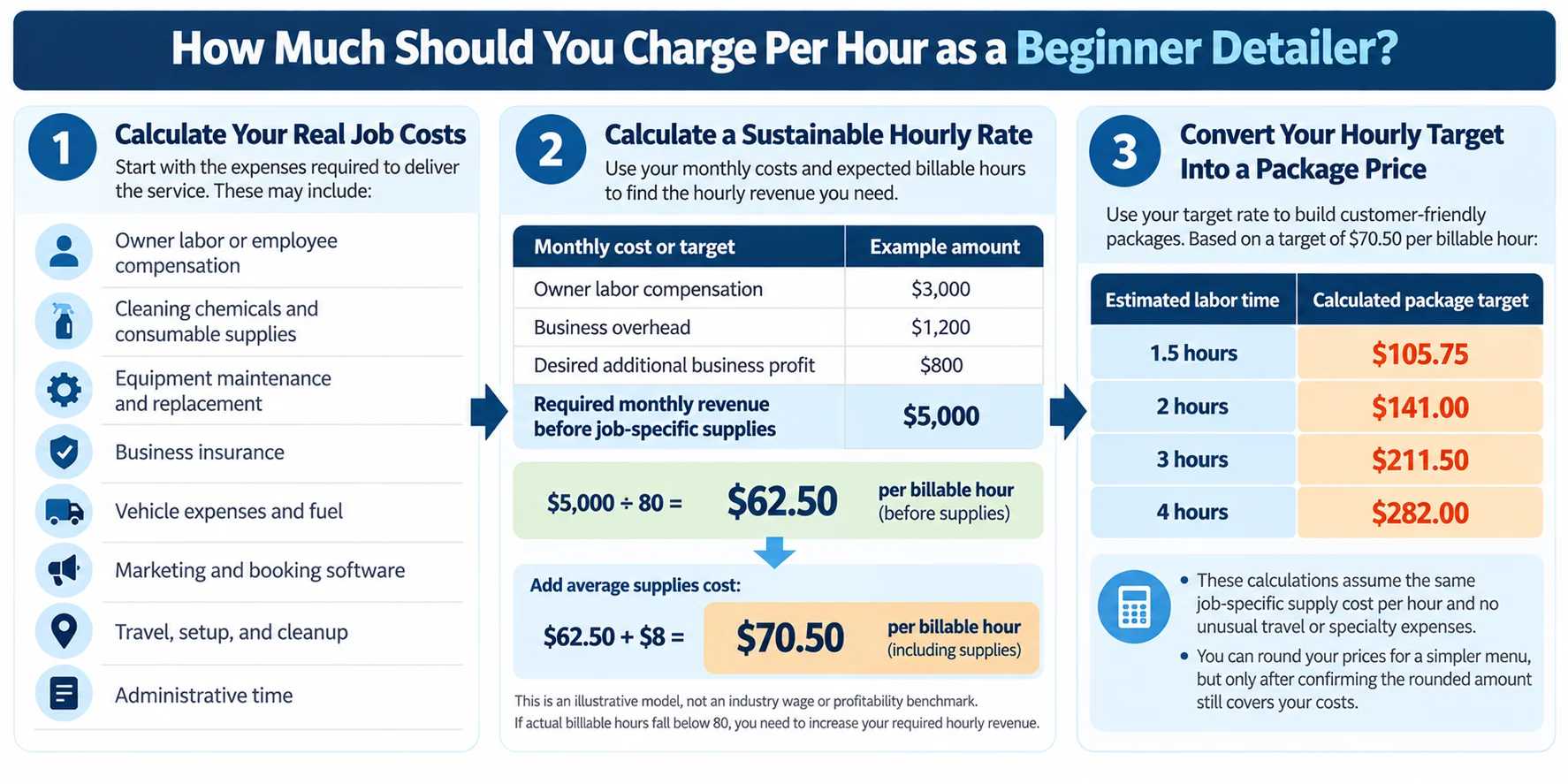
Step 1: Calculate Your Real Job Costs
Start with the expenses required to deliver the service.
These may include:
- Owner labor or employee compensation
- Cleaning chemicals and consumable supplies
- Equipment maintenance and replacement
- Business insurance
- Vehicle expenses and fuel
- Marketing and booking software
- Travel, setup, and cleanup
- Administrative time
The U.S. Small Business Administration recommends identifying startup expenses and distinguishing one-time costs from ongoing expenses when planning a business.
The same discipline applies when building a pricing model.
Step 2: Calculate a Sustainable Hourly Rate
Consider a hypothetical solo mobile detailer with the following monthly targets.
| Monthly cost or target | Example amount |
|---|---|
| Owner labor compensation | $3,000 |
| Business overhead | $1,200 |
| Desired additional business profit | $800 |
| Required monthly revenue before job-specific supplies | $5,000 |
Suppose the business expects 80 billable detailing hours per month.
The required hourly revenue before job-specific supplies is:
$5,000 ÷ 80 = $62.50 per billable hour
If supplies average $8 per billable hour, the target increases to:
$62.50 + $8 = $70.50 per billable hour
This is an illustrative model, not an industry wage or profitability benchmark. It assumes the monthly overhead estimate already includes non-billable travel and administrative costs and does not double-count them.
If actual billable hours fall below 80, you need to increase your required hourly revenue.
That's one reason a busy schedule doesn't always translate into a profitable business.
Step 3: Convert Your Hourly Target Into a Package Price
Once you've established a target rate, you can build customer-friendly packages.
Suppose your target is $70.50 per billable labor hour.
| Estimated labor time | Calculated package target |
|---|---|
| 1.5 hours | $105.75 |
| 2 hours | $141.00 |
| 3 hours | $211.50 |
| 4 hours | $282.00 |
These calculations assume the same job-specific supply cost per hour and no unusual travel or specialty expenses.
You can round your prices for a simpler menu, but only after confirming the rounded amount still covers your costs.
For a broader framework, read How Much Should I Charge for Detailing a Car?.
The Hidden Difference Between Hourly Revenue and Actual Earnings
New mobile detailers often overlook this pricing pitfall.
A detailer's effective hourly revenue is not the same as earnings per hour worked.
Consider this hypothetical job:
| Item | Amount |
|---|---|
| Customer pays | $210 |
| Time cleaning interior | 3 hours |
| Travel and setup | 1 hour |
| Total time committed | 4 hours |
| Chemicals and supplies | $18 |
| Allocated business overhead | $42 |
The job generates $70 per detailing labor hour.
But after deducting the example supplies and overhead:
$210 − $18 − $42 = $150
Dividing that amount by four hours gives:
$37.50 per total working hour
That $37.50 is what remains to compensate the owner and provide any additional profit, before taxes and any costs not included in the example. It is not a net take-home wage.
This distinction matters most for mobile businesses.
If you consistently ignore travel, setup, and other non-billable work, your prices may appear reasonable while your actual earnings remain disappointing.
A Simple Pricing Efficiency Formula
Use two calculations after each job:
Effective detailing hourly rate = Customer price ÷ Detailing labor hours
Revenue per total working hour = Customer price ÷ Total working hours
Then calculate job contribution after deducting direct costs and allocated overhead.
Track all three figures over time.
You'll learn which services generate useful revenue and which consume more time than expected.
Should Interior Detailers Charge Hourly or Offer Packages?
For most routine interior detailing jobs, a fixed package with clear condition adjustments is easier for customers to understand.
Hourly billing can still make sense when labor requirements are hard to estimate.
| Pricing method | Best suited for | Main limitation |
|---|---|---|
| Flat-rate package | Predictable maintenance and standard details | Risk of underestimating labor |
| Hourly billing | Uncertain, labor-intensive work | Final price may be less predictable |
| Package plus add-ons | Standard work with condition-related extras | Requires clear service boundaries |
| Custom inspection quote | Complex restoration or unusual vehicles | Requires additional assessment |
For a beginner, a practical starting point is to offer two or three well-defined interior packages.
Set a starting price based on vehicle size and expected condition. Then quote additional work separately when appropriate.
For example, a standard interior package might exclude extensive pet hair removal or major stain extraction. You can price those services after reviewing photos or inspecting the vehicle.
Avoid promising unlimited cleaning time under one fixed price.
Also avoid adding unexpected fees without the customer's approval.
When Should You Charge Extra for Interior Detailing?
Additional charges should correspond to additional work, materials, or clearly defined service requirements.
Common examples include:
Excessive Pet Hair
Pet hair embedded in carpet fibers may require repeated brushing, agitation, and vacuuming.
The amount of labor depends on the fabric, hair type, and how much has accumulated.
Deep Stain Extraction
Some stains require pretreatment, agitation, extraction, and additional drying time.
Old stains may not disappear completely, especially when fibers are permanently discolored or damaged.
Three-Row Vehicles
Additional seats, floor areas, cup holders, and cargo compartments can increase cleaning time.
Clearly stating a vehicle-size adjustment is often easier to explain than an arbitrary surcharge.
Odor-Related Work
Assess odor problems before quoting treatment.
Surface cleaning may help with ordinary dirt and residue, but persistent odors can come from contaminated padding, moisture intrusion, or other hidden sources.
Do not guarantee odor removal without identifying the likely cause and understanding the limits of the service.
Severe or Potentially Hazardous Contamination
Do not treat suspected mold, bodily fluids, or other hazardous contamination as routine detailing add-ons.
The U.S. Environmental Protection Agency provides guidance on mold and moisture problems. Some affected materials may require specialist handling or replacement.
A standard mobile detailing business should know when to decline a job or refer it to a qualified specialist.
Stop Guessing. Start Building.
Not sure how to allocate your equipment budget? Explore starter equipment recommendations for $750, $1,000, or $1,500 before committing to purchases.
Explore Build My Starter RigHow Can Mobile Detailers Improve Their Effective Hourly Rate?
Raising prices is one option, but it isn't the only way to improve job economics.
Better scheduling, accurate estimates, and an efficient workflow can also help.
Use a Repeatable Interior Cleaning Process
A consistent process helps reduce unnecessary tool changes and repeated work.
For example:
- Inspect the vehicle and document its condition.
- Remove accessible loose debris and prepare the work area.
- Vacuum and clean from upper areas toward lower surfaces as appropriate.
- Treat materials with compatible products and methods.
- Complete glass, finishing, drying checks, and final inspection.
The exact order should reflect the vehicle's materials, equipment, and condition.
The goal isn't to rush. It's to avoid repeating the same work.
Track Estimated Time Against Actual Time
After each job, record the vehicle type, condition, package, quoted price, actual labor hours, and travel time.
If standard interiors consistently take longer than expected, adjust your estimates or service scope.
Even a simple spreadsheet can reveal patterns.
Organize Equipment Before Appointments
Missing supplies, tangled hoses, inadequate extension cords, and disorganized storage can create unnecessary delays.
A well-organized setup can make the work more predictable, though time savings depend on your workflow.
If you're assembling a beginner setup, our Mobile Detailing Equipment List explains the essential categories to consider.
Avoid Buying Equipment Just to Look Professional
An extractor, steamer, or other specialized machine may help with certain services. But equipment purchases should match your actual service menu, workload, and available utilities.
Before upgrading, ask:
- Will this equipment support services customers actually request?
- Can my vehicle safely transport it?
- Do I have adequate power and water access?
- What maintenance and replacement costs will it add?
- Does the expected workload justify the purchase?
For beginners planning a first setup, the Mobile Detailing Startup Kit and How to Start a Mobile Detailing Business guides provide additional planning context.
You can also use the Starter Rig Builder to explore equipment options within a selected startup budget. Treat displayed historical or reference prices as planning information, and verify current merchant prices before purchasing.
How Can Customers Avoid Overpaying for Interior Detailing?
A reasonable price isn't always the lowest.
The better question is whether the quote includes the work your vehicle actually needs.
Before booking, ask the detailer:
- Is the price fixed or an estimate?
- Which interior areas are included?
- Does the package include shampooing or extraction?
- Are pet hair and stain treatments extra?
- Is there a mobile travel fee?
- What could increase the final price?
- Are there limitations on stain or odor removal?
You should also provide accurate information about the vehicle's condition.
Photos of the seats, carpets, floor mats, and cargo area can help the detailer estimate the work more realistically.
If a quote is much lower than others, check whether the service scope is comparable before deciding it's the better deal.
Frequently Asked Questions about How Much Does Interior Car Detailing Cost Per Hour
Is $100 an Hour Too Much for Interior Car Detailing?
Not necessarily. A $100 hourly rate can be reasonable for professional or specialized work, depending on location, equipment, service complexity, and expected results.
For basic maintenance cleaning, however, that rate may be hard to justify unless it includes other costs or services.
Compare the complete quote and service scope rather than the hourly number alone.
How Long Does a Full Interior Car Detail Take?
A standard interior detail may take approximately two to four hours, while heavily soiled vehicles or complex restoration work can take longer.
Actual time depends on vehicle size, interior condition, equipment, staffing, and included services.
How Much Should I Charge for a Three-Hour Interior Detail?
If your target revenue is $70 per billable labor hour, a three-hour detail would have a calculated starting price of $210.
That is a hypothetical calculation, not a recommended universal rate.
Check your costs, local market, service scope, and expected travel time before finalizing the quote.
Is Mobile Interior Detailing More Expensive Than Shop Detailing?
It can be, because mobile operators must account for travel, setup, fuel, and equipment transport.
However, shop-based businesses have their own operating expenses, including premises and utilities.
Neither business model is automatically more expensive in every market.
Should Beginners Charge Less Than Established Detailers?
Beginners may choose simpler services or introductory prices while building experience, but they should still cover their actual costs.
Charging too little makes it hard to maintain equipment, buy supplies, and operate sustainably.
A clearly defined basic package is often better than offering extensive cleaning at an unsustainably low price.
Final Thoughts: What Is a Fair Hourly Price for Interior Detailing?
For general U.S. planning, approximately $50–$100 per hour is a useful professional detailing benchmark, with some basic services priced below that range and specialized work priced higher.
But hourly rates tell only part of the story.
Customers should focus on the total quote, included services, vehicle condition, and expected results.
Detailing business owners should calculate the real cost of completing each job, including supplies, overhead, travel, and non-billable time.
A $200 interior detail might be a strong job for one operator and an underpriced job for another.
The difference comes down to labor time, service scope, operating costs, and business efficiency.
Price the work you actually perform—not just the hours customers see.
Disclosure: This page may contain affiliate links. If you purchase through them, we may earn a small commission at no extra cost to you.