
Starting an auto detailing business takes more than buying a pressure washer, stocking up on cleaning chemicals, and finding your first customer.
You need to know what services you'll offer, who will pay for them, how much each job costs, and whether you can earn enough to keep the business running.
That's where an auto detailing business plan comes in.
The good news? You don't need a 30-page document to get started. If you're launching a small mobile detailing operation, a practical one-page plan supported by realistic financial estimates may be enough to guide your first few months.
This guide walks you through the process, including a sample business plan, startup budget, pricing calculations, and a 90-day launch roadmap.
What Should an Auto Detailing Business Plan Include?
A useful auto detailing business plan explains how your business will attract customers, deliver services, cover expenses, and eventually become profitable.
At a minimum, it should answer seven questions:
- Who are your target customers?
- What detailing services will you provide?
- How much will you charge?
- What equipment and supplies do you need?
- How will customers find your business?
- What are your startup and monthly operating costs?
- How many jobs must you complete to cover your expenses?
According to the U.S. Small Business Administration's business planning guidance, small businesses can use either a detailed traditional business plan or a simpler lean startup plan.
For a solo mobile detailer using an existing vehicle, the lean approach is often a practical starting point. If you're seeking financing, leasing a commercial location, or hiring employees, a more detailed plan may be appropriate.
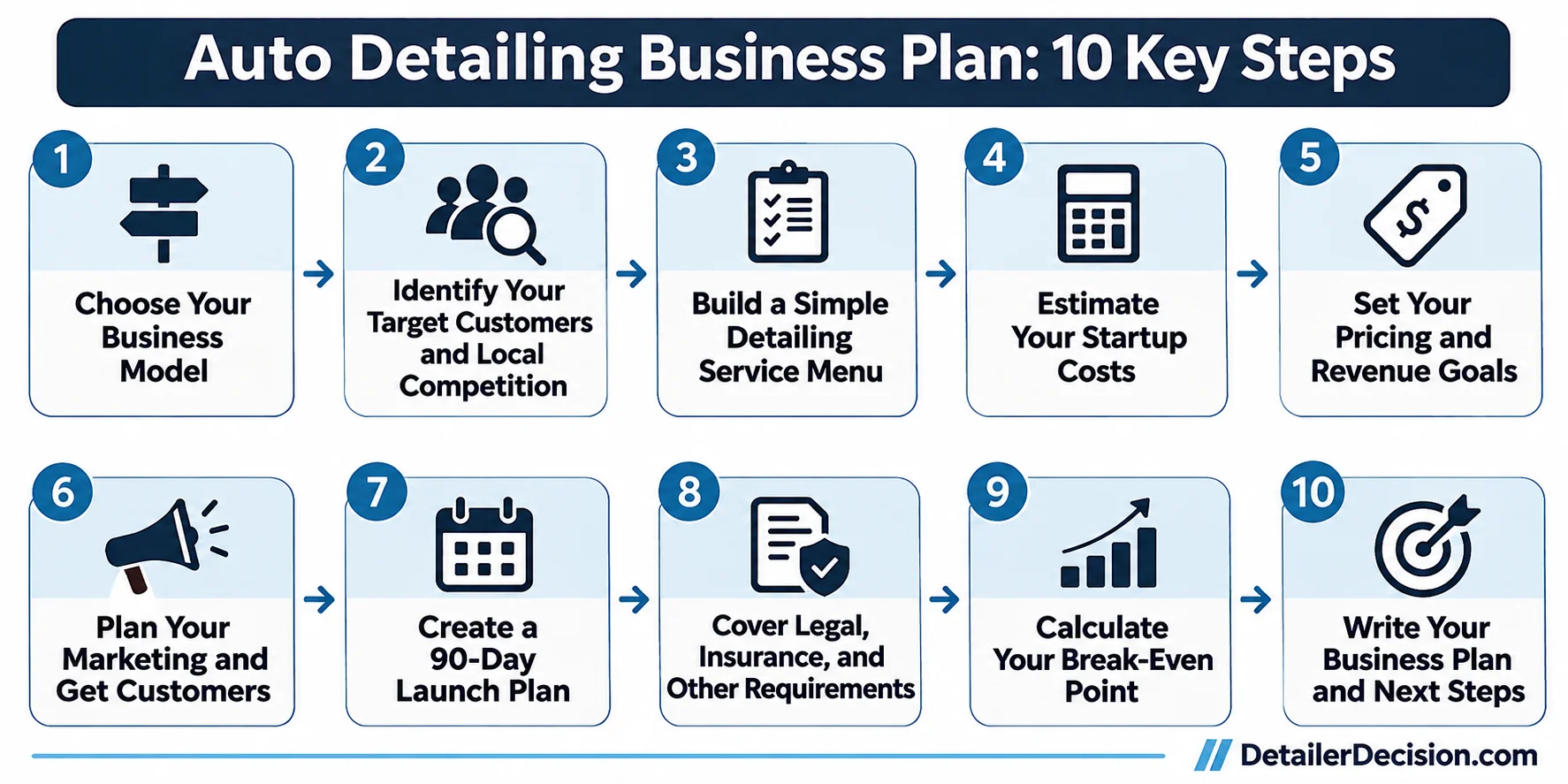
Step 1: Choose Your Auto Detailing Business Model
Your operating model determines your startup investment, monthly overhead, equipment requirements, and customer experience.
Most new operators consider two options.
| Factor | Mobile detailing | Fixed-location shop |
|---|---|---|
| Location | Customer's property or approved service site | Dedicated commercial facility |
| Startup investment | Often lower when using an existing vehicle | Typically higher due to facility costs |
| Customer convenience | Service comes to the customer | Customer travels to the shop |
| Main expenses | Equipment, vehicle, fuel, insurance | Rent, utilities, facility setup, equipment |
| Main challenges | Weather, travel, water and power access | Lease obligations, facility compliance, overhead |
| Expansion | Additional crews or vehicles | More bays, staff, services |
Why a mobile auto detailing business plan needs extra detail
Mobile detailing can eliminate the need for a commercial lease, but it introduces operational questions that a shop-based business may not face.
For example, will you use the customer's water and electricity? Do you need a generator? Can your vehicle safely carry a water tank? How much unpaid travel time will each appointment require?
These decisions affect your costs and scheduling capacity.
If you're still comparing startup approaches, see our guide to starting a mobile detailing business.
Step 2: Identify Your Target Customers and Local Competition
Trying to serve every vehicle owner in your city makes marketing and pricing unnecessarily difficult.
Start by choosing one or two customer groups.
Potential customer segments
| Customer segment | Typical needs | Possible service focus |
|---|---|---|
| Busy professionals | Convenient appointments | Mobile interior and exterior detailing |
| Families | Food spills, stains, pet hair | Interior deep cleaning |
| Car enthusiasts | Appearance and finish care | Maintenance details and paint care |
| Used-car dealers | Vehicle presentation | Repeat inventory preparation |
| Commercial fleets | Consistent vehicle cleanliness | Scheduled maintenance services |
These are possible target segments, not evidence that any particular group has strong demand in your area.
Research five local competitors
Search Google Maps for auto detailing businesses in your intended service area.
Record their service packages, advertised prices, travel fees, appointment availability, and customer reviews.
Look for practical gaps rather than assuming you can win by charging less.
For example, competitors may offer full details but have limited weekday availability. Others might focus on exterior cleaning while offering few interior services.
Your competitive advantage could be convenient scheduling, clearly defined packages, or consistent communication.
Practical tip: Before purchasing specialized equipment, talk to potential customers. Ask which services they actually want and what problems they've had with previous detailing providers.
Step 3: Build a Simple Detailing Service Menu
Beginners don't need to offer every detailing service immediately.
Start with services you can perform safely, consistently, and profitably using equipment you understand.
A three-package structure is easy for customers to compare.
| Package | Services | Example pricing |
|---|---|---|
| Basic Interior | Vacuuming, surface cleaning, interior glass | $100 |
| Standard Detail | Interior cleaning plus exterior wash and protection | $175 |
| Deep Detail | More intensive interior and exterior work | $275 |
These prices are hypothetical planning figures, not current national averages or verified local market rates.
Your final prices should reflect vehicle size, condition, service scope, labor time, operating expenses, and local competition.
Avoid offering advanced services too early
Paint correction, ceramic coating, and complex stain removal may require additional training, specialized equipment, and more time.
If you haven't developed the necessary skills, leave those services out of your initial business plan.
You can add them later once you have demonstrated consistent results and understand the costs involved.
Step 4: Estimate Your Auto Detailing Startup Costs
One of the most common questions from beginners is: How much does it cost to start a mobile detailing business?
There isn't one reliable amount for every operator.
Someone who already owns a suitable vehicle, vacuum, and pressure washer has a very different starting budget from someone purchasing a van and a fully self-contained setup.
Your business plan should distinguish equipment you already own from items you must purchase.
Example mobile detailing startup budget
The following hypothetical budget assumes you already own a suitable vehicle and plan to start with customer-provided water and electrical access, where permitted and agreed upon.
| Expense | Illustrative budget |
|---|---|
| Pressure washer and accessories | $200 |
| Wet/dry vacuum | $150 |
| Cleaning chemicals | $150 |
| Microfiber towels, brushes, wash tools | $150 |
| Hoses, cords, and connectors | $100 |
| Storage and organization | $75 |
| Business registration and permits allowance | $150 |
| Initial insurance allowance | $200 |
| Website and initial marketing | $125 |
| Contingency | $200 |
| Total | $1,500 |
This is a budgeting example, not a verified shopping list. Actual insurance, permit, and equipment costs may differ significantly. Some insurance policies require substantial upfront payments, and some operations will need additional equipment or compliance expenses.
The example also excludes vehicle purchase costs, major repairs, taxes, specialized training, and any required wastewater-control equipment.
What if your budget is only $1,000?
A $1,000 launch budget may be possible if you already own important equipment and can legally operate a limited service model. Don't assume every beginner can start with that amount.
Prioritize essential cleaning tools, basic chemicals, a reliable vacuum, and the equipment required for your selected services.
Delay optional purchases until customer demand justifies them.
A generator, water tank, extractor, and polisher shouldn't automatically appear on every beginner's shopping list.
Plan your equipment before buying
Your equipment requirements depend on your budget, vehicle, services, and access to utilities.
The DetailerDecision Starter Rig Builder can help you explore equipment choices for a beginner mobile detailing setup.
Use its results as a planning reference, then confirm current prices, availability, compatibility, and operating requirements before purchasing.

Build Your Mobile Detailing Setup With Confidence
Find the right pressure washer, vacuum, chemicals, and tools for your budget—without buying what you don't need.
Build My Starter RigStep 5: Calculate Pricing, Operating Costs, and Break-Even
Revenue alone doesn't tell you whether a detailing business is financially viable.
A $200 appointment might look attractive until you account for cleaning supplies, travel, payment processing, equipment wear, and the hours spent completing the job.
Your business plan needs to distinguish revenue from expenses and owner earnings.
Example monthly financial plan
Assume a solo operator has the following hypothetical business model:
| Financial assumption | Amount |
|---|---|
| Average revenue per completed job | $175 |
| Variable cost per job | $25 |
| Monthly fixed operating costs | $600 |
| Target completed jobs per month | 32 |
At 32 jobs per month:
- Monthly revenue: $5,600
- Variable costs: $800
- Fixed costs: $600
- Remaining operating contribution: $4,200
That $4,200 is not necessarily take-home pay or accounting net profit. Under these simplified assumptions, it is the amount remaining before owner compensation, income taxes, depreciation, financing costs, and any expenses not included in the model.
Calculate your monthly break-even point
The basic formula is:
Using the example:
ILLUSTRATIVE OPERATING BREAK-EVEN
4 jobs per month
Covers the modeled $600 in monthly fixed costs, but not a salary for the owner.
That distinction matters. A business that covers its bills but doesn't adequately compensate the owner isn't necessarily financially sustainable.
Include your own income target
Suppose you want to allocate another $3,000 per month toward owner compensation before personal taxes.
Your required monthly contribution becomes $3,600.
Under the same assumptions, you would need about 24 completed jobs per month.
That's about six jobs per week over four weeks.
But is six jobs per week realistic once you include travel, setup, cleanup, weather interruptions, marketing, and administration?
Your business plan should answer that question before you commit to expensive equipment or recurring payments.
Methodology: These calculations use a simplified contribution-margin model consistent with the SBA's break-even guidance. They are illustrative scenarios, not projections of typical detailer earnings.
Step 6: Create an Equipment and Operating Plan
A mobile detailing business plan should explain not just what equipment you'll buy, but how you'll actually use it.
Consider four operating questions.
Water access
Will customers provide water, or will you carry your own supply?
A self-contained water system increases independence but adds cost, weight, storage requirements, and potential wastewater-management obligations.
Water weighs approximately 8.34 pounds per U.S. gallon. A 50-gallon supply alone weighs roughly 417 pounds before adding the tank and mounting hardware.
Check your vehicle's payload capacity before planning a large water tank.
Electrical power
Will you use customer electricity, a battery-powered setup, or a generator?
A generator must support the equipment's actual running and starting requirements. Avoid choosing one based only on its advertised maximum output.
Equipment storage
Consider where you'll store wet towels, chemicals, hoses, electrical equipment, and clean supplies.
Keep incompatible chemicals separate, following product labels and safety data sheets. Secure equipment to prevent shifting during transportation.
Job scheduling
A three-hour detail isn't necessarily a three-hour business commitment.
Travel, setup, packing, customer communication, and cleaning your equipment can add substantial time.
If one appointment requires four or five total working hours, scheduling three such jobs in one day may be unrealistic.
Your pricing should reflect the total workload, not just hands-on cleaning time.
Step 7: Plan Licensing, Insurance, and Training
Before accepting paying customers, research the requirements in every jurisdiction where you plan to operate.
Requirements can differ by state, county, municipality, and service location.
Your plan should address business registration, applicable licenses, taxes, insurance, and environmental rules.
Choose a business structure
A sole proprietorship may be simpler to establish, while an LLC can separate business and personal liabilities.
However, an LLC does not replace insurance or eliminate all personal liability.
Review the options with a qualified accountant or attorney rather than assuming one structure is automatically best.
Identify insurance needs
Depending on your operation, coverage may include general liability, commercial auto, tools and equipment, and protection for customers' vehicles in your care.
Policy terminology and coverage vary. Ask an insurance professional specifically about mobile detailing activities and exclusions.
Read our mobile detailing insurance guide for a closer look at the coverage questions to consider.
Plan for wastewater management
Vehicle washwater may contain detergents, oils, metals, and other contaminants.
The U.S. Environmental Protection Agency recommends practices that reduce polluted washwater entering storm drains. Commercial operators should check applicable state and local requirements before choosing a wash method or disposal approach.
A customer's permission to use their driveway does not necessarily authorize discharging wastewater into a storm drain.
Do you need auto detailing certification?
No single nationwide certification is required for every auto detailing business in the United States.
However, local licensing requirements, specific services, and industry training standards can differ.
Professional training can help you develop consistent techniques, especially for more advanced services.
See our auto detailing certification guide to explore training and credential considerations.
Step 8: Develop a Customer Acquisition Plan
A detailing business needs a predictable way to generate appointments.
Launching a website or social media account alone doesn't guarantee bookings.
Start with a few marketing channels and measure what happens.
A practical beginner marketing plan
Your first priority should be to establish local visibility and build evidence of your work.
Create a Google Business Profile if your business meets Google's eligibility requirements. Clearly describe your service area, services, and contact methods.
Build a simple website that explains packages, pricing conditions, and booking options.
Take before-and-after photos with customer permission, and ask for honest reviews without offering prohibited incentives.
You can also approach local businesses that may need recurring vehicle cleaning, such as used-car dealers or small fleet operators.
For more promotion ideas, read our car detailing advertising guide.
Track marketing performance
Instead of measuring only likes or website visits, track:
| Metric | What it tells you |
|---|---|
| Leads received | How many people inquire |
| Booking conversion rate | How many inquiries become appointments |
| Customer acquisition cost | What you spend to acquire a customer |
| Average job revenue | Revenue per completed appointment |
| Repeat booking rate | How often customers return |
| Referral bookings | How many customers arrive through recommendations |
A small number of repeat customers can make planning easier, but don't assume recurring revenue until customers actually book again.

Stop Guessing. Start Building.
Not sure how to allocate your equipment budget? Explore starter equipment recommendations for $750, $1,000, or $1,500 before committing to purchases.
Explore Build My Starter RigStep 9: Write Your One-Page Auto Detailing Business Plan
You can now combine your research into a short working document.
Here is a completed sample mobile auto detailing business plan for a hypothetical solo operator.
Sample business plan
| Business model | Owner-operated mobile detailing |
|---|---|
| Target customers | Busy professionals and families within a 15-mile service area |
| Core services | Interior cleaning, standard detailing, deep detailing |
| Positioning | Convenient appointments, transparent service descriptions, consistent results |
| Startup budget | $1,500, assuming an existing vehicle and customer-provided utilities |
| Average job revenue | $175 planning assumption |
| Monthly fixed costs | $600 planning assumption |
| Initial monthly target | 24 completed jobs, subject to demand and capacity |
| Marketing channels | Google Business Profile, website, referrals, local outreach |
| First 90-day goal | Validate pricing, build a repeatable workflow, and establish reliable booking records |
This example is deliberately simple. It doesn't assume employees, a commercial lease, or expensive specialty services.
It also doesn't guarantee that the business will generate 24 jobs per month. Test that target against actual demand and available working hours.
For a loan application, expand the document with more detailed cash-flow forecasts, financing requirements, risk analysis, and supporting records.
Step 10: Follow a 90-Day Launch Roadmap
A business plan becomes useful when it guides specific actions.
Here's a practical sequence for the first three months.
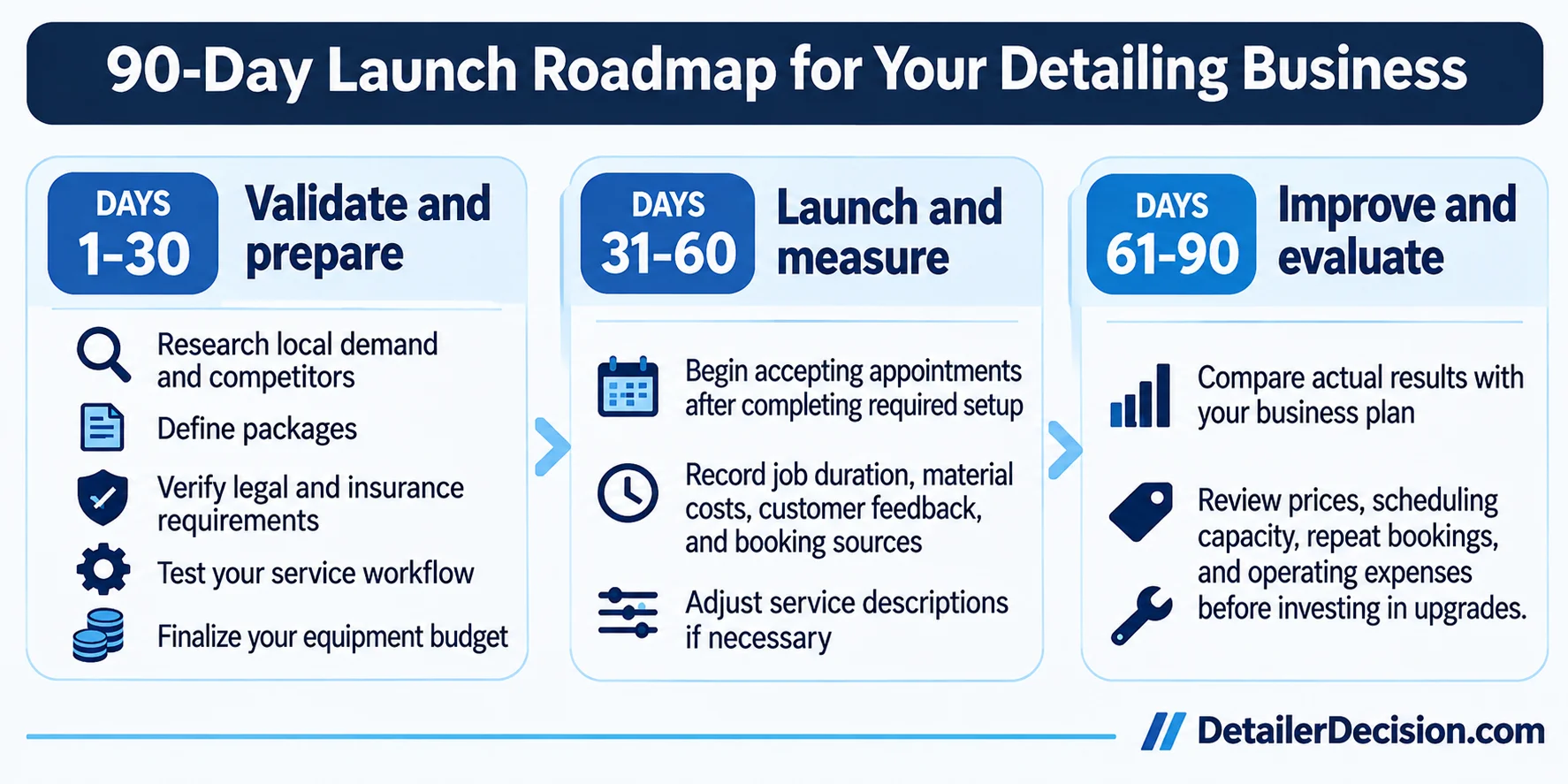
Compare actual results with your business plan. Review prices, scheduling capacity, repeat bookings, and operating expenses before investing in upgrades.
At the end of 90 days, you should have a clearer picture of what customers buy, how long jobs take, and which equipment purchases are justified.
Common Auto Detailing Business Plan Mistakes
Even a well-written plan can fail if its assumptions are unrealistic.
Underestimating unpaid working time
Travel, customer messages, invoicing, equipment maintenance, and setup all consume time.
Track these activities so you can estimate your actual hourly earnings.
Buying equipment before defining services
A professional-looking setup doesn't guarantee customers.
Choose services first, then purchase equipment that supports them.
Copying competitors' prices without understanding costs
A competitor may have lower overhead, more experience, or a different service scope.
Use competitors as market references, not as substitutes for your own financial calculations.
Confusing revenue with profit
A busy schedule can still produce disappointing earnings if prices don't cover all costs and owner labor.
Expanding before demand is proven
Adding a second vehicle, hiring staff, or leasing a shop increases financial commitments.
Consider expansion only when customer demand, operating capacity, and cash flow support it.
Should You Start From Scratch or Buy an Auto Detailing Business for Sale?
Some entrepreneurs consider purchasing an established auto detailing business rather than building one from zero.
An existing operation may come with equipment, customers, a website, and an established name.
However, an advertised business for sale isn't automatically profitable.
Before buying, review financial statements, tax records, customer concentration, equipment condition, outstanding debts, leases, insurance claims, and any transferable permits.
Also determine whether customers are loyal to the business or primarily to the current owner.
A new business offers more flexibility and may require less initial capital, while an acquisition can provide an existing operating structure at a higher cost and with different risks.
Your business plan should compare both options using verified financial information, not the seller's revenue claims alone.
Frequently Asked Questions about Auto Detailing Business Plan
How much does it cost to start a mobile detailing business?
Startup costs vary based on equipment ownership, vehicle requirements, service offerings, licensing, and insurance. A limited operation using existing equipment may require relatively little new spending, while a self-contained professional setup can require substantially more. Prepare an itemized budget using actual local quotations.
Can I start a mobile detailing business with $1,000?
Possibly, if you already own a suitable vehicle and key equipment, and you can deliver your planned services legally and safely within that budget. Don't treat a $1,000 budget as a universal startup estimate.
Do I need a business plan for a small detailing business?
A formal business plan isn't universally required simply to operate a small detailing business, but a written plan helps you evaluate costs, pricing, customer demand, and risks. Lenders or investors may request a more detailed document.
How profitable is a mobile detailing business?
Profitability depends on prices, completed jobs, service costs, travel time, overhead, and owner compensation. Use your own cost estimates and booking assumptions to calculate break-even requirements rather than relying on advertised industry profit margins.
Can I run a detailing business part-time?
Yes, as long as you meet applicable legal and insurance requirements and can reliably serve customers. A part-time model can help test demand before making larger financial commitments, although limited availability may affect booking opportunities.
Final Thoughts: Build a Plan You Can Actually Use
An auto detailing business plan doesn't need to be complicated, but it needs to reflect how your business will operate.
Start with a clearly defined customer group, a manageable service menu, realistic pricing, and an equipment budget based on what you actually need.
Then calculate your monthly costs, estimate the number of jobs required to support your income goals, and test those assumptions with real customers.
Your first business plan won't be perfect. The goal is to make informed decisions, track results, and improve the plan as your business develops.
Before purchasing your setup, explore the Starter Rig Builder to organize your equipment decisions around your starting budget.
Disclosure: This page may contain affiliate links. If you purchase through them, we may earn a small commission at no extra cost to you.