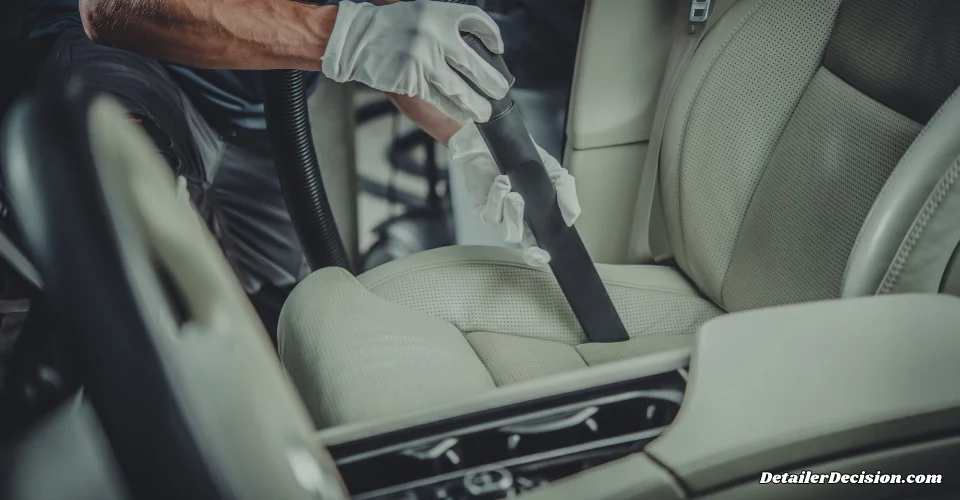
Choosing the best vacuum for car detailing isn't just about buying the machine with the highest advertised horsepower. You need something that can pull sand out of carpet, reach between tight seat rails, handle pet hair, and fit into your available workspace.
For mobile detailers, another challenge is working within your vehicle's storage space and available power supply.
A large shop vacuum might deliver excellent cleaning performance but take up valuable room in your SUV or van. A cordless handheld might be convenient but struggle with heavily soiled interiors.
The right choice depends on the work you're doing, not just the vacuum's price or size.
Quick Answer: What’s the Best Vacuum for Auto Detailing?
For most beginners who have reliable access to electrical power, the RIDGID WD4070Ex 4-Gallon Wet/Dry Vacuum is a strong starting choice. Its compact design, 5.0 peak horsepower rating, and compatibility with automotive accessories make it worth considering for regular interior detailing.
If you need a different setup, these five options cover the most common situations.
| Vacuum | Best for | Main limitation |
|---|---|---|
| RIDGID WD4070Ex | Best overall for beginners | Requires AC power |
| Vacmaster Beast 5-Gallon | Heavy debris and demanding cleaning | More equipment to carry |
| Armor All AA255W | Compact, budget-conscious setups | Smaller tank and accessory ecosystem |
| DEWALT DCV580H | Cordless mobile cleaning | Battery runtime and additional costs |
| BISSELL Little Green ProHeat | Upholstery spot extraction | Not a replacement for dry vacuuming |
These recommendations are based on published specifications, independent testing, and practical use-case analysis—not firsthand testing by DetailerDecision.com.
1. RIDGID WD4070Ex — Best Overall Vacuum for Beginner Detailers
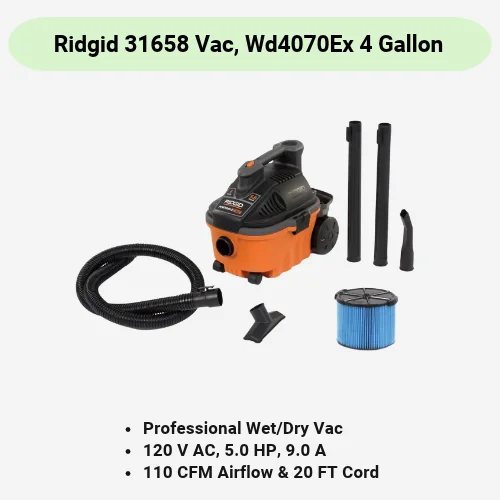
The RIDGID WD4070Ex 4-Gallon Wet/Dry Vacuum offers a practical balance of portability, tank capacity, and cleaning capability.
Its four-gallon tank is manageable for a mobile setup, while the included hose and interchangeable accessories allow it to handle different interior surfaces.
Key specifications
| Feature | Specification |
|---|---|
| Tank capacity | 4 gallons |
| Peak horsepower | 5.0 HP |
| Power | 120V AC |
| Rated current | 9 amps |
| Power cord | 20 ft |
| Airflow | 110 CFM |
Why it makes sense for beginners
A four-gallon vacuum is a reasonable compromise between a small handheld and a bulky workshop machine. You can store it with other detailing equipment without needing the space a large rolling shop vacuum takes up.
The WD4070Ex also offers a 1-7/8-inch hose system. Before buying a separate automotive detailing kit, check whether its connectors fit that hose size.
For vehicle interiors, a narrow crevice attachment and a suitable upholstery nozzle are often more useful than the general-purpose tools included with a workshop vacuum.
Who should buy it? Beginners who offer regular interior detailing, work from a garage, or have reliable customer-site electrical access.
Who should skip it? Mobile operators who can't rely on AC power and don't have a suitable independent power supply.
What changes the recommendation? If you already own a capable wet/dry vacuum, buying better attachments may be more sensible than replacing the entire machine.
2. Vacmaster Beast 5-Gallon — Best for Heavy Debris and Deep Interior Cleaning
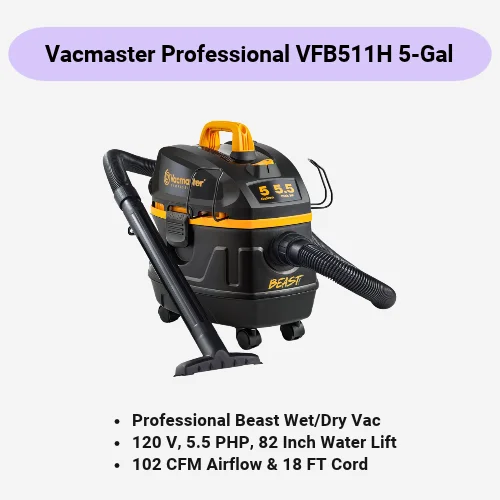
The Vacmaster Professional Beast Series 5-Gallon Wet/Dry Vacuum is worth considering if you regularly clean vehicles with sand, soil, leaves, and other difficult debris.
The Beast line includes multiple revisions, so pay attention to the exact model number.
For example, the U.S. manufacturer lists a VFB511B 0202 version with a 5-gallon tank, 102 CFM airflow, and 82 inches of water lift. It also lists a 20-foot cord and a seven-foot hose. Cleva North America
Why choose a larger wet/dry vacuum?
The advantage isn't simply having a bigger tank. A capable wet/dry vacuum with appropriate attachments can make removing embedded debris more manageable.
However, strong suction alone won't release every grain of sand or strand of pet hair. You may still need a carpet brush or another agitation tool.
The supplied Reddit discussion reinforces that point: multiple detailing enthusiasts describe loosening debris from carpet fibers before vacuuming. Those comments are useful practical observations, not controlled product tests.
What to consider before buying
A larger vacuum can create a few inconveniences for mobile work. You need somewhere to store its hose, cord, filters, and attachments. You'll also need to plan around electrical access.
The Beast may be a better fit for demanding interiors, but that doesn't mean every beginner needs one.
Best for: Detailers who frequently encounter heavily soiled carpets and want a compact but capable workshop-style vacuum.
Skip it if: Most of your jobs involve light maintenance cleaning, or every inch of vehicle storage matters.
What changes the recommendation? A higher daily workload and more demanding interior jobs make this type of machine more attractive.
Build Your Mobile Detailing Setup With Confidence
Find the right pressure washer, vacuum, chemicals, and tools for your budget—without buying what you don't need.
Build My Starter Rig3. Armor All AA255W — Best Compact Vacuum for Budget-Conscious Detailers
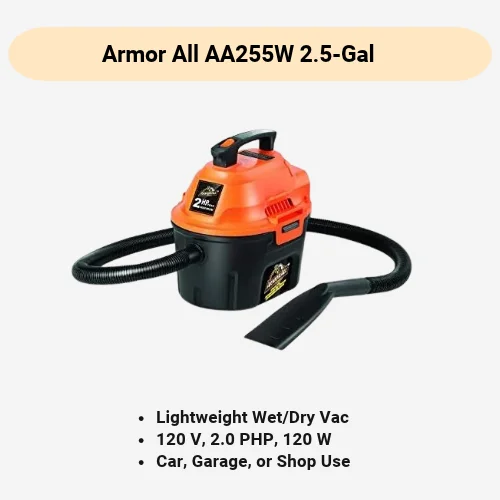
The Armor All AA255W 2.5-Gallon Wet/Dry Vacuum is a compact option for people who want something more capable than a miniature handheld without carrying a larger shop vacuum.
Its strongest selling points are portability and automotive-focused accessories.
What independent testing found
Vacuum Wars selected the AA255W as its overall car-cleaning recommendation in its supplied 2026 comparison.
The publication reported 66 inches of water lift in its testing, along with a 2.5-gallon tank and useful automotive attachments.
That result matters because it shows why a relatively small wet/dry vacuum can compete for car cleaning. A larger tank doesn't automatically mean better suction.
Where the Armor All makes sense
This is an appealing option for someone cleaning personal vehicles, offering occasional detailing services, or building a small equipment kit.
Its compact footprint can also be helpful if you transport supplies in a sedan or small SUV.
However, a small vacuum still needs proper filter maintenance. Frequent cleaning of dirty vehicles can also make a compact collection tank less convenient.
Best for: Occasional detailing, compact setups, and buyers prioritizing portability.
Skip it if: You need a machine intended for frequent demanding commercial use or a larger debris capacity.
What changes the recommendation? If your workload increases significantly, a more serviceable wet/dry vacuum with a larger tank and readily available replacement parts may become preferable.
4. DEWALT DCV580H — Best Cordless Vacuum for Mobile Detailing
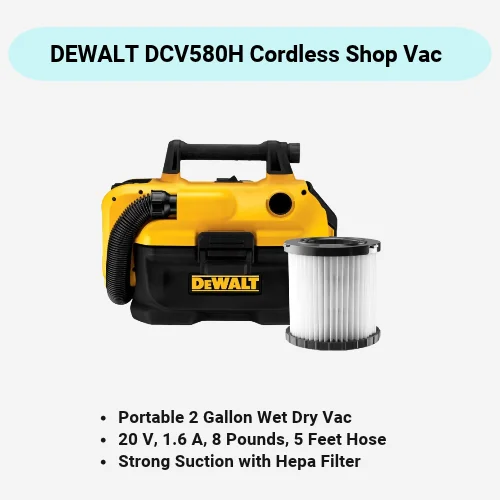
The DEWALT DCV580H 20V MAX Cordless Wet/Dry Vacuum solves a problem that corded vacuums cannot: it operates without requiring an electrical outlet during use.
That makes it especially interesting for mobile detailers working at locations where power access is uncertain.
According to DEWALT's official documentation, it features a two-gallon tank, a five-foot flexible hose, and a washable, reusable filter. The battery and charger are sold separately. DEWALT
The advantage of cordless operation
With a cordless vacuum, you can move between vehicles without routing a power cord around the work area.
This can help with maintenance details, quick interior cleaning, and locations where running an extension cord is inconvenient.
But cordless operation comes with trade-offs.
Battery runtime depends on the battery and workload. You may need spare batteries, a charger, and a charging plan for multiple appointments.
If you already own compatible DEWALT batteries, the purchase may be easier to justify. If you're starting from scratch, the complete system cost matters more than the vacuum's tool-only price.
Is it powerful enough for professional detailing?
That depends on your service.
A cordless wet/dry vacuum can help with routine interior cleaning. However, you shouldn't assume it will match a powerful corded shop vacuum on embedded sand or heavily contaminated carpet.
Best for: Mobile operators prioritizing portability and independence from customer-site power.
Skip it if: You need sustained cleaning for multiple heavily soiled vehicles and cannot reliably recharge or swap batteries.
What changes the recommendation? Owning compatible batteries, working mostly on maintenance details, or having no dependable AC power makes cordless operation more attractive.
5. BISSELL Little Green ProHeat — Best for Upholstery Spot Extraction
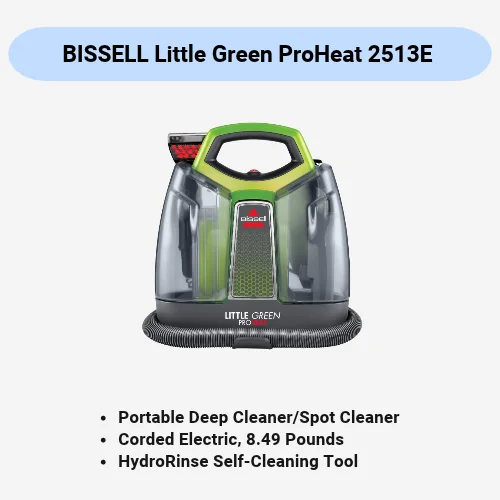
The BISSELL Little Green ProHeat Portable Carpet Cleaner serves a different purpose from the other vacuums on this list.
It's a portable upholstery and carpet cleaning machine designed to apply cleaning solution and recover dirty liquid.
BISSELL lists features such as a stain-cleaning tool, a separate clean-water tank, and a hose-cleaning attachment on its ProHeat models. Specifications differ by model and region, so verify the exact U.S. SKU before purchasing. BISSELL
A wet/dry vacuum is not the same as an extractor
This distinction matters for beginners.
A wet/dry shop vacuum collects dry debris and, when properly configured, can collect certain liquids. An extractor uses a cleaning solution delivery and recovery process to clean fabric or carpet.
A portable spot extractor is useful for stained cloth seats and localized carpet cleaning. It is not a substitute for thoroughly vacuuming dry dirt before wet cleaning.
Also avoid oversaturating upholstery, and follow the vehicle manufacturer's cleaning recommendations.
When should you buy an extractor?
If your services include shampooing cloth seats or cleaning stained upholstery, an extractor may become an important addition.
But if you're just starting with basic interior vacuuming and wipe-down services, a capable dry vacuum should generally come first.
Best for: Detailers adding fabric spot-cleaning services.
Skip it if: You need your first general-purpose vacuum for sand, crumbs, dust, and dry debris.
What changes the recommendation? Offering more extensive upholstery cleaning or regularly handling stained interiors can justify a dedicated extractor.
Shop Vac vs. Cordless Vacuum vs. Extractor: Which Do You Actually Need?
The best auto detailing vacuum depends on the services you plan to offer.
| Your situation | Recommended equipment |
|---|---|
| Starting a basic interior detailing service | Compact wet/dry shop vacuum |
| Cleaning heavily soiled carpets | Capable shop vacuum + agitation tools |
| No dependable electrical outlet | Cordless wet/dry vacuum |
| Quick maintenance cleaning | Compact vacuum or cordless unit |
| Shampooing stained fabric seats | Dry vacuum + suitable extractor |
| Working from a fixed detailing garage | Corded wet/dry or dedicated shop vacuum |
For most beginners, the priority is to buy one vacuum that reliably handles common dry debris. Specialized equipment can follow as your service menu grows.
What Actually Matters When Buying a Car Detailing Vacuum?
1. Suction and airflow—not just peak horsepower
Shop vacuum marketing often emphasizes peak horsepower. But that alone doesn't determine cleaning performance.
Two useful specifications are:
- Water lift: A measure of suction pressure, commonly expressed in inches of water.
- CFM (cubic feet per minute): A measure of airflow.
Water lift helps describe the vacuum's ability to create pressure differences. Airflow helps describe how much air moves through the system.
Both matter, but actual pickup also depends on hose restrictions, filters, nozzles, and the material being cleaned.
Do not compare peak horsepower ratings as though they were directly interchangeable with suction measurements.
2. Hose length and attachment compatibility
A good vacuum with the wrong attachment can be frustrating inside a vehicle.
You need to reach under seats, around seat rails, into narrow footwells, and between the center console and seats.
A flexible hose and properly sized accessories can make these jobs easier.
Before buying a detailing attachment kit, check the vacuum's hose diameter and connector design. A tool advertised as universal may still require an adapter.
3. Tank size and portability
A larger tank lets you collect more debris before emptying it. It does not automatically improve suction.
For mobile detailing, the right capacity depends on how frequently you clean vehicles and how much storage space you have.
A compact vacuum may be easier to transport, while a larger unit may reduce interruptions during messy jobs.
4. Electrical requirements
This is one of the easiest purchasing considerations to overlook.
A vacuum can look ideal on paper but be impractical if your mobile setup cannot power it.
For example, RIDGID lists the WD4070 at 120V and 9 amps. That corresponds to approximately 1,080 volt-amperes at its rated operating values, but it is not a verified startup-wattage requirement or a complete generator-sizing recommendation.
Check your generator's continuous output, surge capability, other simultaneous loads, and the vacuum manufacturer's requirements before choosing a power system.
If you're also planning a pressure washer, read our Best Pressure Washer for Mobile Detailing guide to understand how equipment choices affect the overall setup.
5. Filters and maintenance
Dirty or clogged filters can restrict airflow and reduce cleaning effectiveness.
Before buying a vacuum, consider how easily you can obtain replacement filters and clean the tank.
For wet pickup, follow the manufacturer's instructions on appropriate filters and configuration. Don't assume a dry-dust filter should stay installed for every liquid-cleanup job.
Stop Guessing. Start Building.
Not sure how to allocate your equipment budget? Explore starter equipment recommendations for $750, $1,000, or $1,500 before committing to purchases.
Explore Build My Starter RigEssential Vacuum Attachments for Car Detailing
A vacuum alone won't solve every interior cleaning problem.
For a beginner, the following accessories are worth prioritizing.
| Attachment | Main purpose |
|---|---|
| Crevice tool | Seat rails, gaps, narrow spaces |
| Wide automotive nozzle | Floor mats and larger carpet areas |
| Soft detailing brush | Vents, trim, and delicate surfaces |
| Rubber pet-hair tool | Loosening embedded hair |
| Carpet agitation brush | Dislodging sand and dry debris |
| Flexible hose | Reaching difficult interior areas |
A useful approach for sand is to gently loosen dry debris before vacuuming. For pet hair, a rubberized tool can help separate hair from fabric fibers.
Use caution with powered brushes. Aggressive agitation can damage delicate upholstery, carpet fibers, and trim. Test an inconspicuous area first.
How Much Should a Beginner Spend on a Detailing Vacuum?
You don't need the most expensive vacuum to start offering basic interior cleaning.
However, the total cost is more than the machine itself.
Consider three purchasing situations.
Scenario A: Starting with a limited budget
You have basic cleaning supplies and need your first vacuum.
Prioritize a compact corded wet/dry vacuum with adequate attachments. Avoid spending heavily on specialized extraction equipment before you know which services you'll offer.
Scenario B: Building a $1,000 mobile detailing setup
Suppose your total startup equipment budget is $1,000.
Your vacuum needs to compete with other essential purchases: a pressure washer if required, hoses, chemicals, brushes, towels, safety equipment, and possibly a power solution.
In this situation, the best shop vac for car detailing isn't necessarily the highest-spec model.
A moderately priced vacuum that leaves room for the rest of your equipment may be the better business decision.
For the complete equipment picture, see our Mobile Detailing Equipment List.
Scenario C: Upgrading an existing business
You already own a functional vacuum, but your workload has increased.
Before replacing it, identify the actual limitation.
Are you losing time because the vacuum lacks suction? Are you frequently emptying the tank? Is the hose difficult to maneuver? Or do you need a separate extractor for upholstery work?
Each problem points toward a different upgrade.
Replacing a vacuum without identifying the bottleneck can waste money.
Five Common Mistakes Beginners Make When Buying a Detailing Vacuum
1. Buying based on peak horsepower alone. Compare airflow, suction information, attachments, and practical design rather than relying on one marketing number.
2. Choosing a tiny cordless vacuum as the only cleaning machine. Small handheld models may work well for surface debris but can be limiting for full interior details.
3. Ignoring accessory costs. A vacuum may require separate detailing nozzles, filters, hose adapters, or batteries.
4. Confusing wet/dry pickup with extraction. A shop vacuum doesn't automatically provide a fabric-cleaning solution delivery system.
5. Forgetting power and storage requirements. A vacuum that doesn't fit your vehicle or available electrical setup may create more problems than it solves.
Build a Vacuum Setup That Fits Your Mobile Detailing Business
Your vacuum is one part of a larger equipment system.
If you're starting a mobile detailing business, the real question isn't simply which vacuum has the best specifications. It's which equipment combination fits your services, budget, and operating conditions.
Our Mobile Detailing Startup Kit guide explains how to prioritize your initial purchases.
Plan Your Starter Rig Before You Buy
Not sure how to balance your vacuum purchase with pressure washing equipment, chemicals, and other essentials?
Use the free Starter Rig Builder to explore equipment recommendations based on your startup budget and setup requirements. Check product recommendations and reference prices against current retailer listings before purchasing.
Frequently Asked Questions
What is the best vacuum for auto detailing?
For beginners with reliable electrical access, a compact corded wet/dry vacuum such as the RIDGID WD4070 is a practical starting point. It balances tank capacity, portability, and accessory flexibility.
Your best choice may change if you need cordless operation, high-volume cleaning, or upholstery extraction.
What is the best cordless vacuum for car detailing?
The DEWALT DCV580H is worth considering for mobile detailers who need a cordless wet/dry vacuum, especially if they already own compatible DEWALT batteries.
For quick personal-vehicle cleaning, a smaller handheld model may be more convenient. For demanding paid detailing jobs, check whether battery runtime and cleaning performance are sufficient.
Is a shop vac better than a regular vacuum for detailing?
A wet/dry shop vacuum is often more practical for detailing because it can handle varied debris, use flexible hoses, and accept specialized attachments.
However, some household vacuums can clean vehicles effectively. The most important considerations are performance, access to tight spaces, and suitability for the work.
Do I need an extractor vacuum for car detailing?
Not necessarily.
You can offer basic interior cleaning without a dedicated extractor. If you plan to shampoo cloth seats or provide deeper fabric-cleaning services, a suitable extractor becomes more useful.
Vacuum dry debris before wet cleaning.
Is a 4-gallon shop vac big enough for mobile detailing?
A four-gallon vacuum can be a practical size for mobile detailing, especially when portability and storage matter.
The ideal tank capacity depends on your workload and the type of debris you encounter. A larger tank doesn't automatically mean stronger suction.
Final Recommendation: Buy for Your Workload, Not the Biggest Specification
For most beginners, the RIDGID WD4070 is a sensible first vacuum to evaluate. It offers a compact wet/dry format and useful accessory flexibility without requiring the space of a large workshop machine.
The Vacmaster Beast is worth comparing if you frequently handle heavily soiled interiors. The Armor All AA255W offers a smaller alternative, while the DEWALT DCV580H makes sense when cordless operation is a priority.
If upholstery shampooing is part of your service menu, a dedicated extractor such as the BISSELL Little Green ProHeat can complement your dry vacuum.
Start with the cleaning tasks you need to perform, confirm your power and storage requirements, and choose the vacuum that fits your other equipment.
For a broader overview of building your business, read How to Start a Mobile Detailing Business.
Disclosure: This page may contain affiliate links. If you purchase through them, we may earn a small commission at no extra cost to you.