Starting a mobile detailing business means working on other people's vehicles, transporting equipment, and providing services at locations you don't control. Even a routine appointment can involve risks that personal auto insurance or a basic business liability policy won't cover.
The challenge is figuring out which insurance policies you actually need without paying for coverage that doesn't fit your operation.
Mobile detailing business insurance isn't a single policy. It combines protections for your business vehicles, customers' property, equipment, employees, and daily services.
This guide explains the main coverage options, typical insurance costs, common coverage gaps, and how to compare policies before purchasing.
What Insurance Does a Mobile Detailing Business Need?
Quick answer: Most mobile detailing business owners should evaluate general liability insurance, appropriate commercial auto coverage, and protection for customers' vehicles. Equipment coverage may also be necessary, and workers' compensation becomes especially important when you have employees.
Your actual requirements depend on state laws, contracts, vehicle ownership, and the services you provide.
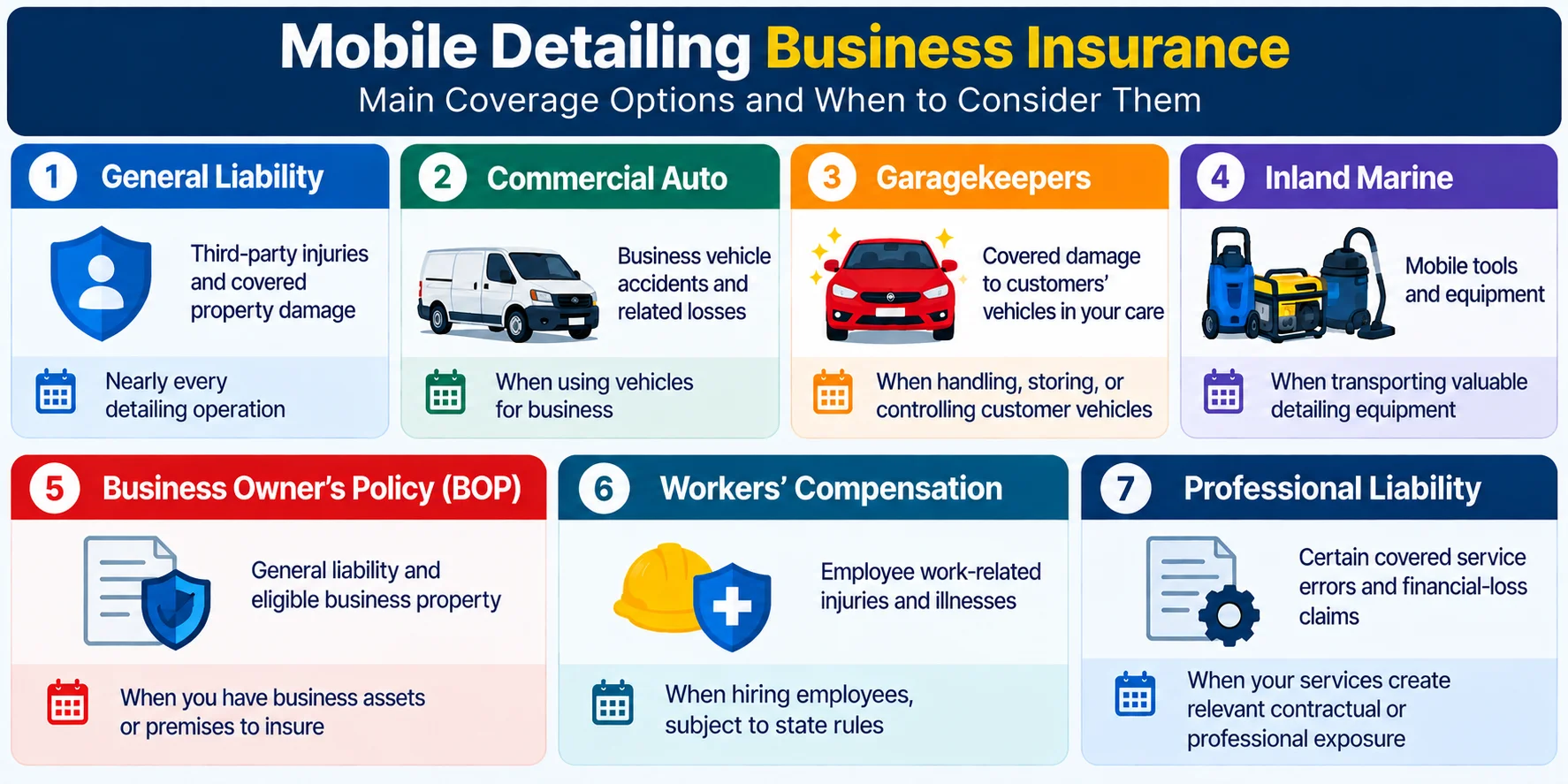
Not every mobile detailer needs all seven.
A solo operator cleaning vehicles at customers' homes has different risks from a detailing company operating multiple vans, employing technicians, and accepting dealership contracts.
The best approach is to identify your actual exposures first, then match insurance policies to them.
1. General Liability Insurance: Your Basic Business Protection
General liability insurance for mobile detailing helps protect against certain third-party bodily injury and property damage claims arising from business operations.
Imagine you're cleaning a customer's SUV in their driveway. A visitor trips over an extension cord and gets injured.
If the incident meets your policy's terms, general liability insurance may help pay covered medical expenses, legal defense costs, or damages.
Other potential situations include:
- Accidentally damaging a customer's garage door with equipment.
- Causing a visitor to slip on a wet work area.
- Damaging nearby property during an exterior cleaning service.
However, general liability does not automatically cover damage to the specific customer vehicle you're detailing.
Standard policies often include care, custody, or control exclusions and other restrictions for property you're working on.
This distinction matters because damage to a customer's car may be one of your biggest day-to-day financial exposures.
Before purchasing general liability coverage, ask the insurer:
"Does this policy cover accidental damage to a customer's vehicle while I'm actively detailing it? If not, which coverage or endorsement would address that risk?"
For a closer look at these limitations, read our general liability insurance for mobile detailing guide.
2. Garagekeepers Insurance: Protecting Customer Vehicles
Garagekeepers insurance is especially relevant when your business has possession of, or control over, customers' vehicles.
Depending on the policy, it may cover losses involving vehicles in your care, custody, or control.
For example, consider these situations:
- A customer leaves a vehicle with your business for detailing.
- You move a customer's car to another work area.
- A vehicle is damaged while stored at your business location.
- A covered incident occurs while the vehicle is under your supervision.
Garagekeepers insurance may respond to certain losses, but coverage depends on the policy form, exclusions, limits, and the circumstances of the incident.
Does garagekeepers insurance cover detailing mistakes?
Not necessarily.
You shouldn't assume a garagekeepers policy covers every type of damage caused during detailing.
For example, if an inappropriate chemical damages leather upholstery or an aggressive polishing process damages paint, the policy may not cover it.
Whether the policy covers that loss depends on the wording, including exclusions for faulty workmanship, damage to the property being worked on, and other restrictions.
Ask specifically about:
- Chemical damage to paint or interior surfaces.
- Scratches or damage caused during polishing.
- Damage while moving a customer's vehicle.
- Theft or vandalism while you have the vehicle.
- Whether coverage applies at temporary mobile job sites.
Also ask whether the policy uses direct primary, direct excess, or legal liability coverage. These arrangements can affect when the insurer responds and whether you must prove negligence.
The important question isn't simply whether garagekeepers coverage appears on your insurance quote.
It's whether the coverage applies to the actual services you perform.
Build Your Mobile Detailing Setup With Confidence
Find the right pressure washer, vacuum, chemicals, and tools for your budget—without buying what you don't need.
Build My Starter Rig3. Commercial Auto Insurance: Protecting Your Work Vehicle
Mobile detailing businesses depend on transportation.
Whether you use a pickup truck, SUV, cargo van, or trailer, your vehicle is essential to your operation.
Commercial auto insurance addresses covered risks associated with business vehicles, including liability for certain accidents and optional physical damage coverage.
Personal auto insurance may exclude or restrict commercial use. Don't assume your existing personal policy covers regular detailing appointments.
What commercial auto insurance may cover
Depending on the coverage selected, a commercial auto policy may include:
- Liability for bodily injury or property damage caused by a covered vehicle accident.
- Collision damage to your insured vehicle.
- Comprehensive losses, such as certain theft or weather damage.
- Uninsured or underinsured motorist coverage, where available.
However, commercial auto insurance generally doesn't automatically cover loose detailing tools inside your van.
Your pressure washer, vacuum, extractor, and portable generator may require separate equipment coverage.
What if you use your personal vehicle?
Tell your insurer exactly how you use the vehicle.
Explain whether you transport detailing chemicals, water tanks, generators, or other business equipment, and whether employees or contractors drive it.
Depending on the circumstances, your insurer may recommend a commercial auto policy, a permitted business-use arrangement, or another solution.
Hired and non-owned auto coverage may also apply to certain vehicles used in business activities, but it doesn't replace confirming coverage for a personally owned vehicle.
4. Inland Marine Insurance: Protecting Your Mobile Equipment
Your detailing equipment can represent a substantial investment.
A basic setup might include a pressure washer, wet/dry vacuum, hoses, chemicals, towels, and brushes.
A more advanced operation may also use an extractor, generator, polisher, and water delivery system.
If someone steals or damages equipment, replacing it can interrupt your business.
Inland marine insurance, sometimes marketed as tools and equipment coverage, can protect eligible portable business property while it is transported or used away from a fixed location.
Consider a hypothetical situation:
You finish a detailing appointment and leave your locked van parked overnight. Someone breaks in and steals your pressure washer and extractor.
Commercial auto insurance may cover certain damage to the van, but it generally won't automatically replace unattached business equipment.
An appropriately structured inland marine policy may cover eligible stolen tools, subject to policy conditions.
Before purchasing, verify:
- Whether theft from an unattended vehicle is covered.
- Whether overnight storage restrictions apply.
- Whether the policy covers equipment at customers' locations.
- Whether the policy pays replacement cost or actual cash value.
- Whether generators, water tanks, and permanently installed equipment require separate treatment.
Don't assume a business owner's policy provides identical protection for equipment transported between jobs.
5. Business Owner’s Policy: Is a BOP Worth It?
A business owner's policy, commonly called a BOP, combines general liability insurance with commercial property coverage.
Some BOPs also include business income protection for interruptions resulting from qualifying covered property losses.
This can help detail businesses that maintain a workshop, storage location, office, or other substantial property.
However, a BOP isn't automatically the best option for every mobile operator.
A home-based detailer who transports equipment between customer locations may need more specialized protection for mobile tools than a standard property policy provides.
A BOP also doesn't automatically replace commercial auto or garagekeepers coverage.
Compare the bundled package with separate policies, paying particular attention to off-premises property coverage.
6. Workers’ Compensation Insurance: When You Hire Help
Workers' compensation insurance generally provides benefits for employees with covered work-related injuries or illnesses.
For mobile detailers, possible workplace hazards include chemical exposure, slips and falls, repetitive physical work, and injuries while moving equipment.
Workers' compensation requirements vary by state, business structure, and employee classification.
A sole proprietor without employees may face different requirements from a company employing two full-time technicians.
Before hiring, verify your state's rules with the appropriate workers' compensation agency or a licensed insurance professional.
Also remember that calling someone an independent contractor doesn't automatically determine their legal classification.
How Much Does Mobile Auto Detailing Business Insurance Cost?
Insurance cost depends on your business activities, location, vehicle usage, revenue, employees, equipment value, coverage limits, and claims history.
For a useful starting point, Insureon publishes policy-cost data for auto detailing and car wash businesses.
Published insurance cost benchmarks
| Insurance Policy | Reported Median Monthly Cost | Approx. Annual Cost |
|---|---|---|
| General liability | $54 | $648 |
| Business owner's policy | $89 | $1,068 |
| Workers' compensation | $131 | $1,572 |
| Commercial auto | $46 | $552 |
Source: Insureon, Auto Detailing and Car Wash Business Insurance Costs, updated March 31, 2025. Annual amounts above are monthly medians multiplied by 12; they may differ slightly from the source's separately reported annual figures.
These figures describe policies Insureon customers purchased in the auto detailing and car wash category. They are not guaranteed quotes for mobile detailers, and they do not represent a complete insurance package.
Garagekeepers and inland marine coverage may add costs that aren't reflected in the table.
Actual premiums can also be substantially higher or lower.
Why insurance quotes vary
Two mobile detailing businesses operating in the same city may receive different quotes because they have different risks.
An insurer may evaluate:
- Services: Basic cleaning versus paint correction, ceramic coatings, or other specialized work.
- Vehicles: Number, value, ownership, driving records, and commercial usage.
- Customer property: Vehicle values, custody arrangements, and whether cars are moved or stored.
- Equipment: Replacement value and storage conditions.
- Employees: Payroll, job duties, and applicable workers' compensation classifications.
- Coverage: Policy limits, deductibles, endorsements, and exclusions.
A low monthly premium isn't necessarily a good deal if the policy excludes the losses most likely to affect your operation.
Three Mobile Detailing Insurance Scenarios
The following examples are hypothetical decision frameworks, not insurance quotes or guarantees of coverage.
Scenario 1: Solo Beginner Working at Customer Locations
Business profile: One owner, one personal vehicle used for appointments, no employees, and a basic cleaning equipment setup.
Priorities include general liability, confirming appropriate vehicle coverage, and evaluating protection for customer vehicles.
Equipment coverage becomes more valuable as the replacement cost of portable tools increases.
Check workers' compensation requirements under applicable state rules, but a solo owner without employees may not have the same obligations as an employer.
Main risk to investigate: Assuming general liability automatically covers accidental damage to the vehicle being detailed.
Scenario 2: Full-Time Mobile Detailer With a Dedicated Van
Business profile: One full-time owner, a dedicated work van, valuable portable equipment, and regular customer appointments.
Commercial auto coverage becomes a central consideration.
Inland marine insurance may also be important because the business transports tools between locations.
The owner should confirm whether garagekeepers or other specialty coverage applies to customer vehicles during detailing.
Main risk to investigate: Assuming commercial auto insurance covers everything stored inside the van.
Scenario 3: Growing Detailing Business With Employees
Business profile: Two service vehicles, multiple technicians, commercial clients, and a wider range of detailing services.
This business needs a more comprehensive insurance review.
General liability, appropriate commercial auto coverage, customer-vehicle protection, equipment insurance, and workers' compensation may all be relevant.
Commercial clients may also request certificates of insurance and specific liability limits.
Main risk to investigate: Purchasing individual policies without checking whether their exclusions leave important gaps between coverages.
A Practical Insurance Coverage Decision Matrix
The most useful way to compare insurance is to start with the event you're trying to protect against.
| Potential Loss | Coverage to Investigate |
|---|---|
| Customer trips over detailing equipment | General liability |
| Customer vehicle damaged during detailing | Garagekeepers or specialty coverage, with workmanship exclusions reviewed |
| Work van involved in a road accident | Commercial auto |
| Portable pressure washer stolen from van | Inland marine |
| Employee injured while working | Workers' compensation |
| Business property damaged in a covered fire | Commercial property or BOP |
| Customer vehicle damaged while being moved | Garagekeepers and applicable garage/auto coverage |
This matrix identifies policies to investigate, not guaranteed claim outcomes.
Coverage depends on the facts of the loss and the actual policy.
Seven Questions to Ask Before Buying Business Insurance
Before purchasing a policy, use these questions to evaluate whether it fits your operation.
- Are mobile detailing services explicitly covered? Confirm that the insurer understands you work at customers' homes, businesses, and other temporary locations.
- What happens if I damage a customer's vehicle? Ask about scratches, chemical damage, paint correction mistakes, and interior damage.
- Does coverage apply while I move or store customer vehicles? Explain whether you drive, reposition, or retain custody of vehicles.
- Are my tools protected in transit? Ask about theft, unattended vehicles, overnight storage, and equipment replacement value.
- What exclusions apply to my services? Discuss ceramic coatings, machine polishing, engine cleaning, and any specialized work you offer.
- What are the coverage limits and deductibles? Compare the maximum protection available and the amount you may need to pay after a loss.
- Can the insurer provide a certificate of insurance? Ask whether your policy can satisfy commercial customer or property-management requirements.
Request written confirmation of important coverage details rather than relying only on verbal descriptions.
How to Compare Mobile Detailing Insurance Quotes
Comparing quotes is easier when each insurer receives the same business information.
Step 1: Prepare your business profile
Gather your business location, estimated annual revenue, services offered, number of employees, vehicle details, and approximate equipment replacement value.
Be accurate about your services. An insurer may evaluate a business offering basic wash packages differently from one performing advanced paint correction.
Step 2: Request comparable coverage
Ask multiple licensed insurance agents or providers for quotes with the same coverage types and similar limits.
Otherwise, a cheaper quote may simply provide less protection.
Step 3: Compare more than premiums
Use this checklist:
- Policy limits and aggregate limits.
- Deductibles.
- Customer-vehicle coverage.
- Workmanship exclusions.
- Mobile equipment coverage.
- Commercial vehicle protection.
- Coverage territory and job-site restrictions.
- Additional insured and certificate requirements.
Step 4: Confirm the policy before starting work
Review the declarations, coverage forms, endorsements, and exclusions.
Make sure the named insured and business operations are correctly described.
If you need a certificate of insurance for a client, obtain it before the scheduled appointment.
A certificate summarizes insurance information but doesn't independently expand coverage beyond the policy.
Stop Guessing. Start Building.
Not sure how to allocate your equipment budget? Explore starter equipment recommendations for $750, $1,000, or $1,500 before committing to purchases.
Explore Build My Starter RigCommon Mobile Detailing Insurance Mistakes
Buying only general liability
General liability is useful, but it doesn't replace commercial auto insurance or automatically protect customer vehicles and your equipment.
Choosing the cheapest quote
A lower premium may reflect lower limits, higher deductibles, narrower coverage, or exclusions that matter to your services.
Forgetting equipment theft
Portable detailing equipment can be stolen while traveling or parked between appointments.
Check where and when your equipment is insured.
Not updating your policy as your business grows
Adding employees, purchasing another van, offering new services, or accepting higher-value vehicles may change your insurance needs.
Review your policies when operations change.
Confusing business licensing with insurance
A business license and an insurance policy serve different purposes.
Licensing concerns legal permission to operate, while insurance addresses specified financial risks.
Requirements may differ by state and municipality.
For more information, read our car detailing license guide.
Include Insurance in Your Detailing Business Budget
Treat insurance as a recurring business expense, not an unexpected bill.
Your monthly operating budget may also need to account for chemicals, fuel, equipment maintenance, replacement supplies, payment processing, and other overhead.
For example, suppose a hypothetical detailer pays $180 per month for combined insurance policies and completes 40 paid jobs.
The insurance allocation would be:
$180 ÷ 40 jobs = $4.50 per job
This is only an expense-allocation example. It isn't a market insurance quote, and it doesn't include other business costs.
If that operator completes only 20 jobs in a slower month, the same insurance expense becomes $9 per job.
That difference shows why your pricing needs to reflect realistic booking volume rather than assuming every week will be fully booked.
For help evaluating your service pricing, see our interior car detailing prices list.
If you're still planning your business, our guide to starting a mobile detailing business explains other startup decisions that affect your budget.
You can also use the free Starter Rig Builder to explore equipment options within your startup budget.
The tool helps with equipment planning; it does not calculate insurance premiums or determine insurance eligibility.
Frequently Asked Questions about Mobile Detailing Business Insurance
Is mobile detailing business insurance required by law?
Requirements depend on your state, vehicle use, employees, and business activities.
Commercial auto liability coverage and workers' compensation may be legally required under applicable circumstances. General liability is often purchased for financial protection or to meet contractual requirements, not because of a universal statewide mandate.
Verify your obligations with the relevant state agencies and a licensed insurance professional.
Does general liability insurance cover scratches on a customer's car?
Not automatically.
Damage to a vehicle you're actively working on may fall under care, custody, or control exclusions or other policy restrictions.
Ask your insurer whether the specific damage scenario is covered and whether you need additional garagekeepers or specialty coverage.
Can I use personal car insurance for my mobile detailing business?
You shouldn't assume personal auto insurance covers regular business use.
Contact your insurer, describe your detailing operations, and confirm the appropriate coverage in writing.
Do I need garagekeepers insurance if I only work at customers' homes?
It depends on your operations and the policy.
Even if you don't operate a fixed garage, you may have custody or control of a customer's vehicle during certain services.
Ask an insurer familiar with mobile auto detailing whether garagekeepers or another coverage form addresses your specific exposure.
How can I lower my mobile detailing insurance costs?
Compare equivalent quotes, review available bundling discounts, maintain safe working practices, and choose limits and deductibles based on your financial risk.
Don't reduce essential coverage just to lower the monthly premium.
Final Thoughts: Build Coverage Around Your Actual Risks
The right mobile detailing business insurance package depends on what you do, where you work, the vehicles and equipment you use, and whether you employ other people.
General liability is a useful starting point, but it isn't complete business protection.
Before purchasing, pay particular attention to customer-vehicle damage, commercial driving, portable equipment, and the exclusions that apply to your services.
The goal isn't to buy the most policies. It's to understand your exposures and get coverage that matches the risks your business actually faces.
Disclaimer: This article provides general educational information for U.S. mobile detailing businesses. It is not legal or insurance advice. Requirements and coverage vary by state, insurer, and policy. Consult your state regulator and a licensed insurance professional for guidance specific to your business.