Watch a few professional detailers on YouTube, and you might think you need dozens of chemicals, multiple pressure washers, and a van full of specialized tools to start detailing cars.
One professional recommends an expensive wheel cleaner. Another uses an all-purpose cleaner for several jobs. A third has an entirely different collection of products.
So what do professional auto detailers actually use, and how much of that equipment does a beginner really need?
The answer depends on the services you plan to offer, the vehicles you work on, and how you operate your business.
Quick Answer: Most beginners can start with a relatively small collection of cleaning chemicals, quality microfiber towels, appropriate brushes, a wet/dry vacuum, and a reliable washing setup. Specialized products and expensive equipment matter more when you start offering advanced services such as paint correction, ceramic coatings, and intensive interior restoration.
The goal isn't to copy every product a professional uses. It's to understand which tools and chemicals you need for the work you intend to do.
What Makes Someone a Professional Detailer?
A professional detailer does more than wash vehicles.
Professional auto detailers clean, maintain, and restore vehicle surfaces using the right products, equipment, and techniques. Their services may include routine exterior cleaning, interior detailing, paint decontamination, polishing, and protective treatments.
The difference between basic car washing and professional detailing often comes down to the scope of work and attention to individual surfaces.
For example, exterior cleaning may involve washing the paint, removing contaminants, cleaning wheels, drying delicate surfaces, and applying protection.
Interior detailing can require vacuuming, cleaning plastics, treating upholstery, removing embedded dirt, and addressing stains.
A professional also needs to recognize when a product or technique could damage a surface.
That includes knowing when to avoid aggressive cleaners, how to test unfamiliar materials, and when a customer's expectations exceed what a particular service can realistically deliver.
Professional Skills Go Beyond Cleaning
Technical skills matter, but running a detailing business requires additional abilities.
Professional detailers also need to manage customer expectations, estimate job times, price services, maintain equipment, and communicate clearly about the results customers can expect.
For mobile operators, travel time, equipment storage, electrical access, water availability, and working conditions become part of the job.
If you're considering turning detailing into a business, our guide to starting a mobile detailing business covers the broader planning process.
What Chemicals Do Professional Detailers Actually Use?
One of the biggest sources of confusion for beginners is how many detailing chemicals are available.
Specialized products exist for wheels, tires, paint, glass, leather, fabric, plastics, bugs, tar, iron contamination, and protective coatings.
But not every service requires a different bottle.
In a Reddit discussion titled Professional detailers, what chemicals do you use?, several contributors emphasized simplifying their chemical collections and choosing products based on practical needs rather than online popularity.
One contributor described reducing a collection of more than 20 chemicals to approximately six as their experience increased.
That's an individual experience, not a universal recommendation. Still, it illustrates an important principle: a larger product collection doesn't automatically mean better detailing.
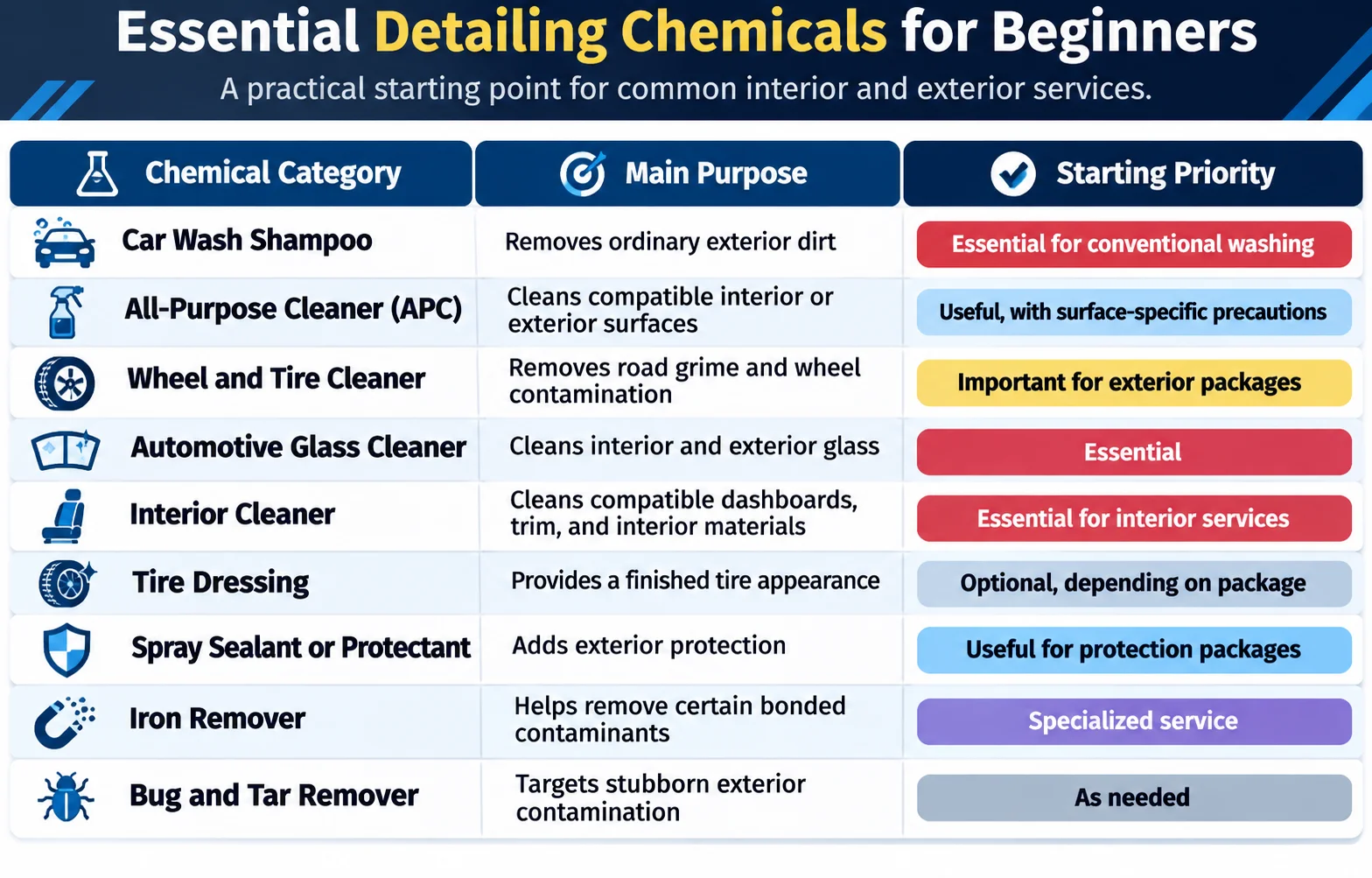
Essential Detailing Chemicals for Beginners
The following categories provide a practical starting point for common interior and exterior services.
| Chemical category | Main purpose | Starting priority |
|---|---|---|
| Car wash shampoo | Removes ordinary exterior dirt | Essential for conventional washing |
| All-purpose cleaner (APC) | Cleans compatible interior or exterior surfaces | Useful, with surface-specific precautions |
| Wheel and tire cleaner | Removes road grime and wheel contamination | Important for exterior packages |
| Automotive glass cleaner | Cleans interior and exterior glass | Essential |
| Interior cleaner | Cleans compatible dashboards, trim, and interior materials | Essential for interior services |
| Tire dressing | Provides a finished tire appearance | Optional, depending on package |
| Spray sealant or protectant | Adds exterior protection | Useful for protection packages |
| Iron remover | Helps remove certain bonded contaminants | Specialized service |
| Bug and tar remover | Targets stubborn exterior contamination | As needed |
These are product categories, not recommendations to use any one chemical on every surface.
For example, an all-purpose cleaner may work on some plastics or heavily soiled exterior areas but may be inappropriate for delicate leather, sensitive trim, or certain finishes.
Always check the product's instructions and surface compatibility before using it.
Do Professionals Need Expensive Chemical Brands?
Not necessarily.
An expensive product can be worthwhile when it performs a specialized task effectively, but price alone doesn't establish cleaning performance.
Professional operators should also consider how much usable solution a product provides.
Concentrated chemicals can be economical when purchased and diluted correctly. However, the actual value depends on the purchase price, required dilution, amount used per vehicle, and suitability for the task.
Consider this hypothetical comparison:
- Product A costs $30 and makes 10 gallons of usable solution.
- Product B costs $18 and makes 3 gallons of usable solution.
Product A costs $3 per usable gallon, while Product B costs $6 per usable gallon.
That doesn't prove Product A cleans better. It simply shows why comparing bottle prices can be misleading.
Dilute concentrates only according to the manufacturer's instructions. Never assume that a stronger mixture will improve results.
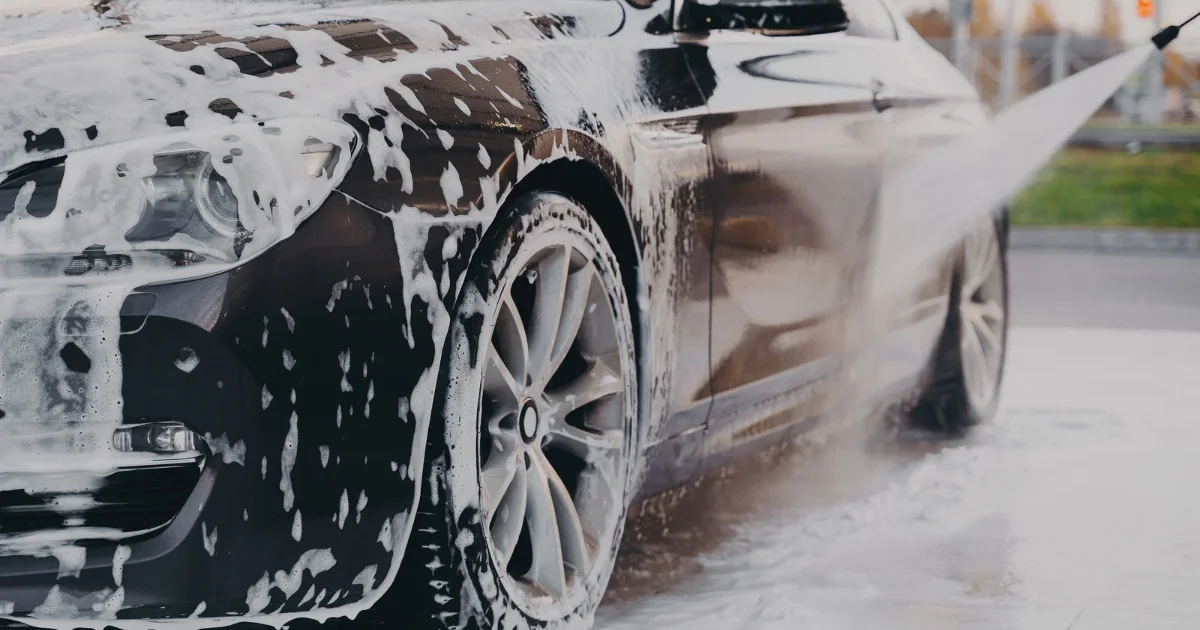
Build Your Mobile Detailing Setup With Confidence
Find the right pressure washer, vacuum, chemicals, and tools for your budget—without buying what you don't need.
Build My Starter RigWhat Equipment Do Professional Auto Detailers Use?
Professional detailing equipment ranges from simple hand tools to expensive machines designed for specialized work.
For beginners, the most useful question is not which equipment looks professional.
It's which equipment is required to complete the services you plan to sell.
1. Wet/Dry Vacuum
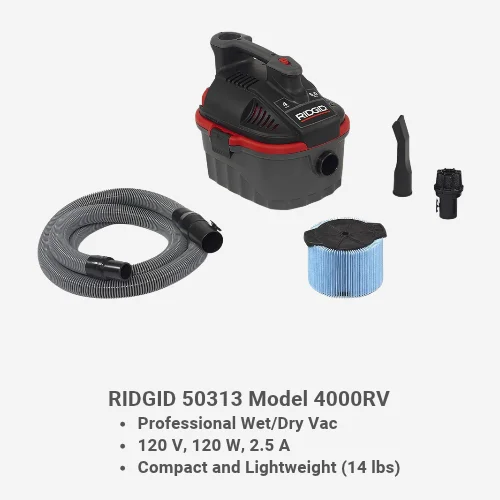
A wet/dry vacuum is one of the most useful tools for interior detailing.
It helps remove loose dirt, dust, sand, and debris from carpets, floor mats, seats, and cargo areas.
When choosing a vacuum, consider its suction performance, hose and attachment options, capacity, portability, and electrical requirements.
For mobile work, the vacuum must also fit your vehicle and power setup.
2. Pressure Washer or Alternative Washing Setup
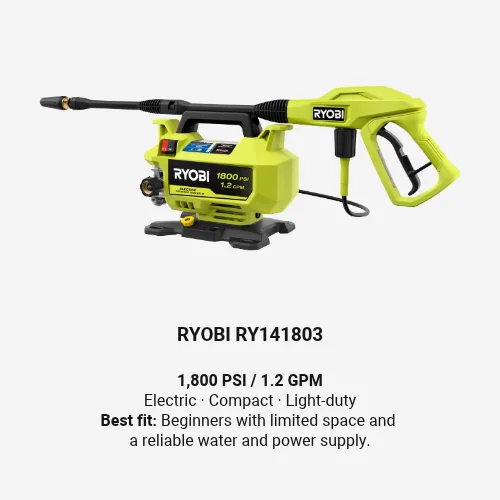
A pressure washer can help remove loose exterior dirt and rinse vehicles efficiently.
However, not all professional detailers need the same pressure washer.
Equipment selection depends on water access, available electricity, intended workload, and compatible accessories.
A beginner doing basic maintenance washes may be able to use a simpler setup than an operator handling frequent, heavily soiled vehicles.
Higher pressure is not automatically better. Incorrect pressure, nozzle selection, or working distance can damage sensitive surfaces.
3. Microfiber Towels and Wash Mitts
Quality microfiber towels are essential for many detailing tasks.
Use them to dry, clean interior surfaces, remove product residue, and apply certain finishing products.
A practical setup separates towels by task.
For example, don't reuse towels used on wheels or heavily contaminated areas on delicate paint surfaces without proper laundering and inspection.
Keeping clean and dirty towels separate also helps reduce cross-contamination.
4. Brushes and Small Accessories
Detailing brushes help clean areas that towels cannot easily reach.
Common examples include wheel brushes, soft interior brushes, tire brushes, and tools designed for narrow crevices.
Choose brush materials and stiffness according to the surface. A brush suitable for tires may be far too aggressive for delicate interior trim or painted surfaces.
5. Specialized Equipment
As services expand, professional detailers may add:
- Carpet extractors for appropriate fabric-cleaning jobs
- Steam cleaners for compatible surfaces and tasks
- Dual-action polishers for paint correction
- Dedicated lighting for paint inspection
- Air blowers or compressed-air equipment
- Water tanks and pumps for self-contained mobile operations
- Generators or other compatible power solutions
These purchases should be driven by actual service requirements, not the assumption that every professional must own them.
For a broader equipment breakdown, see our mobile detailing equipment list.
Essential vs. Optional: What Should Beginners Buy First?
The easiest way to avoid overspending is to organize purchases around the services you intend to offer.
| Planned service | Start with | Add when justified |
|---|---|---|
| Basic exterior wash | Shampoo, wash media, drying towels, compatible water setup | Specialized decontamination chemicals |
| Basic interior detail | Vacuum, interior cleaner, glass cleaner, microfiber towels, brushes | Extractor or steamer |
| Wheel and tire cleaning | Compatible cleaners, brushes, towels | Specialized contamination removers |
| Exterior protection | Suitable applicators and basic protectant | Advanced coating systems |
| Paint correction | Proper training, inspection equipment, compatible polishing system | Additional pads, compounds, and specialized tools |
This framework also helps explain why two successful detailing businesses may have completely different equipment collections.
One may specialize in interior cleaning, while another focuses on paint correction and premium protective coatings.
Both can be professional operations without using identical products.
Three Questions Before Buying Another Product
Before adding another chemical or tool, ask:
1. Which service requires it?
If you cannot identify the task, the purchase may not be necessary yet.
2. Can your existing equipment safely complete that task?
Sometimes an appropriate tool or chemical you already own can handle more than one job.
However, never substitute products without checking surface compatibility and manufacturer instructions.
3. Will you use it often enough to justify the expense?
A specialized tool may make sense for recurring work but be difficult to justify for a service you rarely perform.
These questions help keep your equipment collection practical, not excessive.
What Do Professional Detailers Do Differently?
Professional results depend on process as much as products.
Experienced detailers often develop repeatable workflows that reduce unnecessary steps while maintaining consistent quality.
Inspect Before Cleaning
Not every vehicle needs the same treatment.
Before starting, examine the condition of the paint, wheels, upholstery, carpets, and interior materials.
Look for existing damage, unusual stains, sensitive surfaces, and areas that may require specialized treatment.
Inspection also helps establish realistic customer expectations.
Match the Chemical to the Surface
A product that removes stubborn grime from one material may damage another.
Professional detailing requires understanding product instructions, chemical strength, surface compatibility, and safe application.
Avoid mixing chemicals unless the manufacturer explicitly authorizes it.
The U.S. Occupational Safety and Health Administration's Hazard Communication guidance explains workplace chemical labeling, safety data sheets, and related employee training requirements.
Work in a Consistent Order
A repeatable workflow can reduce missed areas and unnecessary rework.
For example, an interior-detailing process might begin with removing loose items and vacuuming, then move to surface cleaning, targeted stain treatment, and a final inspection.
The exact sequence depends on the vehicle and the work being performed.
Check the Finished Work
A professional service should include a final inspection.
Before returning the vehicle, check for leftover cleaner residue, glass streaks, missed debris, and other visible issues.
Small details can influence how customers judge the overall service.
Do You Need Professional Detailing Certification?
Professional detailing certification can help demonstrate training and technical knowledge, but it should not be confused with a government-issued business license.
The International Detailing Association (IDA) offers a certification program with two main levels.
Certified Detailer (CD): The first phase evaluates technical knowledge through written examinations covering subjects such as equipment, chemicals, interior detailing, paint correction, and safety.
Certified Detailer, Skills Validated (CD-SV): The second phase adds practical assessments designed to evaluate hands-on detailing skills.
These credentials may help detailers demonstrate their commitment to professional development.
However, certification alone does not guarantee customer satisfaction, business success, or competence in every specialized service.
Requirements for operating a business are separate and may vary by location.
For more information, read our guides to auto detailing training, car detailing certification, and car detailing licenses.
Professional Mobile Detailers vs. Shop-Based Detailers
Professional detailers can operate from a fixed location, travel to customers, or use a combination of both models.
Each approach creates different equipment requirements.
| Consideration | Mobile detail service | Fixed detailing shop |
|---|---|---|
| Workspace | Customer location | Dedicated facility |
| Water access | Must be confirmed or supplied | Depends on facility infrastructure |
| Electrical power | Customer supply or independent system | Usually facility-based |
| Equipment storage | Limited by vehicle space and payload | Depends on shop space |
| Weather exposure | Often a major operating constraint | More controllable indoors |
| Travel time | Part of daily scheduling | Customers typically travel to the shop |
A mobile detail service can reduce the need for a dedicated commercial workspace, but it introduces additional planning requirements.
Operators must consider transportation, safe equipment storage, setup time, weather, and local wastewater requirements.
The Environmental Protection Agency explains that stormwater runoff can carry pollutants through drainage systems into local waterways. Mobile detailers should check applicable local requirements before allowing wash water to enter storm drains.
Mobile businesses also need to consider vehicle payload when carrying water tanks, generators, chemicals, and other equipment.
These practical limitations matter more than choosing equipment simply because it is popular with professional detailers online.
Stop Guessing. Start Building.
Not sure how to allocate your equipment budget? Explore starter equipment recommendations for $750, $1,000, or $1,500 before committing to purchases.
Explore Build My Starter RigFive Mistakes Beginners Make When Copying Professional Detailers
1. Buying Too Many Chemicals
It's easy to accumulate several products that perform similar jobs.
Start with the categories required for your services and expand only when you identify a real need.
2. Copying Someone Else's Equipment Setup
A detailer working from a large van may use equipment that doesn't make sense for someone operating from a compact vehicle.
Choose equipment based on your own space, power, water access, and workload.
3. Assuming Stronger Chemicals Work Better
Incorrect dilution or aggressive chemicals can create unnecessary risks.
Follow manufacturer instructions and test unfamiliar products on suitable inconspicuous areas.
4. Offering Advanced Services Without Training
Paint correction, advanced stain treatment, and coating installation require additional knowledge and practice.
Buying the equipment does not automatically provide the skills to use it correctly.
5. Ignoring Operating Costs
The purchase price of equipment is only part of the cost.
Consider replacement towels, chemical consumption, accessories, maintenance, travel, and time spent preparing equipment.
For mobile operators, these recurring expenses can influence which services are practical to offer.
How to Build Your First Professional Detailing Setup
If you're starting from scratch, focus on a manageable service offering.
Step 1: Choose Your Initial Services
Decide whether you'll begin with basic exterior washes, interior cleaning, or combined maintenance packages.
Avoid committing to advanced paint correction or coating work before you have the necessary training and equipment.
Step 2: Identify the Minimum Equipment
List the tools and chemicals needed to complete each service safely.
Separate essential items from products that would simply be convenient.
Step 3: Check Your Operating Constraints
Before purchasing equipment, confirm your available power, water supply, storage space, and vehicle capacity.
A tool is not useful if it cannot operate reliably in your intended setup.
Step 4: Practice a Repeatable Workflow
Develop a consistent process for inspecting, cleaning, and checking vehicles.
Practice on vehicles where you have permission to work, and avoid unfamiliar or high-risk treatments until you understand the requirements.
Step 5: Upgrade Based on Actual Needs
As your workload changes, identify which tools are limiting your services or efficiency.
Upgrade for a specific reason, not just because an online creator recommended it.
Plan Your Equipment Before You Buy
Not sure which tools fit your startup budget?
The DetailerDecision Starter Rig Builder helps beginners evaluate starter equipment choices based on their setup needs and budget.
Use it as a planning aid, then confirm product specifications, compatibility, and current prices before purchasing.
How to Find Professional Detailers Near Me
If you're looking to hire someone rather than start a business, the selection process is different.
Searching for professional detailers near me or car detailers can help you identify local businesses, but search rankings alone don't establish service quality.
Compare the actual services offered, not just advertised package names.
Ask whether the quoted service includes interior cleaning, exterior washing, paint decontamination, polishing, or protective treatments.
These tasks can require very different amounts of work.
You should also consider recent customer reviews, examples of relevant work, the detailer's experience with your vehicle's surfaces, and whether the business can clearly explain its process.
If certification matters to you, ask which credential the detailer holds and what it covers.
A certified professional detailer may have demonstrated particular knowledge or skills, but you should still evaluate the business's service quality and suitability for your needs.
Frequently Asked Questions
What products do professional detailers use most?
Common categories include car wash shampoo, interior cleaners, glass cleaner, wheel and tire products, microfiber towels, brushes, and vacuum equipment. Specialized services may require additional chemicals and machines.
Do professional detailers use expensive chemicals?
Some do, but expensive chemicals aren't always necessary. Professionals may select products based on performance, surface compatibility, dilution requirements, and cost per usable application.
Can you become a professional detailer without certification?
Professional detailing certification is not required to enter the occupation in the United States. However, applicable business licensing, environmental rules, and other legal obligations vary by location. Training and certification can help develop and demonstrate skills.
How much equipment does a beginner need?
That depends on the services offered. A basic interior and exterior maintenance operation generally requires fewer specialized tools than a business offering paint correction, advanced restoration, and ceramic coatings.
Is mobile detailing a good way to start?
Mobile detailing can be a practical entry model for someone who wants to avoid maintaining a dedicated shop. However, it requires careful planning for transportation, power, water, weather, wastewater, and equipment storage.
Final Thoughts
Professional detailers don't all use the same products, equipment, or techniques.
Their choices reflect the services they offer, the vehicles they work on, and the conditions they operate in.
For beginners, the most practical approach is to start with a small, reliable collection of tools and compatible chemicals, learn how to use them safely, and develop a consistent workflow.
As your experience and service offerings expand, your equipment can expand with them.
Professional detailing isn't about owning everything. It's about knowing what each job actually requires.
Disclosure: This page may contain affiliate links. If you purchase through them, we may earn a small commission at no extra cost to you.