
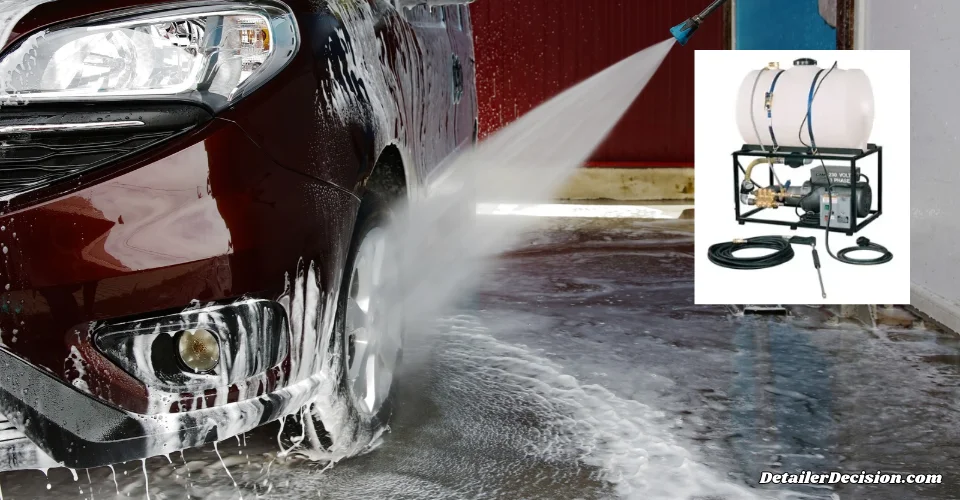
Choosing the right water tanks for pressure washing is about more than finding a container that fits in your truck. Your tank must hold enough water for the job, fit safely in your vehicle, and deliver the flow rate and inlet pressure your pressure washer requires.
A 50-gallon tank might be practical for a mobile car detailer washing one or two vehicles. A contractor cleaning driveways or commercial properties may need a much larger buffer tank. But bigger is not always better, especially when water weight, limited cargo space, and equipment compatibility are involved.
This guide explains which tank sizes make sense, what types to consider, when you need a separate water pump, and how to avoid common setup mistakes.
Quick Answer: What Size Water Tank Do You Need for Pressure Washing?
For beginners, 50 to 100 gallons is a useful starting range for many mobile detailing setups, while commercial pressure washing operations may benefit from 200 gallons or more.
However, the correct size depends on how much water your machine uses, how long you spray, and whether you can refill the tank during a job.
| Water tank size | Potential use | Water weight when full |
|---|---|---|
| 15–35 gallons | Small portable cleaning jobs | 125–292 lbs |
| 50–65 gallons | Compact mobile detailing setups | 417–542 lbs |
| 100 gallons | Larger mobile detailing setups | 834 lbs |
| 200 gallons | Commercial buffer tank applications | 1,668 lbs |
| 275 gallons | Larger truck or trailer setups | 2,294 lbs |
| 500 gallons | Heavy-duty commercial operations | 4,170 lbs |
Weights are approximate and include water only, using 8.34 pounds per U.S. gallon. Add the weight of the empty tank, mounting hardware, equipment, and other cargo.
These are planning categories, not guaranteed job capacities. A small tank can work with frequent refilling, while a large tank can still run empty quickly with a high-flow pressure washer.
Beginner recommendation: Determine your pressure washer's actual water consumption and your vehicle's available payload before buying a tank.
Why Do You Need a Water Tank for Pressure Washing?
A water tank stores water so your pressure washer can operate when a reliable external water supply is unavailable or insufficient.
There are two common situations.
1. Mobile Detailing Without a Customer Water Connection
Some mobile detailers bring their own water because they can't rely on customers to provide a usable outdoor faucet.
A portable water tank lets them serve locations without a convenient water connection.
However, the tank alone doesn't guarantee the pressure washer will work. The machine must match the tank's supply pressure and flow.
2. Commercial Pressure Washing With a Buffer Tank
A buffer tank can help manage differences between the water supplied by a faucet and the amount a pressure washer consumes.
For example, consider a machine rated at 5 GPM connected to a faucet that delivers only 4 GPM.
If both flows remain constant, the tank loses approximately one gallon per minute while the washer operates.
A buffer tank can temporarily cover that difference, but it cannot provide an unlimited water supply. Eventually, you must refill the tank or stop the pressure washer.
Important: A buffer tank stores water. It does not automatically create the inlet pressure every pressure washer requires.
Best Types of Water Tanks for Pressure Washing
Instead of choosing a tank based only on its advertised capacity, compare its shape, construction, outlet configuration, and intended application.
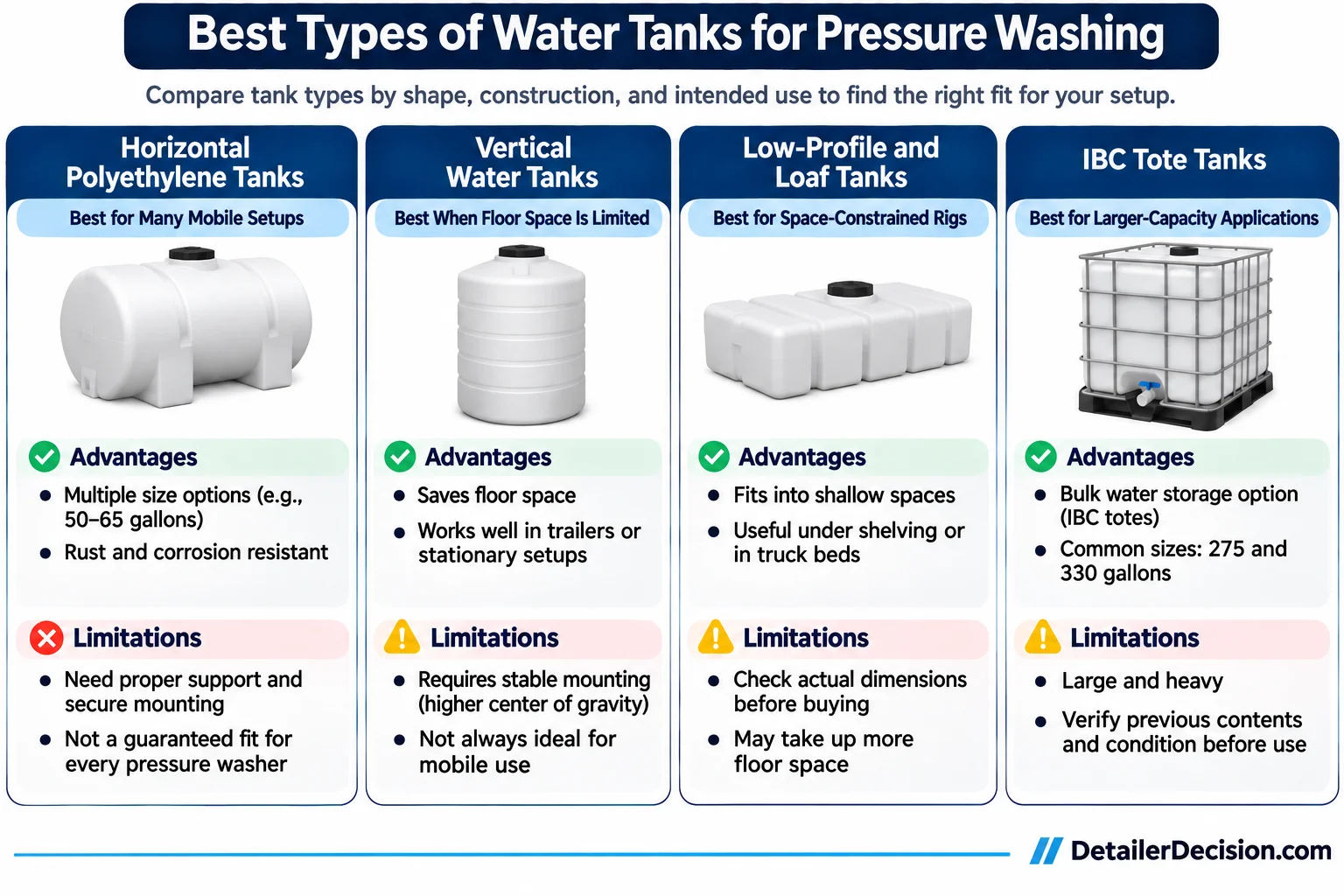
1. Horizontal Polyethylene Tanks — Best for Many Mobile Setups
Horizontal polyethylene tanks are a practical option for mobile detailers using pickup trucks, vans, or trailers.
Their relatively low profile can make it easier to arrange equipment around the tank.
Advantages:
- Available in compact and larger capacities
- Resistant to rust and corrosion
- Various mounting and outlet configurations
- Suitable for many mobile water-storage applications
Limitations:
- Require proper support and secure mounting
- Some models need additional fittings
- Their shape does not guarantee pressure washer compatibility
A 50- to 65-gallon horizontal tank may be worth considering for a compact mobile detailing rig, provided its weight and dimensions suit the vehicle.
2. Vertical Water Tanks — Best When Floor Space Is Limited
Vertical tanks can save floor space when compared with some wider horizontal designs.
They may work well in certain trailers or stationary installations.
However, taller tanks require careful consideration of mounting stability, center of gravity, and manufacturer-approved support.
For mobile use, never assume that a tall tank can be safely transported simply because it fits inside the vehicle.
3. Low-Profile and Loaf Tanks — Best for Space-Constrained Rigs
Low-profile tanks are designed to fit into relatively shallow spaces.
They may be useful when equipment must fit beneath shelving or within a carefully planned truck-bed layout.
Before purchasing, compare the actual dimensions rather than relying on labels such as slimline or low-profile.
A tank that saves height may occupy considerably more floor space.
4. IBC Tote Tanks — Best for Larger-Capacity Applications
Intermediate bulk containers, commonly called IBC totes, are another water-storage option.
Common capacities include 275 and 330 gallons.
They can offer substantial storage capacity, but their size and weight make them unsuitable for many smaller mobile detailing vehicles.
Used IBC totes also require additional caution. Verify their previous contents and condition before considering them for water storage.
Do not assume a reconditioned or previously used chemical container is suitable for your intended application.
Build Your Mobile Detailing Setup With Confidence
Find the right pressure washer, vacuum, chemicals, and tools for your budget—without buying what you don't need.
Build My Starter RigWater Tank Options Worth Comparing in 2027
The following examples illustrate the types of tanks available to buyers. They are not hands-on tested rankings, and pricing and availability may change.
| Tank example | Capacity | Best suited for |
|---|---|---|
| RomoTech polyethylene reservoir | 26 gallons | Compact portable water storage |
| RomoTech horizontal poly tank | 50 gallons | Smaller mobile detailing rigs |
| Norwesco horizontal leg tank | 65–66 gallons | Medium-size mobile water storage |
| RomoTech horizontal poly tank | 100 gallons | Larger mobile detailing setups |
| NTO Tank pressure washer tank | 200 gallons | Commercial buffer tank systems |
| IBC tote tank | 275 gallons | Larger-capacity water storage |
RomoTech 26-Gallon Poly Storage Tank
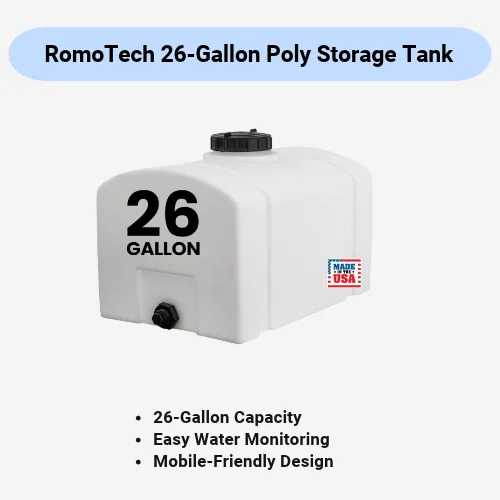
A compact reservoir may appeal to beginners who have limited cargo space and relatively low water consumption.
The 26-gallon RomoTech tank is a smaller polyethylene storage tank.
Its main advantage is manageable capacity, although even 26 gallons of water weighs approximately 217 pounds before adding the tank itself.
Best for: Small setups with limited space and payload.
RomoTech 50-Gallon Horizontal Poly Tank
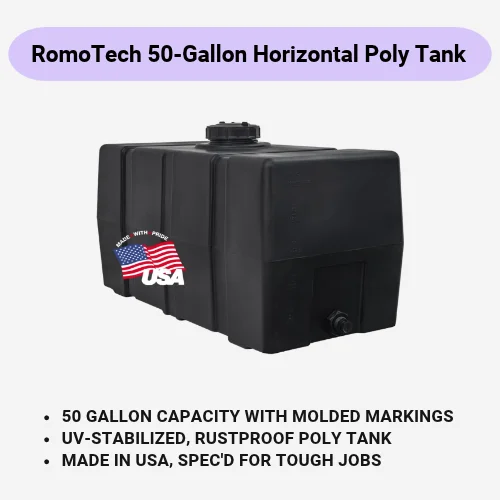
A 50-gallon tank offers a middle ground between compact storage and larger commercial tanks.
It can be an option for mobile detailing operators who want their own water supply without moving to a 100-gallon system right away.
However, a full tank contains approximately 417 pounds of water.
Best for: Beginners who have confirmed their expected water use and vehicle capacity.
Norwesco 65–66 Gallon Horizontal Leg Tank
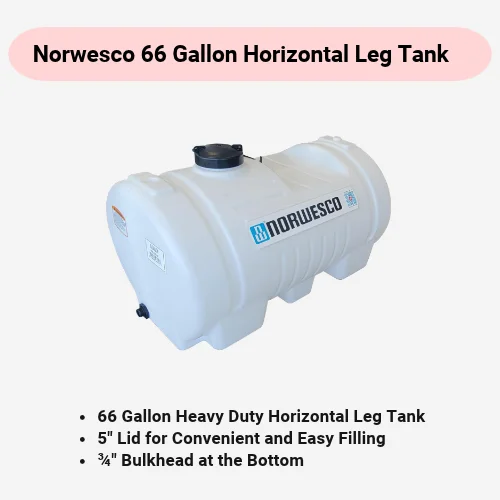
Horizontal leg tanks are designed for supported liquid storage and are available in several capacities.
A tank in this range provides more storage than a 50-gallon model without requiring the space of a much larger commercial reservoir.
Check the exact model's outlet size, mounting requirements, and intended transportation use.
Best for: Mobile operators who need a moderate capacity increase.
RomoTech 100-Gallon Horizontal Poly Tank
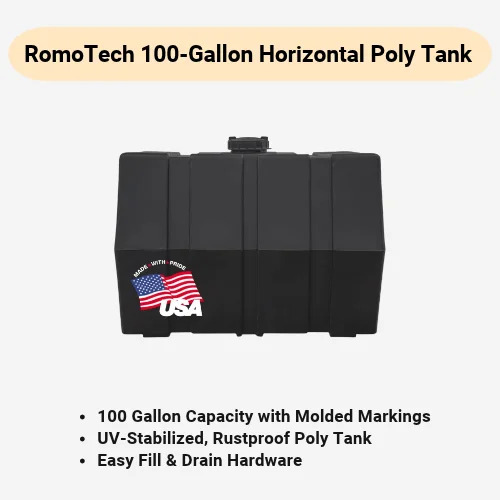
A 100-gallon tank provides substantially more storage but also adds significant weight.
When full, the water alone weighs approximately 834 pounds.
That makes payload planning essential, especially when a van or truck also carries a generator, pressure washer, vacuum, chemicals, and other equipment.
Best for: Larger mobile rigs with adequate verified payload capacity.
200-Gallon Commercial Pressure Washer Tank
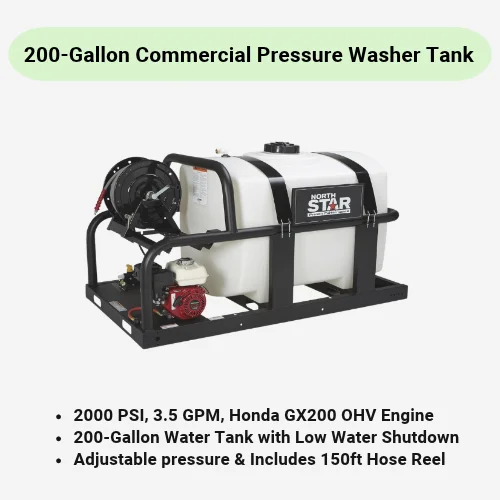
A 200-gallon tank may be useful for commercial pressure washing operations that need a buffer between a water source and a high-flow machine.
The tank's actual usefulness depends on how quickly water enters and leaves it.
For example, if a pressure washer consumes 6 GPM while the incoming supply delivers 4 GPM, the tank experiences a net loss of 2 GPM.
Best for: Commercial operations with appropriate equipment, mounting, and water-supply planning.
275-Gallon IBC Tote
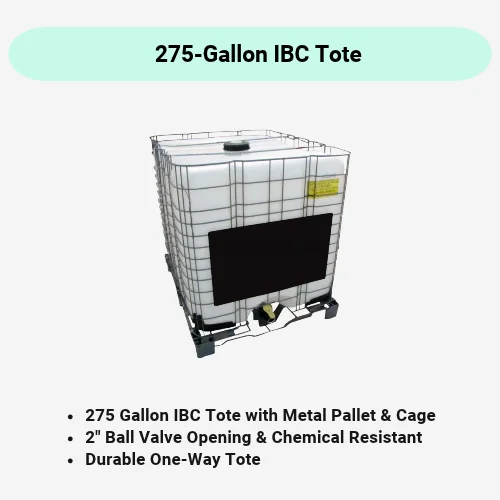
A 275-gallon IBC tote offers considerable storage capacity.
But water alone weighs approximately 2,294 pounds at this capacity.
That weight can exceed the available payload of many vehicles after accounting for passengers, equipment, and other cargo.
Best for: Properly rated larger vehicles, trailers, or stationary installations.
Buying tip: Compare tank dimensions, outlet fittings, mounting instructions, and total installed cost before comparing advertised prices.
How to Calculate the Right Water Tank Size
Start by estimating how long you will actually run the pressure washer.
Water Tank Sizing Formula
Water needed (gallons) = Pressure washer flow rate (GPM) × Actual trigger-on time (minutes)
For example:
A pressure washer consuming 2 GPM with 20 minutes of actual spraying requires approximately:
2 × 20 = 40 gallons
This calculation assumes there is no incoming refill water during use.
It also excludes extra water for priming, rinsing outside the pressure washer, and an operational reserve.
Example: How Long Will a Full Tank Last?
| Tank capacity | 2 GPM washer | 4 GPM washer | 6 GPM washer |
|---|---|---|---|
| 35 gallons | 17.5 min | 8.8 min | 5.8 min |
| 50 gallons | 25 min | 12.5 min | 8.3 min |
| 65 gallons | 32.5 min | 16.3 min | 10.8 min |
| 100 gallons | 50 min | 25 min | 16.7 min |
| 200 gallons | 100 min | 50 min | 33.3 min |
These are theoretical maximum spraying times with a completely full tank, constant rated flow, and no refilling. Real usable runtime will generally be shorter.
Don't Confuse Job Duration With Spraying Time
A two-hour detailing appointment doesn't necessarily mean the pressure washer runs for two hours.
You may spend much of that time applying chemicals, brushing wheels, cleaning the interior, or drying the vehicle.
To estimate tank capacity more accurately, measure the water you actually use during a typical job.
This is more reliable than buying a large tank based solely on the total appointment duration.
Can You Run a Pressure Washer Directly From a Water Tank?
Yes, but only if the pressure washer and water-supply arrangement are compatible.
This is one of the most important details beginners overlook.
Some pressure washers can operate from a gravity-fed or non-pressurized water source when installed according to the manufacturer's instructions.
Others require a minimum pressurized inlet supply.
For example, certain Mi-T-M pressure washer manuals specify a minimum inlet pressure of 20 PSI and a supply flow rate of at least 125% of the pump's rated flow. Other manuals provide separate instructions for gravity-fed tank operation.
That means no universal tank connection works with every machine.
Gravity-Fed Water Tank Setup
A gravity-fed system uses the water's elevation in the tank to create outlet pressure.
A simplified arrangement is:
Water Tank → Outlet Valve → Suitable Inlet Filter → Supply Hose → Compatible Pressure Washer
Position, vent, and connect the tank according to the equipment manufacturer's instructions.
Gravity feed may suit certain pumps, but not all.
Water Tank With Pump for Pressure Washer
A separate supply pump may be necessary when the pressure washer requires inlet pressure that a gravity-fed tank cannot provide.
A simplified arrangement is:
Water Tank → Filter → Compatible Supply Pump → Pressure Washer
Select an auxiliary pump that meets the pressure washer's required inlet pressure and flow without exceeding its maximum inlet pressure.
A separate supply pump is not a substitute for checking the pressure washer's specifications.
For more guidance on machine selection, see our best pressure washer for mobile detailing guide.
What About the Best Portable Pressure Washer With Water Tank?
A portable pressure washer with a built-in tank is different from a conventional pressure washer connected to a large external reservoir.
These compact systems are typically designed for convenience and light-duty cleaning.
Some include a small water reservoir and a battery-powered washing unit.
They may be useful for:
- Light vehicle rinsing
- Small cleaning tasks
- Locations without a convenient hose connection
- Occasional portable use
However, a compact tank can limit operating time.
For example, a 4-gallon tank supplying a machine at 1 GPM provides a theoretical maximum of four minutes of continuous spraying.
Actual runtime depends on the machine's operating flow, pressure setting, and usable tank capacity.
For professional mobile detailing, a separate water tank and compatible pressure washer may offer greater flexibility.
For occasional light cleaning, an integrated portable system may be more convenient.
Do not compare these two categories using PSI alone. Flow rate, water capacity, cleaning performance, and intended use all matter.
How to Set Up a Water Tank for Pressure Washing
A reliable water tank system needs more than a reservoir and a garden hose.
The following steps provide a planning checklist, not a substitute for the equipment manufacturer's installation instructions.
Step 1: Confirm Pressure Washer Compatibility
Check the owner's manual for:
- Minimum inlet pressure
- Required inlet flow rate
- Gravity-feed or suction-feed compatibility
- Permitted supply hose dimensions
- Water filtration requirements
- Maximum inlet pressure and temperature
If the manufacturer does not permit tank-fed operation, do not assume that a different hose or tank elevation will make the setup safe.
Step 2: Choose the Tank Capacity and Location
Select a tank that meets your expected water needs without exceeding your vehicle's available payload.
Position the tank according to the tank and vehicle manufacturers' mounting requirements.
Keep heavy equipment low and properly secured where practical and approved.
Step 3: Install Compatible Plumbing Components
Depending on the system, components may include:
- Tank outlet or bulkhead fitting
- Shutoff valve
- Appropriate suction or supply hose
- Inlet filter
- Venting arrangement
- Float valve for automatic filling
- Auxiliary supply pump, when required
Fittings and hoses must match the intended flow, pressure, and water supply.
Step 4: Secure the Tank
Water moves inside a partially filled tank during braking, cornering, and acceleration.
The mounting system must account for these forces.
Use a tank approved for the intended mobile application and follow its support, restraint, and baffling requirements.
Do not rely on improvised straps or an unsupported tank base.
Step 5: Test Water Delivery Before Operation
Before starting the pressure washer, confirm the water supply meets the machine's inlet requirements.
Check for leaks, blocked filters, air entering the supply line, and insufficient flow.
Follow the manufacturer's priming procedure.
Never operate a pressure washer without adequate water supply.
For a broader equipment arrangement, read our mobile detailing equipment setup guide.
Stop Guessing. Start Building.
Not sure how to allocate your equipment budget? Explore starter equipment recommendations for $750, $1,000, or $1,500 before committing to purchases.
Explore Build My Starter RigWater Tank Weight: What Beginners Often Overlook
Water weight is one of the biggest practical limitations of a mobile pressure washing setup.
One U.S. gallon of water weighs approximately 8.34 pounds.
A 100-gallon tank therefore carries about 834 pounds of water when full.
Now add the weight of the tank, mounting hardware, pressure washer, generator, hoses, chemicals, tools, and vehicle occupants.
A vehicle may have enough physical space for a tank without having enough remaining payload capacity to carry it safely.
Example: 100-Gallon Water Tank Setup
| Component | Example weight |
|---|---|
| Water (100 gallons) | 834 lbs |
| Empty tank | 50 lbs |
| Pressure washer | 50 lbs |
| Other equipment and supplies | 150 lbs |
| Example combined load | 1,084 lbs |
The non-water weights are hypothetical planning assumptions, not specifications for a particular product.
This example also excludes passengers and any other cargo.
Check the vehicle's payload rating, gross vehicle weight rating (GVWR), axle ratings, and the weight of everything being carried.
For van-based setups, our mobile car detailing van guide explains additional vehicle selection and layout considerations.
Common Water Tank Setup Mistakes
Buying a Tank Before Checking Pressure Washer Requirements
A large tank cannot fix an incompatible inlet arrangement.
Start with the pressure washer manual, then choose the tank and supply system.
Assuming Gravity Feed Works With Every Pressure Washer
Gravity creates some pressure, but that pressure depends on the height difference between the water surface and the pressure washer inlet.
It may not meet the needs of a machine that requires a pressurized water supply.
Using an Undersized Supply Hose
A restrictive supply hose can reduce water delivery and contribute to pump starvation.
Use the hose dimensions specified by the equipment manufacturer.
Ignoring Tank Ventilation
A tank that cannot admit replacement air as water leaves may experience vacuum-related flow problems.
Use the tank manufacturer's approved venting arrangement.
Choosing the Largest Tank Available
A larger tank adds weight, occupies space, and may require more substantial mounting.
Choose capacity based on actual water consumption and available payload, not maximum advertised gallons.
Confusing Water Storage Tanks With Pressure Tanks
A standard polyethylene storage tank is not necessarily designed to hold internal pressure.
Likewise, a well-system pressure tank is not automatically the right product for supplying a pressure washer.
Choose a tank designed and rated for the intended application.
How Much Do Water Tanks for Pressure Washing Cost?
Prices vary by capacity, manufacturer, construction, and seller.
As examples, the supplied retailer listings included the following advertised prices:
| Tank size | Example listed price |
|---|---|
| 26 gallons | $190 |
| 50 gallons | $280 |
| 55 gallons | $270 |
| 100 gallons | $420–$500 |
| 200 gallons | $620 |
| 500 gallons | $1,400 |
These are reference listing prices from NTO Tank, not market averages or guaranteed current offers. Shipping, fittings, mounting hardware, and taxes may be additional.
The lowest tank price is not always the lowest installed cost.
A tank without the correct outlet, mounting system, or plumbing components may require additional purchases.
For beginners, compare the total system cost rather than the reservoir price alone.
Frequently Asked Questions about Water Tanks for Pressure Washing
What size water tank do I need for a pressure washer?
It depends on your pressure washer's flow rate, actual spraying time, and access to refill water. Many mobile detailers may consider 50- to 100-gallon tanks, while higher-flow commercial applications may require larger capacities.
Can I use a 50-gallon water tank with a pressure washer?
Yes, if the pressure washer is compatible with the supply arrangement and the tank provides adequate flow. At 2 GPM, 50 gallons represents approximately 25 minutes of theoretical continuous spraying without refilling.
Do I need a pump between my water tank and pressure washer?
Not always. Some pressure washers support gravity-fed or suction-fed water sources, while others require pressurized inlet water. Follow the requirements for your specific model.
What is the best material for pressure washing tanks?
Polyethylene is commonly used because it resists corrosion and is available in many sizes and shapes. However, the tank must also suit the intended contents, installation, and transportation conditions.
Can I use a 275-gallon IBC tote for pressure washing?
An appropriately selected IBC tote can provide bulk water storage, but a full 275-gallon container holds approximately 2,294 pounds of water. Verify its previous contents, condition, suitability, mounting, and the vehicle's or trailer's carrying capacity.
Can a portable pressure washer work without a garden hose?
Some portable pressure washers can draw from compatible water containers or include small built-in reservoirs. Check the manufacturer's instructions, since not every pressure washer supports this arrangement.
Is a 100-gallon tank enough for mobile detailing?
It may be more than enough for some operators and insufficient for others. Measure your actual water consumption per vehicle, consider refill availability, and check vehicle payload before deciding.
Final Verdict: Which Water Tank Should You Buy?
The best water tank meets your actual water needs without creating compatibility, weight, or installation problems.
For a beginner operating a compact mobile detailing setup, a properly supported 50- to 65-gallon polyethylene tank may be a sensible starting point.
A 100-gallon tank may be useful when you need more water capacity, and the vehicle can safely accommodate it.
For commercial pressure washing, a 200-gallon or larger buffer tank may be appropriate, provided the machine's flow requirements, refill supply, and vehicle or trailer capacity support it.
Before buying, confirm three things:
- Water demand: How many gallons will you actually use?
- Machine compatibility: Can your pressure washer safely operate from the proposed tank supply?
- Vehicle capacity: Can your rig safely carry the complete installed system?
Get these decisions right first. Then choose the tank size, shape, and accessories that fit your operation.
A properly planned water system is more valuable than simply buying the biggest tank you can afford.
Disclosure: This page may contain affiliate links. If you purchase through them, we may earn a small commission at no extra cost to you.