Do you need insurance for mobile detailing? If you're planning to start a mobile detailing business, the answer depends on your state, your vehicle, whether you hire employees, and the type of work you perform.
General liability insurance is not universally required by law for solo mobile detailers in the United States. However, you may need commercial auto insurance for your work vehicle, workers' compensation if you hire employees, and proof of insurance may be required by certain customers before they allow you to work.
More importantly, operating without appropriate coverage could leave you personally responsible for expensive accidents or damage to a customer's vehicle.
Here's how to determine what insurance you actually need before accepting your first paying customer.
Is Mobile Detailing Insurance Required by Law?
No single nationwide rule requires every mobile detailing business to purchase the same insurance package.
Insurance requirements depend on state laws, business operations, vehicle use, and employment arrangements.
According to the U.S. Small Business Administration, certain business insurance requirements vary by state. The SBA also recommends evaluating risks a business cannot reasonably afford to cover on its own.
For beginners, it helps to separate three situations.
1. Insurance Required by Law
Certain insurance obligations can apply even to a small detailing business.
For example:
- Commercial vehicle coverage: Your work vehicle must meet applicable auto insurance requirements. Business use may require a commercial policy or an approved business-use arrangement.
- Workers' compensation: Most states require qualifying employers to carry coverage for work-related employee injuries.
- State-specific requirements: Additional obligations may apply depending on your business structure, employees, and location.
The rules for a one-person detailing business can differ substantially from those for a company employing several technicians.
Before starting, check your state's insurance requirements and discuss your vehicle's actual business use with an insurance professional.
2. Insurance Required by Customers or Contracts
Even if a policy isn't legally required, a customer may still require it.
For example, if you want to provide mobile detailing services at an office complex or under a fleet maintenance agreement,
The property manager or contracting business may request a Certificate of Insurance (COI) showing your coverage and policy limits.
Some contracts may also require additional insured endorsements.
Without the requested coverage, you might not qualify for the job.
3. Insurance That Protects Your Business Financially
Some coverage is optional under the law but still worth considering.
A detailer working alone can accidentally damage property, injure someone, or lose valuable equipment.
The question is not simply whether the law requires insurance.
It's whether you could afford the consequences of a serious incident without it.
What Insurance Do You Need for a Mobile Detailing Business?
Mobile detailing insurance isn't necessarily a single policy.
Different coverages address different risks, and a general liability policy alone may leave significant gaps.
| Insurance type | What it generally protects | When to consider it |
|---|---|---|
| General liability | Third-party injuries and property damage | Working at customer locations |
| Commercial auto | Vehicles used for business | Driving to detailing jobs |
| Garagekeepers or appropriate customer-vehicle coverage | Certain damage to vehicles in your care | Handling customer vehicles |
| Tools and equipment coverage | Covered theft or damage to business equipment | Transporting valuable equipment |
| Workers' compensation | Employee work-related injuries | Hiring employees |
| Business owners policy (BOP) | Bundled liability and business property coverage | Needing both types of protection |
Coverage is subject to policy terms, exclusions, deductibles, and limits.
General Liability Insurance for Mobile Detailing
General liability insurance helps protect your business against certain third-party injury and property damage claims.
Consider a hypothetical situation.
You're detailing a customer's SUV in their driveway. Your pressure washer hose stretches across the walkway, and a visitor trips over it.
If the visitor is injured and files a claim against your business, general liability insurance may cover medical expenses, legal defense costs, or damages.
Another example involves accidentally damaging a nearby garage door or window while operating your equipment.
General liability may respond to covered property damage claims.
However, general liability does not automatically cover damage to the vehicle you're detailing.
That distinction matters because the customer's vehicle is the central object of your service.
For a more detailed explanation, read our General Liability Insurance for Mobile Detailing guide.
Build Your Mobile Detailing Setup With Confidence
Find the right pressure washer, vacuum, chemicals, and tools for your budget—without buying what you don't need.
Build My Starter RigGaragekeepers and Customer-Vehicle Damage Coverage
One of the most important insurance questions for a detailer is:
What happens if I accidentally damage the car I'm working on?
Suppose you use a polishing machine and accidentally damage a customer's paint.
You might assume your general liability policy will cover the repair.
But standard general liability policies often exclude property in your care, custody, or control.
Specialized coverage may be necessary.
Garagekeepers insurance can protect against certain losses involving customer vehicles in your possession, such as covered theft, fire, vandalism, or collision.
However, garagekeepers coverage does not automatically cover every detailing mistake. Damage arising directly from cleaning, polishing, chemical application, or faulty workmanship may require different policy provisions or endorsements.
Before purchasing coverage, ask your insurance agent:
"If I accidentally damage a customer's paint, trim, upholstery, or electronics while detailing the vehicle, exactly which part of my policy would respond?"
Ask for an explanation of any exclusions related to the property you're working on.
This question is more useful than simply asking whether a policy includes garagekeepers insurance.
Commercial Auto Insurance
A mobile detailing business depends on transportation.
You may use a sedan, SUV, pickup truck, or cargo van to carry your equipment between customer locations.
But a personal auto insurance policy may not adequately cover that business activity.
For example, imagine you're driving to a customer's home with a pressure washer, vacuum, and detailing chemicals in your vehicle.
You become involved in an accident.
Whether your personal policy covers the incident depends on its business-use provisions and the circumstances.
Commercial auto insurance can provide appropriate protection for qualifying business vehicles.
Before purchasing a separate policy, contact your current auto insurer and explain:
- How often you drive to customers.
- Whether you transport equipment and chemicals.
- Whether you own the vehicle personally or the business does.
- Whether employees will drive it.
- Whether you tow a detailing trailer.
Ask for written confirmation of the coverage that applies.
Don't assume that paying for a personal auto policy automatically insures your mobile detailing activities.
Tools and Equipment Insurance
Your equipment may represent a substantial investment.
Pressure washers, wet/dry vacuums, extractors, generators, polishers, and detailing supplies can be expensive to replace.
Commercial auto insurance generally does not automatically protect loose tools and equipment inside your vehicle.
Tools and equipment insurance, sometimes arranged through inland marine coverage, may protect qualifying equipment against specified losses while it is transported or stored.
Before purchasing, check whether the policy covers theft from a locked vehicle, overnight storage, accidental damage, and equipment kept at temporary job locations.
Also review deductibles, coverage limits, and security requirements.
Workers' Compensation Insurance
If you work alone, workers' compensation requirements may differ from those that apply to businesses with employees.
However, once you hire technicians, your responsibilities can change.
Workers' compensation generally covers qualified medical expenses and lost wages resulting from work-related employee injuries or illnesses.
Requirements vary by state, business structure, and worker classification.
Don't assume that calling someone an independent contractor automatically eliminates your legal obligations.
Check the applicable rules before hiring.
Can You Start a Mobile Detailing Business Without Insurance?
In some circumstances, a solo operator may legally start offering services without purchasing a separate general liability policy.
But that doesn't mean operating uninsured is legal or financially sensible.
Your vehicle still needs legally compliant insurance, and additional requirements may apply.
Consider three hypothetical situations.
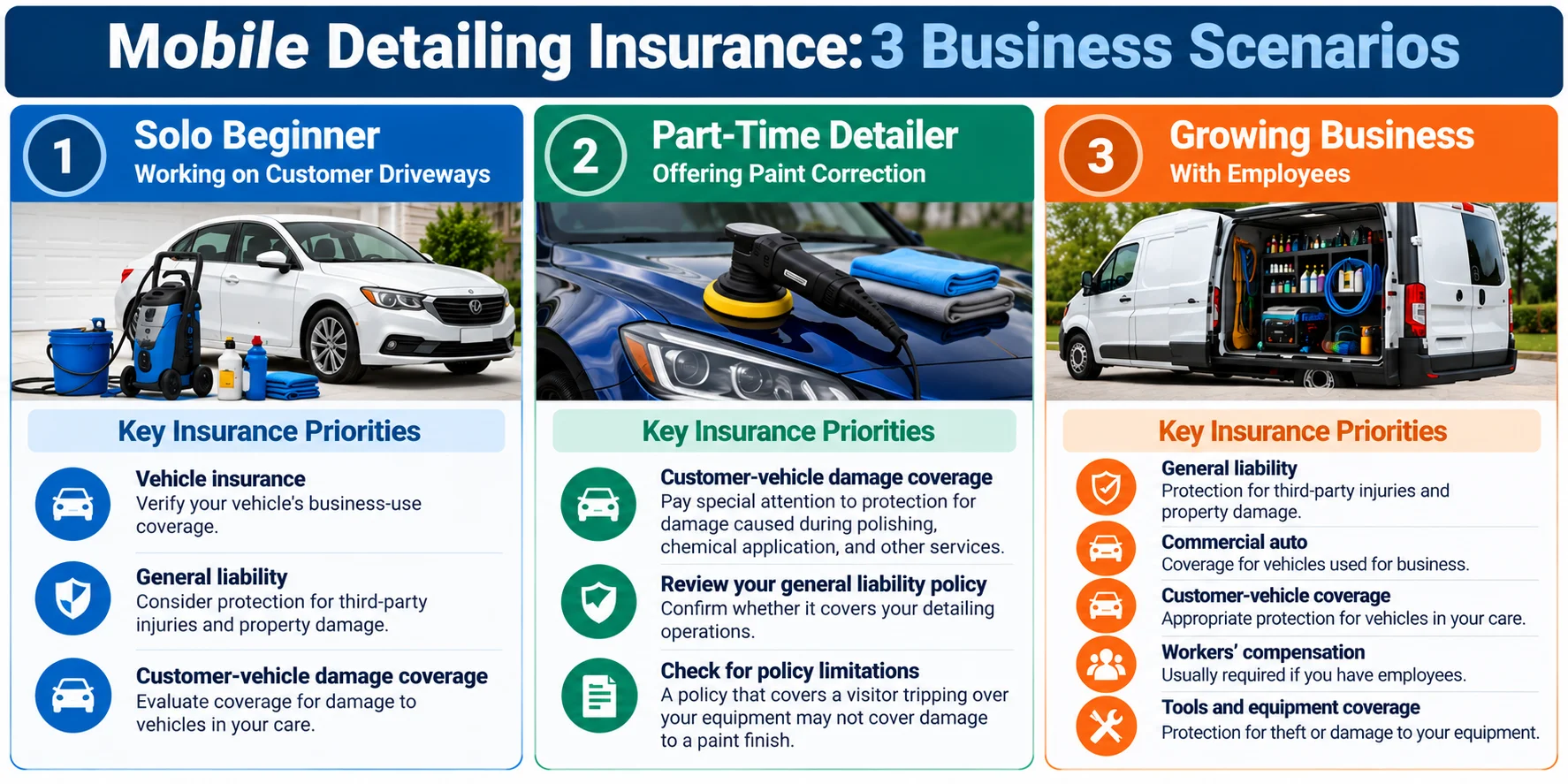
Scenario 1: Solo Beginner Working on Customer Driveways
You have a small equipment setup, work alone, and provide basic interior and exterior cleaning.
Your immediate priorities are to verify your vehicle's business-use coverage and evaluate general liability and customer-vehicle damage protection.
You may not need workers' compensation if you have no employees, subject to your state's rules.
However, not having employees does not eliminate the risk of property damage or injury claims.
Scenario 2: Part-Time Detailer Offering Paint Correction
You work weekends and provide polishing, paint correction, and other services involving direct contact with vehicle finishes.
Your customer-vehicle damage exposure deserves particular attention.
Even if you have general liability insurance, confirm whether it covers your detailing operations.
Ask specifically about damage caused during polishing, chemical application, and other services you perform.
A policy that protects against a visitor tripping over your equipment may not cover damage to a paint finish.
Scenario 3: Growing Mobile Detailing Business With Employees
You operate a dedicated van, employ technicians, and serve residential and commercial customers.
Your insurance needs may include general liability, commercial auto, appropriate customer-vehicle coverage, workers' compensation, and tools and equipment protection.
Commercial customers may also specify minimum liability limits.
At this stage, coverage selection becomes part of operational planning rather than a simple startup purchase.
How Much Does Mobile Detailing Insurance Cost?
Mobile detailing insurance cost depends on the coverage you purchase and the risks associated with your business.
A solo detailer using one vehicle may receive a very different quote from a company with several employees and multiple service vans.
For context, Progressive Commercial reported the following national figures for new customers in 2025.
| Coverage category | Median monthly premium | Average monthly premium |
|---|---|---|
| General liability | $55 | $79 |
| Business owners policy | $80 | $127 |
| Commercial auto — business auto category | $207 | $276 |
Important: These are broader commercial insurance customer statistics, not verified mobile detailing industry averages. They represent different insurance products and customer groups. Do not combine them into a universal mobile detailing insurance quote.
Sources: Progressive Commercial — Business Insurance Costs and Commercial Auto Insurance Costs.
Your actual premium may depend on your location, vehicle, services, business size, claims history, coverage limits, and deductibles.
Specialized customer-vehicle coverage and equipment protection can increase the total.
For a more detailed breakdown, see our Mobile Detailing Insurance guide.
What Happens If You Damage a Customer’s Car Without Insurance?
Imagine you're cleaning the interior of a customer's vehicle and accidentally damage an expensive electronic component.
The customer requests reimbursement.
If you don't have insurance covering the incident, you may need to pay the repair costs yourself.
A dispute could also involve legal expenses.
The same concern applies to damaged paint, broken trim, stained upholstery, or other property damage.
Insurance doesn't guarantee it will pay every claim.
The policy must actually cover the incident.
That is why checking exclusions before accepting customers matters just as much as purchasing the policy.
A useful practice is to document the vehicle's condition before you start work.
Take clear photos, document visible damage, explain the services you'll perform, and obtain customer authorization.
These steps can reduce misunderstandings, but they don't replace insurance.
Stop Guessing. Start Building.
Not sure how to allocate your equipment budget? Explore starter equipment recommendations for $750, $1,000, or $1,500 before committing to purchases.
Explore Build My Starter RigHow to Choose the Right Mobile Detailing Insurance
The best mobile auto detailing insurance is not necessarily the policy with the lowest monthly premium.
It is coverage that fits your actual services and business operations.
Step 1: Describe Your Services Accurately
Tell the insurer exactly what you do.
Basic washing, interior cleaning, steam cleaning, polishing, ceramic coating application, and vehicle transportation can involve different risks.
Don't assume all activities are automatically covered just because the insurer accepts auto detailing businesses.
Step 2: Identify Your Biggest Financial Exposures
Think about what you could realistically lose.
For example, consider customer vehicle damage, third-party injuries, work vehicle accidents, and equipment theft.
Decide which losses you can absorb and which could seriously disrupt your business.
Step 3: Compare Coverage, Not Just Premiums
Request comparable quotes and examine:
- Covered detailing activities and exclusions.
- Customer-vehicle damage protection.
- Per-occurrence and aggregate limits.
- Deductibles.
- Business vehicle coverage.
- Equipment protection during transportation.
- Certificate of Insurance availability.
- Additional insured endorsements, if required.
A lower premium isn't a bargain if the policy excludes the work you do most often.
Step 4: Get Written Answers About Coverage Gaps
Ask the insurer or licensed agent to explain how the policy handles realistic detailing incidents.
For example:
| Potential incident | Coverage to investigate |
|---|---|
| Customer trips over a hose | General liability |
| Pressure washer damages nearby property | General liability |
| Polisher damages customer's paint | Specialized customer-vehicle or operations coverage |
| Work van is involved in a road accident | Commercial auto |
| Pressure washer is stolen from the van | Tools and equipment coverage |
| Employee is injured while working | Workers' compensation |
These are examples of coverage to investigate, not guarantees that a particular claim will be paid.
Step 5: Review Coverage as Your Business Grows
Insurance needs can change when you hire employees, purchase a more expensive vehicle, add equipment, or begin offering higher-risk services.
Review your policy when your operations change, not just at renewal.
For more information about building an appropriate coverage package, read our Mobile Detailing Business Insurance guide.
Five Insurance Mistakes New Mobile Detailers Should Avoid
1. Assuming an LLC replaces insurance. An LLC may separate business and personal liabilities, but it doesn't eliminate all liability or pay insurance claims.
2. Assuming general liability covers every type of vehicle damage. Ask about care, custody, and control exclusions, and damage to the property you're working on.
3. Using personal auto insurance without disclosing business activity. Explain your actual vehicle use to your insurer before accepting jobs.
4. Choosing coverage solely by price. Compare policy exclusions, limits, deductibles, and covered services.
5. Waiting until after an accident to investigate coverage. Insurance generally cannot be purchased retroactively to cover an incident that has already occurred.
Mobile Detailing Insurance Checklist Before Your First Job
Use this checklist before accepting paying customers.
- Confirm your state's insurance requirements.
- Verify that your vehicle insurance permits your business activities.
- Evaluate general liability coverage.
- Ask about customer-vehicle damage and care, custody, and control exclusions.
- Check whether your equipment needs separate protection.
- Review deductibles and policy limits.
- Confirm any insurance requirements in customer contracts.
- Obtain a Certificate of Insurance when necessary.
- Document vehicle condition before beginning work.
- Keep your insurance documents and agent's contact information accessible.
Insurance is only one part of getting your business ready.
You should also understand local licensing requirements, startup expenses, and equipment needs.
Our guides to starting a mobile detailing business and car detailing licenses can help with those decisions.
Frequently Asked Questions about Do You Need Insurance for Mobile Detailing
Do I need insurance for mobile detailing if I work alone?
General liability insurance is not universally required by law for solo detailers, but other requirements may apply. You still need legally compliant vehicle insurance, and you should confirm business-use coverage with your insurer. Even without employees, it's worth evaluating general liability and customer-vehicle damage protection.
Is general liability insurance enough for mobile detailing?
Not necessarily. General liability typically covers certain third-party injuries and property damage, but exclusions may apply to customer vehicles in your care or to damage caused by your work. Commercial auto and specialized customer-vehicle coverage may also be needed.
Do I need commercial auto insurance for mobile detailing?
It depends on your vehicle ownership, business use, state requirements, and existing policy. Personal auto insurance may exclude or restrict business activities. Ask your insurer to confirm the appropriate coverage before using the vehicle for detailing jobs.
Do I need insurance before getting my first detailing customer?
Meet applicable legal requirements and confirm the right protection before accepting paid work. Even a first job can involve an accident or property damage claim. A customer or property manager may also require proof of insurance.
What is the best mobile auto detailing insurance for beginners?
No single policy is best for every beginner. Look for an insurer or broker that understands mobile auto detailing, accurately classifies your services, and can explain coverage for customer vehicles, third-party liability, business driving, and equipment. Compare written quotes based on coverage and exclusions, not price alone.
Final Takeaway: Should You Get Insurance Before Starting Mobile Detailing?
If you're starting a mobile detailing business, include insurance in your startup plan.
General liability insurance may not be legally required for every solo operator, but you shouldn't ignore business risks.
Your vehicle use, state requirements, customer contracts, and services determine which policies to prioritize.
Most importantly, make sure you understand whether the vehicle you're actually detailing is covered for damage.
A low-cost policy that excludes your biggest risk may provide less protection than you expect.
Before accepting your first paying customer, confirm the requirements that apply to your business, discuss your activities with a licensed insurance professional, and get clear answers about coverage limits.
Plan Your Equipment Budget
Insurance is one startup expense. Equipment is another.
If you're also deciding what tools to buy, use the free DetailerDecision Starter Rig Builder to explore equipment recommendations based on your available budget.
The tool helps with equipment planning, not insurance quotes or legal compliance.
Disclaimer: This article provides general educational information for U.S. mobile detailing businesses. It is not legal or insurance advice. Requirements and coverage vary by state, insurer, and policy. Consult your state regulator and a licensed insurance professional for guidance specific to your business.